111 Waverly Place
Greenwich Village | built 1840
Open on the map3 entries

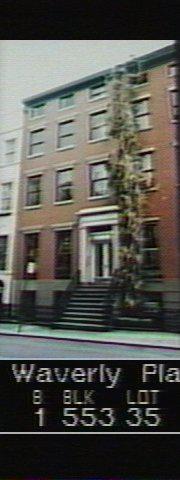
The city photographed every building for its tax records around 1940 and again in the 1980s. NYC Municipal Archives.
Written with AI from the source each entry cites, then fact-checked.
- 1840
Merchant Asaph Stone builds No. 111 as a speculative house beside his own
When Asaph Stone starts his own house at No. 107 Waverly Place in 1839, he adds two nearly matching speculative houses at Nos. 109 and 111, all finished in 1840. No. 111 has Greek Revival iron railings and fencing, wide double entrance doors and parlor windows that reach the floor. Wall Street broker Henry Dwight Jr. is an early occupant and is still living there in 1848.
Source: Daytonian in Manhattan
- 1865
National Guard soldier Charles Raberg Jr. marries months after the Civil War ends
The Raberg family lives at No. 111 during the Civil War, and their youngest son, Edward Leon, dies at the house in April 1862. His older brother Charles H. Raberg Jr. enlists in the New York National Guard. On September 21, 1865, five months after the Confederate surrender, he marries Sallie Duckwitz of Brooklyn, and he is promoted to second lieutenant the following spring.
Source: Daytonian in Manhattan
- 1882
The house becomes a high-end boarding house run by Miss Cameron
By 1882, No. 111 is run as an upscale boarding house by a Miss Cameron. Later boarders include T. Shimooka, who arrives from Japan in 1884 looking for darkroom work, and the activist Leslie A. Toke in the 1890s. The New York Bible Society later owns the house and sells it in 1946.
Source: Daytonian in Manhattan
Further reading
- The Henry Dwight House -- No. 111 Waverly PlaceDaytonian in Manhattan
- Then & Now photos: 111 Waverly PlaceVillage Preservation: Greenwich Village Then & Now
Nearby
- Asaph Stone House107 Waverly Place | 4 entries
- Caxton Press Building171 MacDougal Street | 4 entries
- 112 Waverly Place4 entries
- 114 Waverly Place3 entries
- Robert Hogan House175 MacDougal Street | 5 entries
- 108 Waverly Place2 entries