St. Luke's Hospital
1111 Amsterdam Avenue | also 1101 Amsterdam Avenue | Morningside Heights | built 1920
Open on the map11 entries

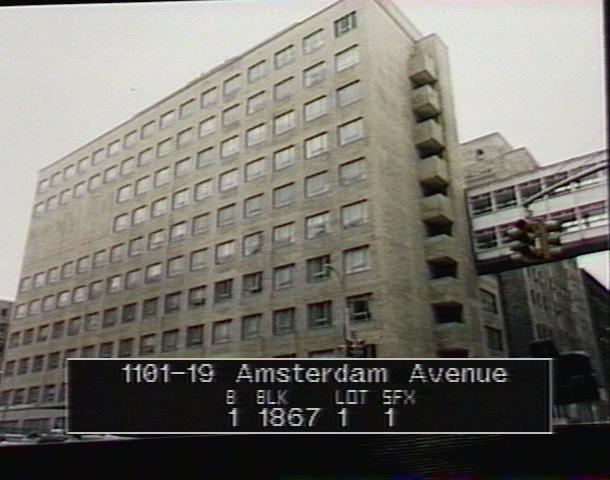
The city photographed every building for its tax records around 1940 and again in the 1980s. NYC Municipal Archives.
Written with AI from the source each entry cites, then fact-checked.
- 1846
William Augustus Muhlenberg founds St. Luke's Hospital
Episcopal minister William Augustus Muhlenberg establishes St. Luke's Hospital in 1846 to treat New York's poor and sick, initially operating it out of his Church of the Holy Communion. The hospital incorporates in 1850 as only the fourth general hospital to open in the city, then moves to Fifth Avenue near 54th Street in 1858 before eventually relocating to Morningside Heights.
Source: Wikipedia
- 1892
St. Luke's buys a block north of the planned cathedral for a new hospital
Outgrowing its Romanesque Revival building at Fifth Avenue and West 54th Street, St. Luke's Hospital bought a block-long site in February 1892, between West 113th and 114th Streets and from Morningside Drive to Amsterdam Avenue. Its 1892 annual report praised the plateau, about 100 feet above the Harlem flats, for light and air, and Morningside Park, then under construction, promised quiet and greenery next door.
- 1892
Ernest Flagg, with no completed building to his name, wins the St. Luke's commission
After a design competition, St. Luke's chose Ernest Flagg in November 1892, although he had only just started his practice. Cornelius Vanderbilt II, who chaired the hospital's executive committee and also sat on its building committee, was married to Flagg's first cousin. A month later the Real Estate Record & Guide reported that the experienced architect Charles W. Clinton would advise Flagg on the working drawings.
- 1893
Flagg's French Renaissance pavilions hide ventilation shafts, toilets and an operating theater
Ground was broken in February 1893 and the cornerstone laid that May for Ernest Flagg's pavilion hospital. Its ornament concealed practical work: the big chimneys were really ventilation shafts, stairs and toilets sat in the corner turrets, and the dome over the central administration pavilion held the operating theater and a water tank. Delays and quarrels with contractors, partly due to Flagg's inexperience and combative manner, dogged construction.
- 1896
Architect Ernest Flagg's nine-pavilion campus opens on Morningside Heights
St. Luke's Hospital relocates to a new campus between West 113th and 114th Streets, just north of the planned Cathedral of St. John the Divine. Architect Ernest Flagg, chosen from among 80 competing firms, designs nine French Renaissance Revival pavilions; construction begins in May 1893 and the first patients move in during January 1896, with the $1.7 million project finished later that year.
Source: Wikipedia
- 1906
The Plant Pavilion for private patients is dedicated on St. Luke's Day
Private patients had been squeezed onto two floors of the Vanderbilt Pavilion until Margaret J. Plant, widow of the railroad magnate Henry B. Plant, offered funds for a pavilion in October 1903. Flagg's eight-and-a-half-story Plant Pavilion, with sixty-five private rooms, was dedicated on October 18, 1906, St. Luke's Day, and took its first patients in November. Strikes delayed it, and the expected cost topped her $400,000 gift by at least $66,000.
- 1928
Cable pioneer James Scrymser's legacy opens the Scrymser Pavilion
After the death of Mary Catherine Prime Scrymser in 1926, the fortune of her husband James A. Scrymser, a pioneer of telegraph cable lines in the Western Hemisphere, was split between the Red Cross and the hospital. Flagg's Scrymser Pavilion for private patients, costing about $1.06 million, was dedicated on February 26, 1928. It was his last pavilion here, finished thirty-six years after he won the original commission, in a plainer brick style with terraces and loggias.
- 1953
St. Luke's merges with Woman's Hospital and builds the Clark Building on Amsterdam Avenue
In 1953 St. Luke's joined with Woman's Hospital and entered a partial affiliation with Columbia University, a tie that deepened into full affiliation in 1971. The postwar building campaign put up the Clark Building, designed by York & Sawyer in 1952-54, along Amsterdam Avenue, where Flagg's last two planned pavilions had never been built.
- 1967
The dome of the Muhlenberg Pavilion is removed
As St. Luke's rebuilt much of its campus in the 1950s and 1960s, the dome crowning the central Muhlenberg Pavilion, once home to the operating theater, was taken down in 1967 because it was thought to be deteriorating. The Norrie Pavilion had already been replaced by the Stuyvesant Building of 1956-57, and the Vanderbilt Pavilion by a Service and Research Building built in 1966-68.
- 1978
St. Luke's merges with Roosevelt Hospital
St. Luke's Hospital merges with Roosevelt Hospital in 1978 to form St. Luke's-Roosevelt Hospital Center, joining two of Manhattan's older charitable hospitals under one administration. The Morningside Heights campus keeps operating as St. Luke's under the merged system for decades, later becoming part of Continuum Health Partners and then Mount Sinai.
Source: Wikipedia
- 2020
The hospital is renamed Mount Sinai Morningside
Following Continuum Health Partners' 2013 merger with Mount Sinai Health System, the former St. Luke's Hospital is renamed Mount Sinai St. Luke's in 2014 and then Mount Sinai Morningside in 2020. Four of Ernest Flagg's original pavilions were sold in 2016 and converted into roughly 300 rental apartments, while its Plant and Scrymser pavilions were designated New York City landmarks in 2002.
Source: Wikipedia
Further reading
- Mount Sinai MorningsideWikipedia
- The reason Morningside Park became a parkEphemeral New York
- A hospital moves to pastoral Morningside HeightsEphemeral New York
- Country-like Morningside ParkEphemeral New York
Nearby
- John Jay Hall1100 Amsterdam Avenue | 4 entries
- Hartley Hall1124 Amsterdam Avenue | 7 entries
- Ruggles Hall508 West 114th Street | 4 entries
- Church of Notre Dame405 West 114th Street | 11 entries
- Hamilton Hall1130 Amsterdam Avenue | 13 entries
- Butler Library535 West 114th Street | 12 entries