Fire Alarm Telegraph Bureau, Bronx Central Office
1129 East 180th Street | Bronx Park | built 1936
Open on the map6 entries

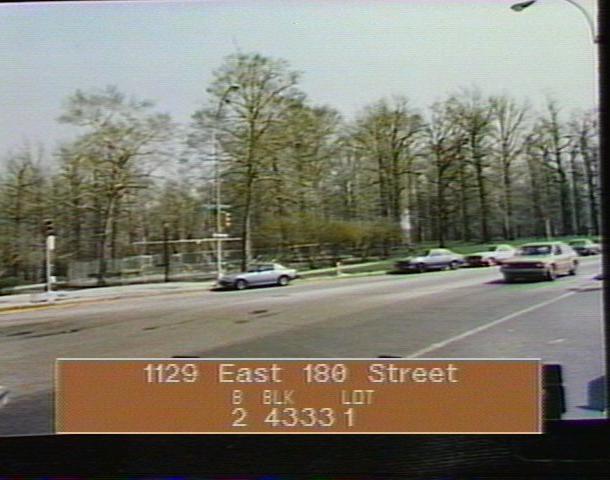
The city photographed every building for its tax records around 1940 and again in the 1980s. NYC Municipal Archives.
Written with AI from the source each entry cites, then fact-checked.
- 1912
Fire Commissioner Joseph Johnson asks for alarm offices that suit their park settings
In 1912 the Fire Department announced plans for 42 new firehouses and three purpose-built fire alarm telegraph offices, for Manhattan, Brooklyn and the Bronx; building and equipping the three offices was estimated at about $490,000. Fire Commissioner Joseph Johnson told the architects to design buildings in keeping with the park landscapes around them. The result was a set of low buildings sized only to hold the signal equipment, fed by wires running underground.
“Fire Commissioner Joseph Johnson, instructed the architects "to plan types of buildings which will harmonize with the landscape scheme of the parks…”
- 1913
Crotona Park neighbors push the Bronx alarm office to the edge of Bronx Park
The Municipal Art Commission first approved Frank J. Helmle's design for a site in the northwestern part of Crotona Park in 1912, but people living near that park objected. In 1913 the city picked a lot on East 180th Street at the southeast corner of Bronx Park instead, already home to the Botanical Garden and the Bronx Zoo. Helmle reused his plans for the Brooklyn Central Office, and work began that year.
“Neighbors of Crotona Park opposed the choice of site and in 1913 a prominent site on East 180th Street in the southeastern corner of Bronx Park…”
- 1915
Frank J. Helmle finishes a small Italian Renaissance pavilion for fire alarms
Brooklyn architect Frank J. Helmle's building, a twin of his Brooklyn Central Office, was completed in 1915. The T-shaped structure is faced in pale brick under a deep terra-cotta cornice and a hipped roof of Spanish tiles. A wide stoop climbs to a recessed loggia behind an arcade set on a balustrade, and the sides of the rear wing each carry three large arched windows.
“The T-shaped building is clad in light brick and topped by a deep, terra-cotta cornice and hipped roof covered in Spanish tiles.”
- 1923
The finished alarm office sits empty for eight years before going into service
Construction of Frank J. Helmle's building ended in 1915, but funding delays kept it empty for the next eight years. It was dedicated in 1923, when, like its Brooklyn twin, it finally became fully operational.
- 2002
The FDNY rehabilitates the alarm office and builds a small addition at the rear
In 2002 the Fire Department began a project to adapt the interior of the Bronx Central Office to a changing communications system. Outside, the work cleaned, repaired and restored the shell to its historic look, and the present windows reproduce the original units, which had been swapped out sometime before 1980. A rear addition built during the project is not counted as part of the building's architectural significance.
“In 2002 the FDNY undertook a project to rehabilitate the Bronx Central Office adapting the interior to meet the needs of a changing communications system.”
- 2023
The Landmarks Preservation Commission designates the Bronx Central Office a landmark
At a public hearing on May 2, 2023, three speakers, including representatives of the New York Landmarks Conservancy and the Historic Districts Council, backed designation and nobody spoke against it. The Commission also received 23 written submissions in support, among them one from the East Bronx History Forum. The building was designated a New York City Landmark on June 13, 2023.
Nearby
- New York, Westchester & Boston Railroad Administration Building481 Morris Park Avenue | 5 entries
- St. Dominic's Church1739 Unionport Road | 3 entries
- St. Anthony's Church1496 Commonwealth Avenue | 3 entries
- Church of Our Lady of Solace731 Morris Park Avenue | 2 entries
- Church of St. Joan of Arc1372 Stratford Avenue | 3 entries
- Aquinas High School2210 Belmont Avenue | 4 entries