New York, Westchester & Boston Railroad Administration Building
481 Morris Park Avenue | also 461 Morris Park Avenue | West Farms
Open on the map5 entries

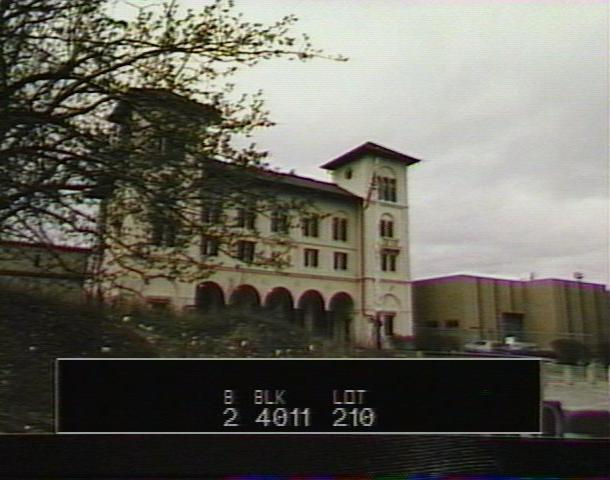
The city photographed every building for its tax records around 1940 and again in the 1980s. NYC Municipal Archives.
Written with AI from the source each entry cites, then fact-checked.
- 1912
Fellheimer & Long and Allen H. Stem complete the railroad's station and headquarters in Italian villa style
Completed in 1912, the building was meant to be both a station and the New York, Westchester & Boston Railway's administrative headquarters. Fellheimer & Long designed it with Allen H. Stem, whose partnership with Charles A. Reed was one of the two firms that designed Grand Central Terminal. Its facade pairs a three-story arcaded center with four-story end pavilions under red tile roofs, and a winged head of Mercury, Roman god of transportation and commerce, crowns the central pediment.
“…providing a base for the winged head of Mercury (the Roman god of transportation and commerce) which is centered in the crowning broken pediment…”
- 1912
The New York, Westchester & Boston opens its first service, running from this building to New Rochelle
"The Westchester" began carrying passengers on May 29, 1912, on a route running from this building, at Morris Park Avenue and East 180th Street, to New Rochelle. Historian Roger Arcara called it the first American main-line railway designed and built from the start as an electric line. Service reached the Harlem River by August 3, while this station building was still under construction.
“It opened for business on May 29, 1912, extending from the Administration Building at East 180th Street and Morris Park Avenue to New Rochelle…”
- 1937
The Westchester shuts down minutes after midnight, its trains never having turned a profit
The railroad never made money: its lines paralleled the New Haven and Harlem routes, riders fell away in the Depression, and its southern terminus in the South Bronx gave no direct link to midtown Manhattan. All service stopped a few minutes after midnight on December 31, 1937. On June 9, 1939, approval came to sell its overhead power wires and then the rest of its assets.
- 1941
The city reopens the old line as the Dyre Avenue shuttle, with this building as its East 180th Street entrance
After residents of the northeast Bronx campaigned in 1940 for the city to buy the right-of-way, a shuttle began running in 1941 between the East 180th Street and Dyre Avenue stations. The Administration Building became the station entrance, with administrative offices on its upper floors. In 1957 tracks were linked to the IRT White Plains Road line, and trains from Manhattan's Seventh Avenue line began running through to Dyre Avenue.
“In 1941 a shuttle service, the Dyre Avenue line, was established between the East 180th Street and Dyre Avenue stations…”
- 1976
The Landmarks Preservation Commission designates the building despite the MTA's request to wait
The commission first held a hearing in November 1973 and heard the building again in 1975, with five witnesses speaking in favor. The Metropolitan Transportation Authority asked that designation wait until plans for the Second Avenue subway were settled. The commission designated it on May 11, 1976, citing it as an example of successful reuse of a railroad building by the city transit system.
Nearby
- Fire Alarm Telegraph Bureau, Bronx Central Office1129 East 180th Street | 6 entries
- St. Anthony's Church1496 Commonwealth Avenue | 3 entries
- St. Dominic's Church1739 Unionport Road | 3 entries
- Church of Our Lady of Solace731 Morris Park Avenue | 2 entries
- Church of St. Joan of Arc1372 Stratford Avenue | 3 entries
- Aquinas High School2210 Belmont Avenue | 4 entries