Our Lady of Lebanon Maronite Cathedral
113 Remsen Street | Brooklyn Heights | built 1855
Open on the map8 entries

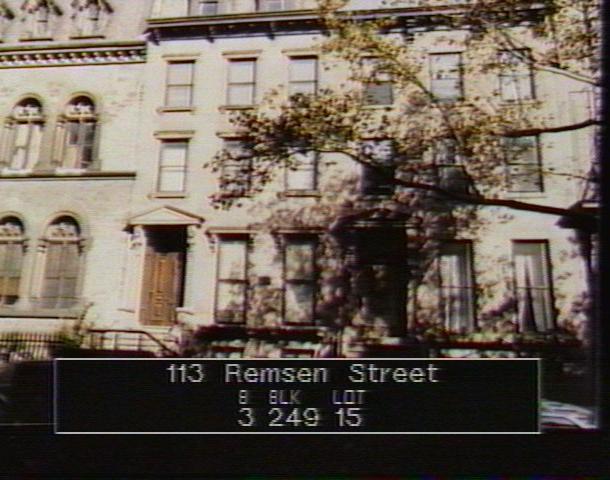
The city photographed every building for its tax records around 1940 and again in the 1980s. NYC Municipal Archives.
Written with AI from the source each entry cites, then fact-checked.
- 1846
Church of the Pilgrims holds its first service in Richard Upjohn's new church
The Congregational Church of the Pilgrims built this church for $65,000 to designs by Richard Upjohn. Work began with a cornerstone on December 22, 1844, and the congregation first worshipped there on May 12, 1846. During construction a truss bridge was added after the timbers meant to hold the roof proved inadequate, and side galleries were added for more seats.
Source: Wikipedia
- 1846
Upjohn designs Brooklyn Heights' Church of the Pilgrims as a Romanesque Revival fortress
Brownstoner's Suzanne Spellen reports that architectural historians rank the Church of the Pilgrims as the first Romanesque Revival church in the country, a solid mass of rough-cut stone. Richard Upjohn, better known for Grace Church in Brooklyn and Trinity Church in Manhattan, was working for Congregationalists, who held the High Church look of Gothic design in low regard. The building is part of the Brooklyn Heights Historic District, designated in 1966.
Source: brownstoner.com
- 1869
Leopold Eidlitz adds a lecture room and 450 seats to the Church of the Pilgrims
An addition by Leopold Eidlitz was begun in 1869. It gave the Church of the Pilgrims 450 more seats and a large lecture room, along with space for classes and meetings. Ten columns had already been added in the 1850s to give the roof more support.
“An addition designed by Leopold Eidlitz was begun in 1869. It added 450 seats to the church, a large lecture room, and other rooms…”
Source: Wikipedia
- 1934
The Church of the Pilgrims merges with Plymouth Church and takes its Tiffany windows along
Shrinking congregations at the Church of the Pilgrims and nearby Plymouth Church led them to merge in 1934 as Plymouth Church of the Pilgrims, based in the historic Plymouth Church on Orange Street. The merged congregation took the church's Tiffany stained glass windows and placed them in Hillis Hall, behind the main Plymouth Church. The Remsen Street building was then sold.
Source: brownstoner.com
- 1943
Maronite Catholics buy the former Church of the Pilgrims for $70,000
Father Mansour Stephen, nephew of the parish's first priest Khairallah Stephen, bought the former Congregational church on December 8, 1943, for $70,000. The Maronite parish of Our Lady of Lebanon had outgrown its first home, a brownstone at 295-297 Hicks Street. The new church was dedicated on Sunday, November 26, 1944.
Source: Wikipedia
- 1945
Bronze doors from the burned liner Normandie are installed at the church entrance
In 1945 the Our Lady of Lebanon congregation bought bronze doors that had been in the dining room of the French liner Normandie, which burned and sank in New York harbor in 1942. The doors were installed in the church's entrance. Brownstoner's Suzanne Spellen calls it a subtle pun to put the Normandie's doors on a church that looks so Norman.
Source: brownstoner.com
- 1953
Swiss artist Jean Crotti makes ten new windows for Our Lady of Lebanon
Jean Crotti, a Swiss artist, made ten new stained glass windows for the church in 1953, working in his workshop in France. He used the Gemmaux method, which binds pieces of colored glass together with colorless enamel. The windows developed problems, so in the late 1950s Sabiha Douaihy, an artist from Lebanon, made further windows and also worked on the ones already in place.
“Swiss artist Jean Crotti created new windows for Our Lady of Lebanon using the Gemmaux method ... The ten windows were created for the church in Crotti's workshop in France during 1953.”
Source: Wikipedia
- 1977
Our Lady of Lebanon becomes the cathedral of the Maronite Eparchy of St. Maron
On June 27, 1977, the Eparchy of St. Maron-USA moved its see city from Detroit to Brooklyn, and Our Lady of Lebanon became its cathedral the same day. The parish had been incorporated in 1903 and had bought this former Church of the Pilgrims building in 1943.
“On June 27, 1977, the See city for the Eparchy of St. Maron-USA was transferred from Detroit to Brooklyn. Our Lady of Lebanon was designated the cathedral on the same day.”
Source: Wikipedia
Further reading
Nearby
- St. Ann & the Holy Trinity Church68 Clinton Street | 6 entries
- Brooklyn Historical Society (Center for Brooklyn History)128 Pierrepont Street | 6 entries
- Herman Behr Mansion82 Pierrepont Street | 6 entries
- People's Trust Company Building181 Montague Street | 9 entries
- Brooklyn Trust Company Building138 Pierrepont Street | 6 entries
- National Title Guaranty Company Building185 Montague Street | 9 entries