23rd Regiment Armory
1162 Atlantic Avenue | also 1155 Pacific Street, 1322 Bedford Avenue, 1164 Atlantic Avenue | Crown Heights | built 1895
Open on the map7 entries

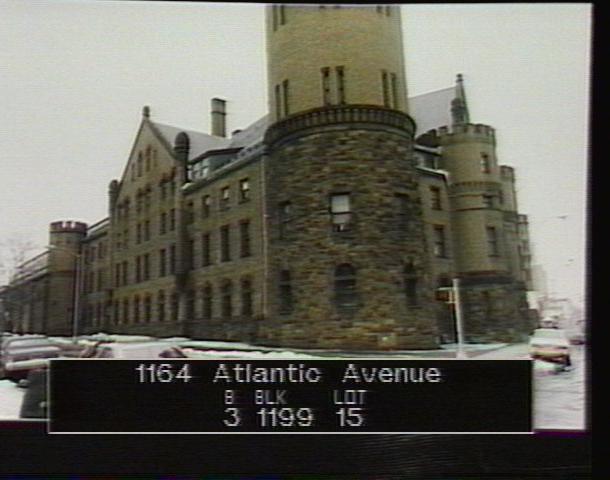
The city photographed every building for its tax records around 1940 and again in the 1980s. NYC Municipal Archives.
Written with AI from the source each entry cites, then fact-checked.
- 1889
A school, two farmhouses and a rowhouse stand where the armory will rise
In August 1889 a site was chosen for the 23rd Regiment's new armory, at the southwest corner of Bedford and Atlantic Avenues. St. Bartholomew's School, two farmhouses and a rowhouse stood on the land then. H. P. Fowler, a principal at Fowler & Hough, owned the rowhouse, and his firm went on to design the armory.
“That August, a site was selected at the southwest corner of Bedford Avenue and Atlantic Avenue.”
Source: Wikipedia
- 1891
Colonel John N. Partridge wins the state money and the cornerstone is laid
Colonel John N. Partridge headed the 23rd Regiment and was also president and general manager of the Brooklyn City and Newtown Railroad Company. The landmark report credits him with securing a $300,000 state grant for the new armory. The architects Fowler & Hough prepared the plans, and the cornerstone was laid on November 14, 1891.
“Partridge was instrumental in obtaining a state grant of $300,000 for the new armory.”
- 1894
The 23rd Regiment marches into its new armory
On November 4, 1894, the regiment marched to the Bedford Avenue building to take possession of it, and the old Clermont Avenue armory was sold soon afterward. On November 15 the regiment began a two-week fundraiser for furnishings that brought in almost $70,000. The drill room was not finished until 1902.
“On November 4, 1894, the 23rd Regiment marched to its new armory to signify that it had taken possession of the building…”
Source: Wikipedia
- 1897
The New-York Tribune raves about the armory's Council Room
The council room has a fireplace 24 feet high, and a Tribune reporter wrote on July 18, 1897, that nothing in any other American armory compared with it and that foreign visitors had never seen the like. A newspaper in 1898 added that the company rooms were the best of any armory in the state.
“Certainly nothing in any other American armory compares with the Council Room and visitors from abroad say they have never seen anything like it.”
- 1923
William Randolph Hearst's film company moves into the armory after a fire
A fire on February 19, 1923 destroyed the production facilities of Hearst's Cosmopolitan Productions. The company then rented the 23rd Regiment Armory for use as studio space. The armory also hosted home shows, car shows, cycling events and school sports over the years.
“In 1923, the building was rented by William Randolph Hearst for use as studio space for his Cosmopolitan Productions…”
Source: Wikipedia
- 1977
The armory becomes a city landmark as an example of Romanesque Revival design
The Landmarks Preservation Commission designated the armory on March 8, 1977. It called the building a vast late-19th-century military design meant to look like a medieval fortress, with a steel portcullis worked by hydraulic pumps at the Bedford Avenue entrance. The corner tower at Pacific Street is the most dramatic feature, and the tallest tower reaches 136 feet.
“The entrance arch can be closed off by means of a heavy steel portcullis which is activated by hydraulic pumps.”
- 1982
The city turns the armory into the 500-bed Bedford-Atlantic men's shelter
New York City converted the building into a men's homeless shelter in 1982, with about 500 beds. Homeless people and neighbors nicknamed it Castle Grayskull for its castle-like look. By 1987 it had 532 beds accommodating 800 men. It also serves as a city intake center, where homeless people are evaluated and sent on to other shelters or programs.
“The city converted the building into the Bedford-Atlantic Shelter, a 500-bed men's homeless shelter, in 1982.”
Source: Wikipedia
Further reading
- 23rd Regiment ArmoryWikipedia
Nearby
- St. Bartholomew's Episcopal Church and Rectory1223 Pacific Street | 2 entries
- Imperial Apartments1198 Pacific Street | 6 entries
- St. Bartholomew's Church1234 Atlantic Avenue | 5 entries
- Imperial Apartments1339 Bedford Avenue | 1 entry
- Kismet Temple (Friendship Baptist Church)92 Herkimer Street | 6 entries
- Alhambra Apartments500 Nostrand Avenue | 5 entries