Eldridge Street Synagogue
12 Eldridge Street | Chinatown | built 1887
Open on the map12 entries

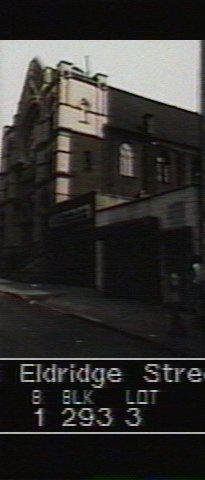
The city photographed every building for its tax records around 1940 and again in the 1980s. NYC Municipal Archives.
Written with AI from the source each entry cites, then fact-checked.
- 1887
Kahal Adath Jeshurun dedicates its new synagogue on Eldridge Street
Congregation Kahal Adath Jeshurun, whose roots went back to a congregation founded in 1852, broke ground here in September 1886 and dedicated the building on September 4, 1887. It was designed by the German-born brothers Peter and Francis William Herter, who were Catholic, and cost about $91,900. Between 1890 and 1915 it counted as many as 800 member families.
Source: Wikipedia
- 1887
The congregation sells seats for $200 to $1,000 to pay for its Eldridge Street synagogue
Kahal Adath Jeshurun raised much of the money for its new building by selling pews, priced by closeness to the ark, from $1,000 for the best to $200 for the farthest. The landmark report notes this was no house of worship for the poor: members included bank owner Sender Jarmulowsky and delicatessen magnate Isaac Gellis. The congregation also hired the celebrated Odessa cantor Pinchas Minkowsky and his choir, a move some critics read as an advertising scheme to lift pew prices.
“…the most prestigious ones near the ark selling for $1000 and those farther away ... costing congregation members $200…”
- 1918
The synagogue hires Rabbi Aharon Yudelovitch as its first full-time pulpit rabbi
In 1918, three decades after the building opened, Kahal Adath Jeshurun hired Rabbi Aharon Yudelovitch as its first full-time pulpit rabbi. The museum describes him as the earliest of a line of renowned Talmudists and speakers who led the congregation. He arrived during the building's heyday, when thousands of people took part in religious services.
Source: eldridgestreet.org
- 1934
Thousands crowd Eldridge Street for the funeral of Menahem Mendel Beilis
Menahem Mendel Beilis, the Russian Jew acquitted in Kiev's notorious 1913 ritual-murder trial, died suddenly at a hotel in Saratoga Springs on July 7, 1934. His funeral was held in the Eldridge Street Synagogue, and over 4,000 people attended. According to a history of the synagogue, the sanctuary could not hold the crowd, and as many as a dozen police officers failed to restore order in the street.
Source: Wikipedia
- 1940
The dwindling congregation seals off its grand main sanctuary
By the 1940s, shrinking membership on the Lower East Side left Kahal Adath Jeshurun unable to maintain its grand main sanctuary. The congregation moved daily worship into the synagogue's lower-level chapel and closed off the large room above. The abandoned sanctuary sat hidden behind locked doors for decades, until its rediscovery in 1986.
Source: eldridgestreet.org
- 1944
A shrinking congregation makes its last mortgage payment and fills the broken rose window with glass blocks
In October 1944 the last mortgage payment was made by the few worshippers who remained, and the congregation took ownership of the synagogue it had built in 1887. Only about 25 people attended regularly by then, though up to 400 still came for the High Holidays, including families of former members. That year the rear rose window, smashed in a 1938 hurricane and left unrepaired, was replaced with glass blocks designed to resemble four tablets.
“The congregation took ownership of the synagogue after the remaining worshippers made their last mortgage payment in October 1944…”
Source: Wikipedia
- 1980
The Landmarks Commission designates the synagogue with nine speakers in favor and none against
Landmark designation came on July 8, 1980, after a December 1979 hearing at which nine witnesses spoke in favor and none against. The commission's report called the building the earliest and best of the Lower East Side's Orthodox Eastern European synagogues. It described a pressed-brick and terra-cotta facade blending Moorish, Gothic and Romanesque ideas that the architects, the Herter Brothers, went on to reuse on many tenements.
“Nine witnesses spoke in favor of designation. There were no speakers in opposition to designation.”
- 1986
Roberta Brandes Gratz founds the Eldridge Street Project to save the synagogue
Preservationist Roberta Brandes Gratz rediscovered the sealed, deteriorating main sanctuary in 1986, a century after the synagogue opened, and organized the nonprofit Eldridge Street Project to save it. Pigeons had settled into the balconies and the stained glass had warped with age by the time repairs began. The Project pursued the restoration for nearly two decades, finishing the work in December 2007.
Source: eldridgestreet.org
- 1989
Restorers find a skeleton in the synagogue basement
When restoration work began in 1989, a human skeleton turned up in the synagogue's basement. Further investigation showed that it belonged to a young man who had died decades earlier, and the bones were interred in burial plots owned by the congregation, Kahal Adath Jeshurun. The congregation kept praying in the former rabbi's study throughout the work.
“At the beginning of the project, a skeleton was found in the basement of the synagogue.”
Source: Wikipedia
- 2007
The synagogue is rededicated after a $20 million restoration
As members moved away, the congregation had retreated to its basement-level sanctuary by 1954, and the grand main sanctuary was sealed off. The Eldridge Street Project, founded in 1986, raised money to save the building. On December 2, 2007, the synagogue was rededicated after a $20 million renovation, and the project was renamed the Museum at Eldridge Street.
Source: Wikipedia
- 2010
Kiki Smith and Deborah Gans install a new rose window
Hired in 2009, artist Kiki Smith and Deborah Gans designed a stained-glass rose window that was installed in October 2010. Its yellow center is ringed by blue panes, and it mixes six-pointed Stars of David with five-pointed stars like those on the U.S. flag. Instead of heavy lead strips, the panes are glued with silicone to a sheet of clear glass, so the joints are nearly invisible from a distance.
Source: Wikipedia
- 2024
Artist Mark Podwal's zodiac mosaic floor is laid in the synagogue vestibule
In 2024 the Museum at Eldridge Street unveiled a glass mosaic floor by the artist Mark Podwal in the vestibule outside the historic main sanctuary. It shows the twelve zodiac signs, each paired with the first Hebrew letter of its Hebrew-calendar month; Capricorn appears as a sea goat holding a Hanukkah menorah. Artisans from Progetto Arte Poli, a studio in Verona, Italy, made and installed it, with funding from the estate of Roger Jacques Herz.
Source: eldridgestreet.org
Further reading
- Eldridge Street SynagogueWikipedia
Nearby
- St. Barbara Greek Orthodox Church27 Forsyth Street | 3 entries
- Engine 9 / Ladder 6 firehouse75 Canal Street | 3 entries
- Jarmulowsky Bank Building56 Canal Street | 12 entries
- Preschool of America Eldridge39 Eldridge Street | 1 entry
- Knickerbocker Station Post Office128 East Broadway | 4 entries
- 50 Eldridge Street2 entries