Jarmulowsky Bank Building
56 Canal Street | also 9 Orchard Street, 54 Canal Street, 60 Canal Street | Chinatown | built 1913
Open on the map12 entries

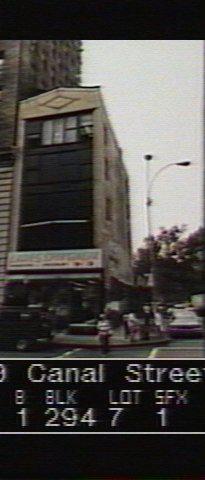
The city photographed every building for its tax records around 1940 and again in the 1980s. NYC Municipal Archives.
Written with AI from the source each entry cites, then fact-checked.
- 1902
A 1902 novel about the Lower East Side casts Sender Jarmulowsky's bank as a revered local institution
Sender Jarmulowsky was famous enough that he appeared as a fictional character, Jobbelousky, in the 1902 book Ghetto Silhouettes. It calls his bank a revered institution of the East Side and describes him as the neighborhood's banker, doing business in thousands where others did hundreds. By then he owned this corner lot, bought in 1900, and one of its two buildings housed his business.
“Jobbelousky's bank is a revered institution of the East Side.… He was the banker of the East Side.”
- 1911
Jarmulowsky demolishes his old bank buildings and moves to temporary quarters on Canal Street
Once Rouse & Goldstone's plans were filed, Jarmulowsky's bank relocated to temporary space at 68 Canal Street, and demolition of the old buildings on the corner was under way by May 1911. The New York Times called the planned tower an East Side innovation, a tall bank and office building of the highest grade, the first of its kind in the neighborhood. Construction began two months later.
- 1912
Sender Jarmulowsky's twelve-story bank rises at Canal and Orchard Streets
Sender Jarmulowsky, born in Russia in 1841, ran a bank in Hamburg before founding S. Jarmulowsky's Bank in New York in 1873. In May 1911 he announced a twelve-story fireproof building at 54–58 Canal Street, designed by W. L. Rouse and L. A. Goldstone at an estimated cost of $350,000. He died on June 2, 1912, as his building neared completion.
Source: waltergrutchfield.net
- 1912
Sender Jarmulowsky dies weeks after his new bank tower opens
Sender Jarmulowsky died on June 1, 1912, when his new tower at Canal and Orchard Streets had been open only a few weeks. The Kehillah, the Jewish Community of New York, convened an emergency session to discuss the loss. One Yiddish newspaper remembered him as an East Side businessman of the best kind, and his half of the bank passed to his children.
- 1914
Three thousand angry depositors of a related bank crowd outside the Jarmulowsky tower
On the evening of October 31, 1914, about 3,000 depositors of the failed M.&L. Jarmulowsky Bank crowded outside the S. Jarmulowsky tower, angry about a proposed plan to repay their lost savings. Police reserves from three stations fought to disperse the crowd and took two women to the Clinton Street station on charges of inciting a riot. The S. Jarmulowsky Bank itself remained solvent then.
“…about 3,000 of M.&.L. Jarmulowsky's depositors gathered in front of the S. Jarmulowsky Bank Building on the evening of October 31, 1914…”
- 1917
The state closes S. Jarmulowsky's Bank, leaving 7,000 depositors short
After World War I broke out, depositors withdrew nearly $3 million from the bank, much of it to send to relatives overseas. On May 11, 1917, the state closed the bank, which owed about $1.25 million to some 7,000 depositors and had only $600,000 in assets. Two of Jarmulowsky's sons were indicted for banking fraud, and the building was sold at a bankruptcy auction in 1920.
Source: waltergrutchfield.net
- 1920
The failed bank's tower is sold by court order for $100,000
Louis and Harry Jarmulowsky were bankrupt by 1920, when a court ordered the bank building sold. Its construction had reportedly cost between $200,000 and $350,000, but it went for only $100,000. A financial institution still held the ground floor afterward, first the North American Bank, then the Capitol National Bank, and the Manufacturers Trust Company after 1928.
“Harry and Louis were bankrupt by 1920, when the S. Jarmulowsky Bank Building was sold by court order. ... sold for only $100,000.”
- 1945
A piano maker buys the tower and runs a factory there for two decades
In 1945 the H.W. Perlman Corporation, a piano manufacturer, bought the former bank building and ran a factory in it until the firm dissolved in the mid-1960s. By then the upper floors had long been lofts, and in 1929 they had held makers of lace curtains, flannel nightgowns and overalls. Many later tenants had East Asian names as Asian-owned garment shops expanded in the area.
- 1990
A renovation strips the tower of its rooftop tempietto
Owner Sing May Realty renovated the building in 1990 and removed the ornamental, roughly fifty-foot domed tempietto that had crowned the tower since 1912 and given it a distinctive silhouette on the Lower East Side skyline. The building continued afterward as ordinary commercial space, its rooftop left plain for more than two decades. The loss went largely unremarked until a later restoration project.
Source: Wikipedia
- 2009
The city designates the Jarmulowsky Bank Building a landmark
The Landmarks Preservation Commission designated the S. Jarmulowsky Bank Building an individual landmark on October 13, 2009, after a hearing on June 23. Five speakers backed designation, and the owner's representatives said they had no objection. The owner, who bought it in 2006, said it planned to restore the lost rooftop features as part of a conversion to a hotel or to residences.
- 2020
A replica tempietto restores the tower's lost dome
The Landmarks Preservation Commission approved a replica of the tower's lost tempietto in 2014 as part of its conversion into a hotel, and workers finished rebuilding it by early 2020. The restored dome brought back the silhouette the building had lost in the 1990 renovation. It now tops the Nine Orchard hotel, which opened in the restored bank tower two years later, in 2022.
Source: Wikipedia
- 2022
The Nine Orchard hotel opens in the restored bank tower
The tower's crowning tempietto, a domed structure about 50 feet tall, was removed during a 1990 renovation. The Landmarks Preservation Commission approved a replica in 2014, and it was finished by the beginning of 2020. After a conversion, the building opened as the Nine Orchard luxury hotel in June 2022.
Source: Wikipedia
Further reading
- Jarmulowsky Bank BuildingWikipedia
Nearby
- Knickerbocker Station Post Office128 East Broadway | 4 entries
- Chinatown Soup51 Canal Street | 3 entries
- Kletzker Brotherly Aid Society and Kobre Bank Building41 Canal Street | 6 entries
- Engine 9 / Ladder 6 firehouse75 Canal Street | 3 entries
- Metrograph7 Ludlow Street | 10 entries
- Eldridge Street Synagogue12 Eldridge Street | 12 entries