American Academy of Dramatic Arts
120 Madison Avenue | Midtown South | built 1908
Open on the map15 entries

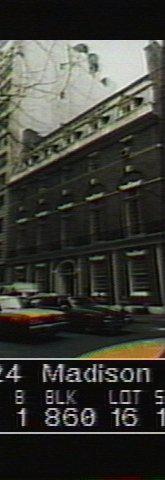
The city photographed every building for its tax records around 1940 and again in the 1980s. NYC Municipal Archives.
Written with AI from the source each entry cites, then fact-checked.
- 1884
The American Academy of Dramatic Arts opens at the Lyceum Theatre as the English-speaking world's first acting school
On October 3, 1884, the academy opened at the Lyceum Theatre in Manhattan, founded by Franklin Haven Sargent, a Harvard professor of speech and elocution, when no school for acting yet existed in the English-speaking world. Its first graduating class had 118 students. In the 20th century it became known as the "Cradle to the Stars," with alumni including Spencer Tracy, Lauren Bacall, Kirk Douglas, Grace Kelly and Robert Redford. That first home stood elsewhere; the school reached the former Colony Club clubhouse at 120 Madison Avenue only decades later.
Source: aada.edu
- 1904
The Colony Club's advisers buy three Madison Avenue brownstones to build a women's clubhouse
The Colony Club was officially organized in December 1903, and its members wanted a clubhouse like those that men's clubs enjoyed. In 1904 its advisory board, including J. Pierpont Morgan, paid $200,000 for three adjoining brownstone-fronted houses, Nos. 120, 122 and 124 Madison Avenue. Tenants were asked to leave by May 1905 so the houses could be demolished.
Source: Daytonian in Manhattan
- 1905
Stanford White helps Elsie de Wolfe win the Colony Club interior commission
In 1905 the architect Stanford White, who designed the clubhouse and was a longtime friend, helped Elsie de Wolfe win the commission to design its interior. The Colony Club became a turning point in her career and made her the most sought-after interior decorator of her day.
“Stanford White, the architect for the Colony Club and a longtime friend, helped de Wolfe secure the commission for its interior design.”
Source: Wikipedia
- 1907
The new Colony Club runs into a liquor-license problem within a month of opening
Within a month of opening, the Colony Club discovered a snag: a law barred liquor licenses within 200 feet of a church unless the church consented. The Madison Square Baptist Church, directly across Madison Avenue and firmly for temperance, refused. Club officers insisted no spirits were served and that members brought their own, though the basement had a wine room, and a leaked menu listing wine by the bottle did not help. The club never obtained a license at this address.
Source: The New York Times
- 1907
Stanford White's Colony Club opens with Elsie de Wolfe interiors, a pool and a gymnasium
The six-story brick clubhouse designed by Stanford White cost about $500,000 with land and furnishings. Elsie de Wolfe handled the interiors, including a Trellis Room winter garden. The basement held a swimming pool, the second floor a double-height gymnasium with a running track, and the fourth floor eleven bedroom suites, each with its own bath, plus squash courts.
Source: Daytonian in Manhattan
- 1909
Elsie de Wolfe passes the hat at the Colony Club for striking shirtwaist workers
In 1909, after a presentation by factory workers at the Colony Club, the decorator Elsie de Wolfe collected $1,300 for striking employees of the Triangle Shirtwaist Company. A rumor also circulated that Anne Morgan, the club's treasurer and J. P. Morgan's daughter, would pay for a $1 million cooperative factory that would take on the garment industry under humane conditions.
Source: The New York Times
- 1910
Members lend antiques from their homes for a Colony Club exhibition of eighteenth-century furniture
In 1910 the club's members staged an exhibition of 18th-century furniture and decoration in the clubhouse. Women lent vintage silver, china and Chippendale, Adam and Sheraton furniture from their own homes. Another show displayed mezzotint copies of paintings by Reynolds, Romney and Gainsborough, again borrowed from members' mansions.
Source: Daytonian in Manhattan
- 1912
Ladies' Four-in-Hand Club coach The Arrow leaves the Colony Club daily for Dyckman Street
Mrs. Thomas Hastings founded the Ladies' Four-in-Hand Club in 1900, and it was somewhat shocking because it let well-bred women drive coaches themselves. By 1912 it owned a coach called The Arrow, which started from the Colony Club at 10:30 each morning, stopped nearly two hours for lunch in Bronx Park, and returned at 4:00. A photograph shows Mrs. Hastings preparing to drive it from in front of the clubhouse.
Source: Daytonian in Manhattan
- 1913
Colony Club members reject a large Lexington Avenue site and move to Park Avenue
In 1913, with lofts and business buildings crowding in around the clubhouse, the club's officers, Florence Harriman and Anne Morgan, were still in office when members decided to move uptown. They split over whether to go to Westchester or Long Island for better sports. The first site chosen, a 125-by-200-foot midblock lot at 66th to 67th Streets near Lexington Avenue, would have fit tennis courts and a skating rink but was rejected as too far from Park and Fifth Avenues. The club built at 62nd Street and Park Avenue instead.
Source: The New York Times
- 1917
After the Colony Club moves uptown, the clubhouse serves the Red Cross and then the Carroll Club
The club voted in February 1914 to buy land at Park Avenue and 62nd Street, having outgrown the building after seven years. In 1917 Mrs. Nicholas F. Brady bought the house for about $400,000 and lent it to the Red Cross for the war, first as a convalescent hospital and then as a nurses' mobilization center. After the war it became home to the Carroll Club for Catholic business women.
Source: Daytonian in Manhattan
- 1956
The Carroll Club moves out and a developer buys the old Colony Club house
In 1956 the Carroll Club, a social and commercial association for Catholic business women that had used the building since the end of World War I, moved to East 38th Street. It had altered little, using the pool for swimming lessons, the assembly room for drama classes and the kitchen for cooking, and adding typing classes. The building was sold to the developer Simon Brothers, which sold it a year later, setting up its conversion to the Seven Arts Center.
Source: Daytonian in Manhattan
- 1958
The Seven Arts Center opens three small theaters in the former clubhouse
After the Carroll Club left in 1956, the building was converted into an off-Broadway complex with two proscenium stages and one arena theater, each seating about 200. Developers kept the pool and added a restaurant, bar and gallery. It debuted on February 27, 1958, and Mia Farrow was among those who first appeared on its stage, in The Importance of Being Earnest.
Source: Daytonian in Manhattan
- 1963
The American Academy of Dramatic Arts buys the building for about $500,000
The academy bought the former clubhouse in 1963, with trustees including Lillian Gish helping to raise the money. It estimated about $100,000 in alterations, supervised by architect Giorgio Cavaglieri, an architect with a record in historic preservation. When the facade was restored in 2003, original features were still in place inside, such as the glass grape light fixtures at the pool level.
Source: Daytonian in Manhattan
- 1966
The Landmarks Preservation Commission designates the former Colony Club as a city landmark
In 1966 the commission found the building had special historical and aesthetic value, having been designed by one of the country's best-known architects. It praised the delicacy of the details and the unusual brickwork, which set the building apart from others in the same style in New York.
Source: flatironnomad.nyc
- 2003
The Academy nearly finishes a $100,000 restoration of the clubhouse facade
By September 2003 the American Academy of Dramatic Arts had almost finished restoring the exterior of its Stanford White building. The brickwork was repaired and cleaned and the iron and wood trim repainted linen white, at a cost of $100,000, said its president, Roger Croucher. The school chose to repair the original ground-floor windows at $3,000 each rather than replace them at $9,000 each. Inside, the old swimming pool had never been filled in and held shelves of props and hanging costume bags beneath the trellis.
Source: The New York Times
Further reading
- American Academy of Dramatic ArtsWikipedia
- Stanford White's 1907 Colony Club -- 120 Madison AvenueDaytonian in Manhattan
Nearby
- Madison House15 East 30th Street | 2 entries
- The Roger Hotel129 Madison Avenue | 3 entries
- Martha Washington Hotel30 East 30th Street | 8 entries
- 277 Fifth Avenue277A 5th Avenue | 5 entries
- Church of the Transfiguration (Little Church Around the Corner)1 East 29th Street | 12 entries
- Hotel Seville22 East 29th Street | 15 entries