Martha Washington Hotel
30 East 30th Street | also 29 East 29th Street | NoMad | built 1903
Open on the map8 entries

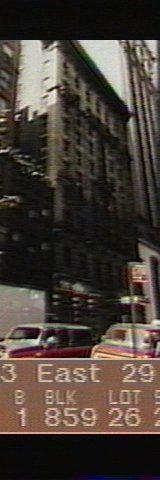
The city photographed every building for its tax records around 1940 and again in the 1980s. NYC Municipal Archives.
Written with AI from the source each entry cites, then fact-checked.
- 1897
The Women's Hotel Company forms to build hotels for working women as a business, not charity
The Women's Hotel Company was organized in 1897 by Charles Day Kellogg of the Charity Organization Society to build high-grade hotels for business and professional women. It raised money by selling stock with a promised 5 percent return and meant to run on business principles. Its first board had Lucien Warner as president, with Robert W. Gibson, the architect, among its advisers.
“Organized in 1897 for the express purpose of building “high grade hotels for the exclusive accommodation of business and professional women,”…”
- 1901
The company buys a school's lots on East 29th and 30th Streets and demolishes them for the hotel
Early in 1901 the Women's Hotel Company paid $200,000 for two lots running through the block between East 29th and East 30th Streets. The American Female Guardian Society had owned them since 1856 and ran a school on the 75-foot site, which was demolished. Investors by then included John D. Rockefeller, Helen Gould and Mrs. Russell Sage, and Robert W. Gibson won the design competition.
“They paid $200,000 to the American Female Guardian Society which had owned the property since 1856 and ran a school on the 75-foot-wide site.”
- 1903
The Martha Washington opens as New York's first hotel for professional women and fills at once
The 12-story hotel opened in March 1903, first as the Women's Hotel, and filled at once with long-term and short-stay guests, with 200 more people waiting for rooms. Manager James Case oversaw a staff made up mostly of women, and men worked only as bellhops and elevator operators. Guests had a drug store, tailor, library, roof promenade and mail chute, and many were teachers, bookkeepers, stenographers, musicians, artists and nurses.
“…was immediately fully occupied with permanent and transient guests, with 200 more on a waiting list…”
- 1907
Unhappy stockholders see the hotel leased for ten years to hotel man Arthur W. Edgar
By 1907 stockholders were angry that they had never received dividends and said the hotel was really a charity. A group including Lucy Kellogg, daughter of the founder, wanted to take over management and lower prices to help working women. The board instead leased the hotel for ten years to Arthur W. Edgar, an experienced hotel man.
“Stockholders were unhappy that they had never received any dividends and complained that the enterprise was in fact a charity rather than a business.”
- 1913
Poet Sara Teasdale makes the hotel her home, and Louise Brooks lands there after the Algonquin
Poet Sara Teasdale lived at the Martha Washington for many years after 1913. The actress Louise Brooks moved in after being evicted from the Algonquin Hotel, and the editor and lecturer Louise E. Dew also lived there. From 1907 the hotel served as headquarters of the Interurban Women's Suffrage Council, and it later appeared as a location in the film Valley of the Dolls.
“…residents of the Martha Washington have included poet Sara Teasdale, who lived there for many years after 1913…”
- 1991
The Danceteria nightclub opens in the old ballroom and runs until 1993
By 1991 the hotel's first-floor ballroom had a new life as a nightclub. The Danceteria opened there in May 1991 and operated until 1993, a period marked by many reports of illegal drug use. The space then became a club called the Melting Pot, with three bars, and by 1998 it had been turned into a mosque.
Source: Wikipedia
- 1998
New owners end the women-only policy over residents' objections
The hotel had run for women only until 1998. The new owners then said they could not discriminate against customers by gender and would accept only suitable males. Men were given rooms with private baths, while many women still shared bathrooms. Many residents objected, and by 2000 the owners had begun upgrading the whole building.
“…the new owners at that time declared that they could not discriminate against clients based on gender…”
- 2012
The city designates the Gibson-designed hotel a landmark
The Landmarks Preservation Commission designated the hotel an individual landmark on June 12, 2012, describing it as the first hotel built in New York to house professional women. Robert W. Gibson designed the Renaissance Revival building, whose facades on 29th and 30th Streets are decorated with quoins, Palladian windows, keystoned lintels and iron balconettes. It was still operating as a hotel at the time.
Further reading
- Martha Washington HotelWikipedia
Nearby
- Emmet Building95 Madison Avenue | 7 entries
- The Roger Hotel129 Madison Avenue | 3 entries
- American Academy of Dramatic Arts120 Madison Avenue | 15 entries
- Hotel Seville22 East 29th Street | 15 entries
- Madison House15 East 30th Street | 2 entries
- Church of the Transfiguration (Little Church Around the Corner)1 East 29th Street | 12 entries