122 Washington Place
also 122 West Washington Plce | West Village | built 1833
Open on the map5 entries

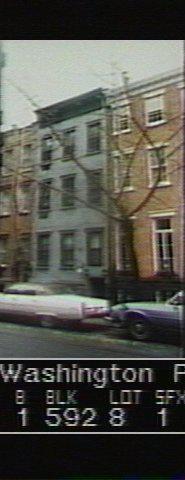
The city photographed every building for its tax records around 1940 and again in the 1980s. NYC Municipal Archives.
Written with AI from the source each entry cites, then fact-checked.
- 1832
Well digger and mason Derick D. Foster builds a rowhouse here and sells it to a merchant the same year
Foster, a well digger and mason who lived on Grove Street, built the house in 1832 and sold it the same year to the merchant Hamilton Murray. Murray bought it as an investment and leased it to middle-class families. The house was later raised to three full stories, and a bracketed cornice now crowns the added floor.
“No. 122 had originall been built by Derick D. Foster, well digger and mason of Grove Street; that same year, 1832, Hamilton Murray, merchant, bought the house…”
- 1896
Three roomers make the 1896 papers: a clerk arrested as a guard, a deafness-cure endorser and a gas death
By the 1890s the house was a respectable rooming house with rooms from $2. Durant Biggony, a clerk at a women's clothier, was arrested in January 1896 after guarding the building against a stockholders' meeting that was then held on the sidewalk. William Peck, a stenographer, lent his name to a deafness-cure advertisement. Joseph Oliver, 25, newly arrived from Charleston, was found dead of gas in his room on November 15.
Source: Daytonian in Manhattan
- 1925
R. Talfair Smith, Inc. takes a 21-year lease and turns the rooming house into apartments and studios
The owner, Margaret L. Malloy, leased the property in February 1925 to R. Talfair Smith, Inc., and the New York Times reported that extensive alterations were planned. By the end of the year the house held a basement apartment, one on the second floor and a housekeeping apartment spanning the parlor and third floors, with rents of $100 to $125. The brownstone stoop was removed and the entrance lowered to a few steps below the sidewalk.
Source: Daytonian in Manhattan
- 1930
Tenant Frances Marion Brandon, a city lawyer, sues a water board president over a broken promise to marry
Brandon was appointed an Assistant Corporate Counsel for New York City at a time when women lawyers were scarce. In 1930 she made headlines by bringing a $500,000 suit against George J. Gillespie, who headed the Board of Water Supply, claiming he had gone back on a promise of marriage. The Daily News reported a settlement out of court of about $25,000.
Source: Daytonian in Manhattan
- 1943
Frances Marion Brandon dies and leaves nearly everything to the doctor who saved her, to her family's anger
Brandon survived double pneumonia in 1941 after other physicians had given up, and credited Dr. John J. McGrath with saving her life. When she died on September 4, 1943, nearly her whole fortune went to him, including her stocks and personal property and the income of a trust fund she created. Her three sisters, two brothers and their children each received $1, and they sued, the Daily News reported on October 1.
Source: Daytonian in Manhattan
Further reading
- A Striking Comeback - the 1832 Richard Merrall House - 122 Washington PlaceDaytonian in Manhattan
- Then & Now photos: 122 Washington PlaceVillage Preservation: Greenwich Village Then & Now
Nearby
- 183 West 4th Street2 entries
- 185 West 4th Street4 entries
- Joseph Annin House114 Washington Place | 5 entries
- Frances Perkins Residence121 Washington Place | 6 entries
- Asa B. Meech House108 Washington Place | 5 entries
- 182 West 4th Street1 entry