Chester A. Arthur Home
123 Lexington Avenue | Kips Bay | built 1910
Open on the map16 entries

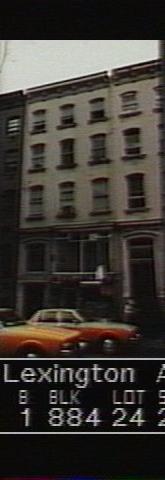
The city photographed every building for its tax records around 1940 and again in the 1980s. NYC Municipal Archives.
Written with AI from the source each entry cites, then fact-checked.
- 1864
Chester and Ellen Arthur move into their first permanent home
Chester and Ellen Arthur buy the brownstone at 123 Lexington Avenue and move in following the birth of their son, Chester Jr., in 1864. Arthur builds a successful law practice from the house, and in 1871 President Grant appoints him Collector of the Port of New York at a $50,000 annual salary. The couple becomes known for lavish entertaining and a box at the opera.
Source: Daytonian in Manhattan
- 1878
Arthur answers President Hayes's request for his resignation with a public refusal written at home
Arthur had served as Collector of the Port of New York since President Grant appointed him in November 1871, a post that paid $50,000 a year. In 1878 President Rutherford B. Hayes asked him to resign, and Arthur answered from his house at 123 Lexington Avenue with a letter of refusal that was widely publicized. Hayes dismissed him anyway.
Source: Daytonian in Manhattan
- 1880
Ellen Arthur dies of pneumonia after catching a chill at a concert
Ellen Lewis Herndon Arthur dies at the Lexington Avenue house on January 10, 1880, after contracting pneumonia at a concert. Chester Arthur, left a widower with two young children, is devastated; he later tells his young daughter, "There is nothing worth having now." He never remarries.
Source: Daytonian in Manhattan
- 1881
News of Garfield's shooting reaches Arthur at his Lexington Avenue house
On July 2, 1881, a telegram from Secretary of State James G. Blaine reached the house with word that President Garfield had been shot by Charles Guiteau. Messenger boys carried replies up the brownstone stoop all day. Garfield lingered until September 19, and Arthur, wary of seeming to seize power while the president lived, stayed in New York instead of going to Washington.
Source: Daytonian in Manhattan
- 1881
Chester Arthur takes the presidential oath in his parlor
Hours after President James Garfield dies from an assassin's bullet, a judge summoned to 123 Lexington Avenue administers the presidential oath of office to Vice President Chester Arthur in his front parlor, at about 2:15 a.m. It is only the second time a sitting president has been sworn in in New York City. Arthur leaves for Washington two days later.
Source: Daytonian in Manhattan
- 1886
A gaunt Arthur leaves the house for the first time in weeks, sixty pounds under his normal weight
After leaving the White House, Arthur came home to Lexington Avenue in 1885 and went back to practicing law, but his health was failing. The Sun reported on May 19, 1886 that he had walked feebly down his front steps to a closed carriage, his first outing in many weeks, colorless and sixty pounds short of his usual weight. In late June he left for New London, Connecticut, to spend the summer at the Pequot House, his famous side whiskers gone.
Source: Daytonian in Manhattan
- 1886
The dying Arthur has his private and official papers carried out and burned
On November 17, 1886, a failing Chester Arthur directed that his personal and official papers be gathered up, carried out of the house and burned. He was dead the following day.
Source: Daytonian in Manhattan
- 1886
Arthur's coffin leaves the Lexington Avenue parlor for the Church of the Heavenly Rest
After his death, Arthur's body lay in the parlor of 123 Lexington Avenue, where the city's and the country's most esteemed citizens called on the family. On November 22, 1886, at 8:30, the coffin was closed and carried out. It was borne to Fifth Avenue's Church of the Heavenly Rest, which over a thousand mourners filled while police kept the crowds back for two blocks in each direction.
Source: Daytonian in Manhattan
- 1886
Chester Arthur dies at his Lexington Avenue home
Chester Arthur, his health broken by Bright's disease, returns to 123 Lexington Avenue after leaving the presidency in 1885. He dies there of cerebral apoplexy on November 18, 1886, the year after his single term ended.
Source: Daytonian in Manhattan
- 1902
William Randolph Hearst buys the house and guts its basement for a garage
Publisher William Randolph Hearst purchases the former Arthur residence in 1902 and demolishes its English basement to build a garage. By 1909, architect James C. Green converts the building into commercial space with apartments above, ending its run as a private home.
Source: Daytonian in Manhattan
- 1909
James C. Green remodels the Arthur house with a new storefront and apartments above
By October 1909 the former Arthur home, owned by William Randolph Hearst, was being remodeled for commercial use. Architect James C. Green planned a new front rising to the third story, large show windows, new stairs and fewer partitions, turning the ground floor into a store and the upper floors into apartments. By 1919 the Evening World lamented that the house had, to some extent, fallen prey to the march of trade.
Source: Daytonian in Manhattan
- 1944
Kerope Kalustyan opens his spice and dried-fruit shop here in Little Armenia
Kerope Kalustyan, an Armenian from Istanbul, opened his shop in 1944 after a plan to export steel to Turkey fell through. He imported spices from Turkey and the Middle East, along with dried fruit, nuts, oils and grains. The neighborhood around Lexington Avenue and 23rd Street was the center of New York's Armenian community, and the store later became the most visible reminder of it.
Source: Wikipedia
- 1955
The landlord is arrested over 400 code violations before the Arthur house is sold
By February 1955 the old president's house was neglected, and authorities counted more than 400 violations against the landlord, Abraham Yarmark, who was arrested. One tenant said he had gone 47 days without gas. Within months Dr. Leo Lindenbaum bought the building, which then held a store, an office and six apartments.
Source: Daytonian in Manhattan
- 1965
The Chester A. Arthur house is designated a National Historic Landmark
The house at 123 Lexington Avenue, the home of the 21st president, became a National Historic Landmark on January 12, 1965. Chester Arthur spent most of his adult life living there, both before and after his years in Washington. A bronze plaque had been placed inside the building the year before by New York Life Insurance together with the Native New Yorkers Historical Society.
Source: Wikipedia
- 1970
Kalustyan's becomes a gathering place as the neighborhood turns into Curry Hill
As Indian immigration to New York grew in the late 1960s and 1970s, Kalustyan's added Indian goods and began making its own chutney and mango pickle. The store became a popular spot for Indians to meet, and Indian spice shops, sweet stores, restaurants and clothing shops opened nearby. The neighborhood, usually called Murray Hill, picked up the nickname Curry Hill.
Source: Wikipedia
- 1988
Sayedul Alam and Aziz Osmani buy Kalustyan's and widen its range to 80 countries
Kerope Kalustyan eventually sold the shop to a relative and employee, John Bas. In 1988 it was bought by two Bangladeshi businessmen, Sayedul Alam and Aziz Osmani, who turned it from an Indian, Armenian and Turkish grocery into a market carrying more than 10,000 products from over 80 countries. They also added an eat-in cafe and deli on the second floor.
Source: Wikipedia
Further reading
- Chester A. Arthur HomeWikipedia
- The Chester A. Arthur House -- 123 Lexington AvenueDaytonian in Manhattan
- A new president is sworn in on Lexington AvenueEphemeral New York
- Chester A. Arthur’s Indian food connectionThe Bowery Boys
Nearby
- St. Stephen's Church (Our Lady of the Scapular-St. Stephen)141 East 28th Street | 8 entries
- Gramercy Arts Theatre138 East 27th Street | 3 entries
- Jazz Standard116 East 27th Street | 4 entries
- Rose Hill203 East 29th Street | 5 entries
- Hook & Ladder Company 7217 East 28th Street | 5 entries
- Hotel Giraffe365 Park Avenue South | 2 entries