St. Stephen's Church (Our Lady of the Scapular-St. Stephen)
141 East 28th Street | Kips Bay | built 1898
Open on the map8 entries

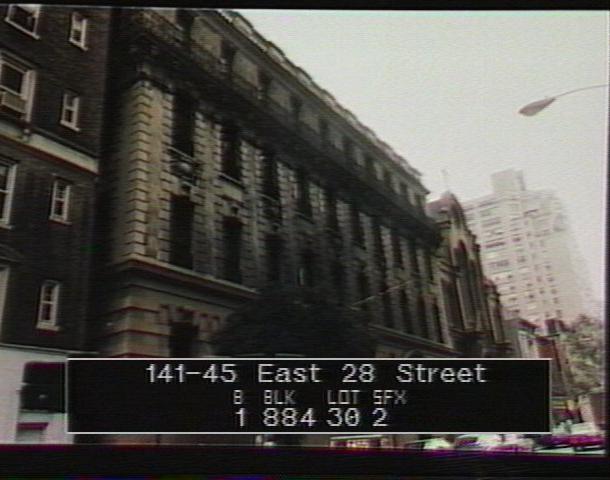
The city photographed every building for its tax records around 1940 and again in the 1980s. NYC Municipal Archives.
Written with AI from the source each entry cites, then fact-checked.
- 1854
Renwick builds St. Stephen's in Romanesque Revival style, unusual for a Catholic church
Designed by James Renwick Jr. and built in 1853-54, St. Stephen's was the second building of a parish founded in 1848. Renwick gave it a round-arched brownstone front in the Romanesque Revival style, which was then used mostly by evangelical Protestant congregations. By 1865-66 the parish had grown so large that the church was extended north through the block to East 29th Street.
“…more commonly applied to Evangelical Protestant Churches at this time and is highly unusual for a mid- nineteenth century Catholic Church…”
- 1868
Constantino Brumidi paints forty-three murals for St. Stephen's
In 1868 the Italian-born painter Constantino Brumidi, who had worked for popes at the Vatican, was hired to decorate St. Stephen's. He created 43 murals, including the large Crucifixion over the high altar, two big canvases over the side altars, one showing St. Stephen's martyrdom, and the Stations of the Cross. Later in his career he painted the historical murals in the Capitol rotunda in Washington, where he died in 1880.
“In 1868, Brumidi was hired to create murals in St. Stephen’s church…”
- 1874
King Kalakaua of Hawaii worships at St. Stephen's and finds the exit blocked by curious parishioners
In 1874 King Kalakaua of Hawaii and his party attended services at St. Stephen's, where the New York Times reported that the music especially pleased him. Afterward he tried to wait for the church to empty so he could avoid a crowd, but parishioners eager to see royalty stayed put, and a stalemate of unmoving bodies followed.
Source: Daytonian in Manhattan
- 1886
Father McGlynn defies the archbishop to speak for Henry George and is later removed as pastor
Edward McGlynn, pastor of St. Stephen's since 1866, was forbidden by Archbishop Corrigan on September 29, 1886 to address a Henry George campaign meeting at Chickering Hall. Corrigan suspended him for two weeks, but McGlynn spoke on October 1 anyway. The archbishop removed him from the pastorate on January 14, 1887, and his excommunication took effect on July 4, 1887, after he refused to go to Rome.
“On September 29, 1886, Archbishop Corrigan forbade him to speak on behalf of Henry George's candidacy at a public meeting…”
Source: Wikipedia
- 1887
Parishioners rebel against McGlynn's replacement with a cold church, a silent choir and no collection
When the Rev. Arthur J. Donnelly arrived to replace McGlynn in January 1887, many parishioners rebelled. The heating engineer resigned and mailed his key to McGlynn, leaving the church unheated for Sunday services; choir director Agatha Munier of eight years walked out, the boys' choir refused to sing, and the collectors would not serve, so no seat tickets were sold and worshippers sat where they pleased.
Source: Daytonian in Manhattan
- 1900
Over 30,000 people view Father McGlynn's body at St. Stephen's, with 110 police on duty
In 1900 the funeral for Edward McGlynn, the outspoken priest whom the Times had branded an agitator, was held at St. Stephen's, a parish whose membership had reached some 25,000 to 28,000 under his preaching. More than 30,000 people viewed his body, and 110 policemen were needed to control the crowd.
Source: Daytonian in Manhattan
- 1916
Spanish poet Juan Ramón Jiménez marries Zenobia Camprubí at St. Stephen's
On March 2, 1916, the Spanish poet Juan Ramón Jiménez, who won the Nobel Prize in Literature in 1956, married Zenobia Camprubí at the church. Their six months in America inspired his book Diario de un poeta recién casado (1917), a work that marked a turning point for his own poetry and for Spanish poetry of the period.
“On March 2, 1916, Spanish poets Juan Ramón Jiménez (Nobel Prize in Literature in 1956) and Zenobia Camprubí got married in this church.”
Source: Wikipedia
- 2008
Landmarks Commission designates St. Stephen's after a hearing with six speakers in favor and none opposed
The Landmarks Preservation Commission held its hearing on St. Stephen's on October 30, 2007. Six people spoke in favor, among them a representative of Congresswoman Carolyn Maloney and speakers for Community Board 6, the Historic Districts Council, the Victorian Society and the Landmarks Conservancy, plus a parishioner; no one opposed. The commission designated the church a landmark on October 28, 2008.
“There were six speakers in favor of designation ... There were no speakers in opposition.”
Further reading
Nearby
- Chester A. Arthur Home123 Lexington Avenue | 16 entries
- Rose Hill203 East 29th Street | 5 entries
- Hook & Ladder Company 7217 East 28th Street | 5 entries
- Gramercy Arts Theatre138 East 27th Street | 3 entries
- St. Illuminator's Armenian Apostolic Cathedral221 East 27th Street | 5 entries
- Jazz Standard116 East 27th Street | 4 entries