Cornelius Van Wyck House
126 West Drive | also 37-04 West Drive, 37-04 Douglaston Parkway | Douglaston | built 1735
Open on the map8 entries

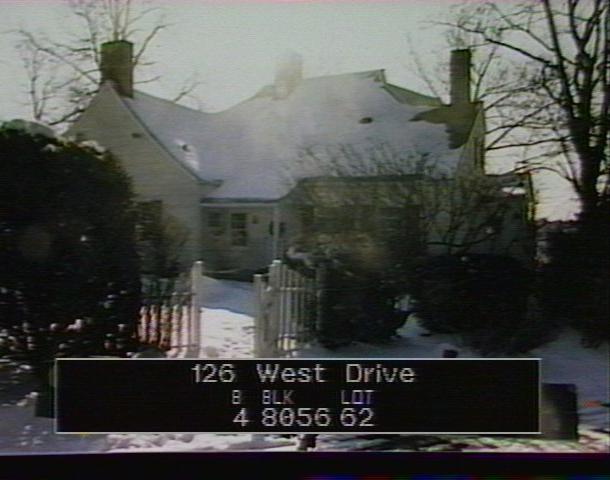
The city photographed every building for its tax records around 1940 and again in the 1980s. NYC Municipal Archives.
Written with AI from the source each entry cites, then fact-checked.
- 1734
Cornelius Van Wyck inherits his father's 125 acres
Johannes Van Wyck had bought 125 acres from Richard and Sarah Cornell, and when he died in 1734 the land passed to his son Cornelius. Cornelius was a third-generation American. With his wife Mary Hicks he enlarged the farm and lived on it until his death.
Source: Wikipedia
- 1735
Cornelius Van Wyck builds the first rooms of a Dutch Colonial farmhouse facing Little Neck Bay
The oldest part of the house, built in 1735, holds today's dining room, master bedroom and living hall, all with heavy oak beams. Over the next 35 years the house grew to the south and west, with hand-hewn shingles and a salt-box roof; Georgian mantels and a fully panelled fireplace wall survive inside, and the kitchen wing was added in 1930.
“The initial portion of the house was built by Cornelius Van Wyck in 1735, and consisted of what are today the dining room, the master bedroom and the living hall.”
- 1819
The Van Wyck family sells the farm to Winant Van Zandt
Cornelius Van Wyck's son Stephen inherited the house, added to it and went on to serve as a delegate to the Continental Congress. In 1819 the family sold the property to Winant Van Zandt, who enlarged it by 120 acres, including an area to the north known as The Point.
- 1907
The Douglaston Country Club enlarges the old farmhouse as its clubhouse
William Douglas, who turned the farm into Douglas Manor, is said to have treated the house as the lodge at the entrance to his property. After the Rickert-Finlay Company acquired the Manor in 1906, the Douglaston Country Club expanded the building in 1907 and used it as a clubhouse.
“In 1907, one year after the acquisition of the Manor by the Rickert-Finlay Company, the Douglaston Country Club enlarged the building for use as a clubhouse.”
- 1921
E. N. Wicht hires Frank J. Forster to return the house to its Dutch Colonial look
In 1921 the house became a private home again. Its owner, E. N. Wicht, engaged architect Frank J. Forster, who was designing Colonial Revival and Tudor Revival houses in the new Douglas Manor suburb, to restore it toward its original Dutch Colonial appearance. The magazine American Architect covered the project in 1924 as the conservation of a colonial relic.
“…its owner, E.N. Wicht, hired Frank J. Forster ... to restore it to its original Dutch Colonial appearance.”
- 1936
The Larsen family buys the house after Edward Wicht's death
When Edward Wicht died in 1936, Mr. and Mrs. Larsen bought the house. Mrs. Larsen took an interest in the history of the old homestead, and the family worked to keep up the house and to furnish it in keeping with its original design.
Source: Wikipedia
- 1950
Sixty members of a Douglaston women's museum group hear the house's history inside it
In 1950 Mrs. C. Turner Richardson gave a talk on the history and importance of the Van Wyck House to a 60-member audience from the Women's Club of Douglaston's Museums Group, meeting in the house itself. A newspaper article on the talk was headlined "History of Van Wyck House Outlined for Museum Group."
Source: Wikipedia
- 1966
The Landmarks Preservation Commission designates the Cornelius Van Wyck House
The commission held a hearing on January 11, 1966, at which nobody testified, and continued it to February 8, when four speakers, including a representative of the owner, supported designation and none opposed it. The designation called the house one of very few Dutch Colonial houses left in New York City. It also praised the house's early colonial craftsmanship, its Dutch-period details and its attractive setting.
“At that time four speakers spoke in favor of designation, including the representative of the owner of the building.”
Further reading
- Cornelius Van Wyck HouseWikipedia
Nearby
- Allen-Beville House38-01 Cedar Lane | 6 entries
- James J. Corbett House221-04 Corbett Road | 3 entries
- Zion Episcopal Church243-16 44th Avenue | 4 entries
- St. Mary's Hospital for Children29-01 216th Street | 2 entries
- Hawthorne Court Apartments215-43 43rd Avenue | 3 entries
- Hawthorne Court Apartments215-37 43rd Avenue | 2 entries