Allen-Beville House
38-01 Cedar Lane | also 29 237th Street, 29 Center Dr Douglaston, 236-12 Center Drive | Douglaston | built 1850
Open on the map6 entries

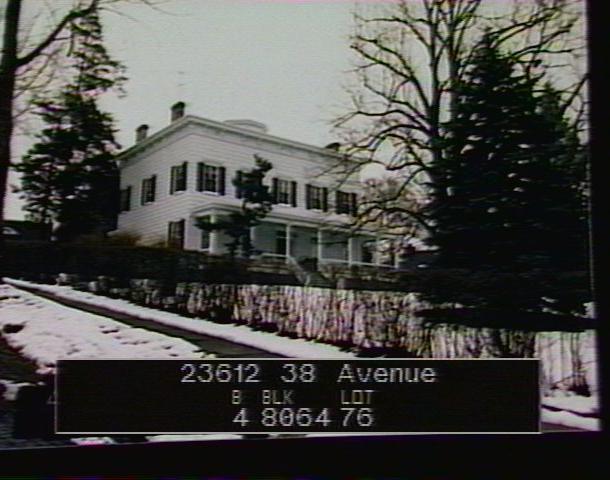
The city photographed every building for its tax records around 1940 and again in the 1980s. NYC Municipal Archives.
Written with AI from the source each entry cites, then fact-checked.
- 1847
Benjamin P. Allen takes title to the family farm site where he will build this house
On August 11, 1847, Benjamin P. Allen acquired the land from Daniel K. Allen, who had inherited it from his uncle Richard Allen. The transfer settled an 1844 ruling by Master-in-Chancery P. T. Ruggers over Richard Allen's estate, a farm of roughly sixteen acres pieced together before 1820 through purchases from Elijah and Philip Allen and from Cornelius Van Wyck.
“Benjamin P. Allen shortly after acquired the site of the house on August 11, 1847, from Daniel K. Allen.”
- 1848
A Greek Revival farmhouse with a bracketed octagonal cupola rises on Allen's land
Allen is believed to have built the house soon after 1847, and the Landmarks Preservation Commission dates it to about 1848-50. The white clapboard house is two and a half stories, five bays wide, with full-width porches front and rear on fluted Doric columns. Small shuttered attic windows punctuate the fascia under the cornice, the paired brackets may be later Italianate additions, and an octagonal cupola tops the roof.
“A bracketed octagonal cupola crowns the house and is one of its most striking features.”
- 1865
Benjamin P. Allen reportedly opens his home as a schoolroom for local children
In 1865 Allen is said to have given space inside the house for a school serving the community's children. He and his wife Catherine raised seven children born between 1855 and 1874, and from 1866 to 1883 he served as vestryman and sometimes warden of Zion Episcopal Church in Douglaston. Allen died on February 27, 1883, and is buried in the Zion churchyard with many of his family.
“In 1865 Mr. Allen reportedly provided space for a school within his home for the children of the community.”
- 1906
The Douglas Manor Company subdivides the old Douglas estate around the Allen house
In 1905-06 the Douglas Manor Company bought the old Douglas estate, which by then included the Allen farmhouse, and carved it into a real estate development that became a middle-class suburb. Anne R. Faddis bought about seventeen lots there, this house among them; twenty-four years later it passed to Walter Scott Faddis.
- 1946
Hugh and Eleanor Beville buy the house that will carry their name
After Walter Scott Faddis's executors sold the property to Alan Warner in 1945, Warner resold it a year later to Hugh and Eleanor Beville. The couple still owned the house when the Landmarks Preservation Commission designated it a landmark.
“…sold by his executors to Alan Warner in 1945, who in turn sold it to the present owners, Hugh and Eleanor Beville, in 1946.”
- 1977
The city names the Allen-Beville House a landmark
The Landmarks Preservation Commission designated the Allen-Beville House a New York City landmark in 1977. It is one of the few farmhouses from the nineteenth century still standing in Queens, and in 1983 it was also added to the National Register of Historic Places.
“The Allen-Beville House was given landmark status by the New York City Landmarks Preservation Commission in 1977…”
Source: Wikipedia
Further reading
- Allen-Beville HouseWikipedia
Nearby
- Cornelius Van Wyck House126 West Drive | 8 entries
- Zion Episcopal Church243-16 44th Avenue | 4 entries
- James J. Corbett House221-04 Corbett Road | 3 entries
- Hawthorne Court Apartments215-43 43rd Avenue | 3 entries
- Hawthorne Court Apartments215-37 43rd Avenue | 2 entries