Bowery Savings Bank Building
130 Bowery | also 228 Grand Street, 108 Elizabeth Street | Little Italy | built 1894
Open on the map16 entries

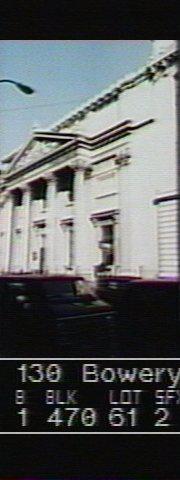
The city photographed every building for its tax records around 1940 and again in the 1980s. NYC Municipal Archives.
Written with AI from the source each entry cites, then fact-checked.
- 1834
The Bowery Savings Bank opens in a three-story house at 128 Bowery
The Bowery Savings Bank took its first deposits on June 2, 1834: $2,020 from fifty customers, in a three-story house at 128 Bowery, on the Bowery front of the lot where its landmark building now stands. The Butchers' and Drovers' Bank already occupied the site, and for a while the two banks split the premises, using them at different hours of the day. By 1836 the older bank had moved next door to 124 Bowery, and by 1850 the savings bank held $3 million in deposits.
Source: Wikipedia
- 1853
The bank moves into an Italianate building at 128-130 Bowery designed by Thomas & Son
After buying the neighboring lot at 130 Bowery in January 1852, the trustees hired Thomas & Son to design a larger Italianate home for the bank, replacing the first house on the same ground. Work started in May 1852 and the doors opened in March 1853. Inside were a U-shaped tellers' counter, a ceiling skylight and vaults in the basement. Deposits kept climbing, from $6.5 million in 1863 to roughly $83 million by 1903.
“…hired the firm of Thomas & Son to design an Italianate structure at 128 and 130 Bowery…”
Source: Wikipedia
- 1892
Five architects compete to design the new Bowery Savings Bank, and McKim, Mead & White win
In November 1891 the trustees paid $155,500 for three lots at 222-226 Grand Street and decided to build anew, with the bank's charter requiring an entrance on the Bowery. Five architects were asked to compete: McKim, Mead & White, Napoleon LeBrun, George B. Post, Cyrus L. W. Eidlitz and Charles W. Clinton. Their entries came in during September 1892, and Professor William Robert Ware reviewed them and recommended the McKim, Mead & White scheme, led by Stanford White.
Source: Wikipedia
- 1894
The new banking room on Grand and Elizabeth Streets is running by June, with about 100,000 depositors
Work on the western half of the site began in May 1893, once existing leases ran out, and the houses along Grand and Elizabeth Streets were gone by July. The new banking room was in operation by June 1894, when the bank counted just over 100,000 depositors. Only then was the older Bowery building demolished to make way for the waiting room, which opened in January 1895; spending on the new building had reached $570,000 by the end of that year.
“The new banking room on Grand and Elizabeth Streets was in operation by June 1894. At this point, the bank had just over 100,000 depositors.”
Source: Wikipedia
- 1904
Four tellers serve 140,000 accounts, and withdrawals mean a wait of hours in the 'Chapel'
By 1904 the Bowery Savings Bank had 140,000 accounts but a counter staff of just four tellers, along with two draft clerks and an information clerk. Opening an account or making a deposit was quick, since men and women used the same window. Withdrawals were far slower, and customers often sat in the waiting room, nicknamed the "Chapel," for two or three hours before their turn.
“…customers frequently had to wait in the "Chapel" for two or three hours…”
Source: Wikipedia
- 1923
Fourteen armored cars and 100 police move $202 million to the bank's new 42nd Street branch
When the Bowery Savings Bank opened its Midtown branch at 110 East 42nd Street, it shifted $202 million in deposits uptown in June 1923, using 14 armored cars under the guard of 100 heavily armed policemen. By then 155,000 people held accounts, 5,600 of them at the new branch. The Bowery office stayed open, and its deposits rose from $100 million in 1910 and reached $250 million by 1930.
Source: Wikipedia
- 1930
The Bowery Savings Bank adds a chromium-steel vault with room for 10,000 safe-deposit boxes
In April 1930 the bank starts offering safe-deposit boxes at its Bowery office, having introduced them at its 42nd Street branch the year before, where they proved very popular. To hold them, a new chromium-steel vault is built with a door weighing 17 short tons and space for 10,000 boxes. The addition also brings coupon and conference rooms.
Source: Wikipedia
- 1966
The Landmarks Preservation Commission designates the Bowery Savings Bank without opposition
After hearings on March 8 and April 12, 1966, with three speakers in favor at the first and one more testifying at the second, the Landmarks Preservation Commission designates the bank at 130 Bowery. Bank president Morris D. Crawford Jr. had written that the bank would not oppose. The Commission cites its early reflection of the classicism of the 1893 Chicago fair, and notes it is reputed to be the only New York bank still keeping a branch on its original site.
“It is reputed to be the only bank in New York which retains a branch on the site where it first started business.”
- 1994
The city designates the Bowery Savings Bank's banking-room interior a landmark
The Landmarks Preservation Commission held public hearings in June 1993 on whether to designate the interior of the Bowery Savings Bank Building, alongside the interiors of four Brooklyn banks and another Manhattan bank. On August 23, 1994 it designated the original banking room's interior, making it a city landmark and adding to the 1966 designation of the exterior.
Source: Wikipedia
- 1995
Greenpoint Bank takes over the banking spaces after the Bowery Savings Bank's 1987 sale
The Bowery Savings Bank nearly went bankrupt in 1985 and was acquired by H. F. Ahmanson & Co. in 1987. In 1995 Greenpoint Bank took over the banking spaces at 130 Bowery after buying many of Ahmanson's branches. The building went on hosting events, including an exhibit of historic photographs, and its records were later moved to Lake Success, New York.
Source: Wikipedia
- 2000
Jeffrey Wu, who bought the Bowery Savings Bank in 2000, spends a year bringing it up to code
Jeffrey Wu bought the Bowery Savings Bank building in 2000. By January 2002 the New York Times reported that he had spent much of the previous year getting the recently vacated landmark up to code. Both its exterior and interior were city landmarks, and Wu said that a restaurant and catering hall were about all the building could be used for.
Source: The New York Times
- 2002
The bank becomes Capitale, an event hall, over neighbors' nightclub worries
Food importer Jeffrey Wu bought the building from Greenpoint Bank in 2000 and had it prepared for use as a catering hall. Residents of Chinatown and Little Italy feared a nightclub, and Community Board 2 asked the State Liquor Authority to deny a license, but the license was granted. Capitale opened in late 2002 after a renovation costing $4 million or $5 million that left the interior largely intact; early guests included Donald Trump and Justin Timberlake, and the hall later served as a filming location for Gossip Girl.
Source: Wikipedia
- 2003
The New Yorker finds Capitale's marble banking hall full of celebrity private parties
Reviewing Capitale for The New Yorker, Nick Paumgarten describes nearly an acre of marble, Corinthian columns and potted palms, with waiters in bank-clerk outfits and big block letters over the door about the depositor's financial welfare. A bartender calls the recent private-party hosts circus freaks and lists 50 Cent, Elton John, Britney Spears and the Stones among them.
Source: The New Yorker
- 2017
Michael and David Marvisi buy the building at a $33 million valuation
The brothers Michael and David Marvisi acquire the Stanford White-designed building in 2017 at a valuation of $33 million. The 33,000-square-foot property has a lone tenant, the events organizer Capitale NYC, which pays $118,000 a month under a lease that does not expire until 2032. In 2019 the owners hope to get $50 million at auction, but that auction never takes place.
Source: therealdeal.com
- 2020
Capitale misses rent in the pandemic and the owners default on a $12 million loan
During the pandemic Capitale begins missing rent payments, according to court documents, and in August 2020 the building's owners default on a $12 million loan from Wells Fargo. In 2022 the Marvisis hold off a forced sale by filing for Chapter 11 bankruptcy protection, then try again to sell it with an initial asking price of $35 million.
Source: therealdeal.com
- 2025
Catering magnate Ilya Zavolunov buys the Bowery Savings Bank Building for $20 million
A sale to SC Holdings for $25.7 million, agreed in September 2023, falls through over a gas-line issue, and an auction is scheduled for January 2025, by which time Capitale is no longer running the event venue. In July 2025 catering magnate Ilya Zavolunov buys the building for $20 million, far below the $33 million valuation of 2017.
“Catering magnate Ilya Zavolunov bought the Bowery Savings Bank Building that July for $20 million.”
Source: Wikipedia
Further reading
Nearby
- Bowery Bank of New York Building124 Bowery | 5 entries
- Delaplaine House134 Bowery | 7 entries
- M. Kessler Hardware229 Grand Street | 2 entries
- Chatham Phoenix Bank116 Bowery | 2 entries
- Pietro Guardino Building92 Elizabeth Street | 1 entry
- 219-221 Grand Street219 Grand Street | 3 entries