130 Charles Street
West Village | built 1853
Open on the map4 entries

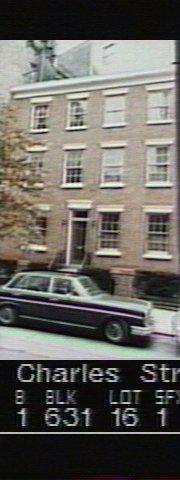
The city photographed every building for its tax records around 1940 and again in the 1980s. NYC Municipal Archives.
Written with AI from the source each entry cites, then fact-checked.
- 1853
The Springsteen brothers replace a stable at No. 130 with a brick house
In 1853 the Springsteen brothers, all in the building trades, raised their wooden house at No. 132 by adding a complete third story. They also built a three-story brick dwelling on the neighboring lot, where a stable had stood. The new house was 29 feet wide, a plain working-class cousin of the Greek Revival, and Joseph, the mason of the three, moved into it.
Source: Daytonian in Manhattan
- 1870
Burglars take $500 and furs from No. 130 while the family is out
On the afternoon of January 13, 1870, thieves got into Joseph Springsteen's house at about 3 o'clock, when nobody was home. They emptied a first-floor bureau drawer of $500 and carried off two silk dresses and furs worth another $600. Neighbors had seen three young men hanging around the house, and gave the police descriptions.
Source: Daytonian in Manhattan
- 1876
Charles Springsteen is shot in the eye outside a Hudson Street saloon and recuperates at No. 130
Joseph Springsteen had given his son Charles the use of No. 130. On the night of May 31, 1876, Charles was in Jacob Peth's saloon at 536 Hudson Street when a quarrel over a bar tab became a brawl. He grappled with Peth out onto the sidewalk, where a pistol shot hit him in the right eye. When the coroner came to the house on June 5 to take a dying statement, he found the young man improving and not in immediate danger.
Source: Daytonian in Manhattan
- 1927
Miriam Taylor converts the old Springsteen house into apartments
After the Springsteen family lost the house to foreclosure in 1914, it served as a rooming house. Miriam Meredith Taylor bought it in 1927 and that April turned it into "non-housekeeping apartments". The house was sold every year from 1930 to 1933 and by then held seven studios. Owners Mary Frank and Virginia Siep made it a single-family home again in 1964.
Source: Daytonian in Manhattan
Further reading
- The 1853 Springsteen House No. 130 Charles St.Daytonian in Manhattan
Nearby
- Wooden house at 132 Charles Street132 Charles Street | 5 entries
- 714 Greenwich Street1 entry
- 134 Charles Street3 entries
- 716 Greenwich Street2 entries
- 708 Greenwich Street3 entries
- Le Gendarme (former Ninth Precinct station house)135 Charles Street | 5 entries