Wooden house at 132 Charles Street
132 Charles Street | West Village | built 1819
Open on the map5 entries

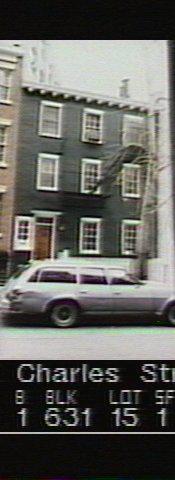
The city photographed every building for its tax records around 1940 and again in the 1980s. NYC Municipal Archives.
Written with AI from the source each entry cites, then fact-checked.
- 1819
Carpenter Matthew Armstrong builds a small wooden house at No. 132 with a partner
Cartman Peter Parsells and carpenter Matthew Armstrong bought the lot together from Richard Amos in 1818. The two-story clapboard house, probably Armstrong's own work, went up around 1819, and he and his wife Ellen lived there until 1830. He became sole owner after Parsells died around 1823. The city's Landmarks Preservation Commission calls it the oldest structure in the Greenwich Village Historic District Extension.
- 1834
Greenwich Village bans wooden buildings, but not on the far west side where No. 132 stands
Wooden construction was prohibited across most of Greenwich Village in 1834, a fire-safety rule that exempted the area west of Washington Street. That exemption left a few frame houses standing in the far western Village, No. 132 among them. In 1849 the city extended the ban to every part of Manhattan below 32nd Street, so such houses became rare.
- 1853
Three Springsteen brothers share No. 132, then raise its roof to make a third floor
The Springsteen family bought No. 132 in 1849, and brothers John (a carpenter), Joseph (a mason) and Levi (a carpenter) lived there together; John had rented it since 1833. Around 1853 a full third story replaced the old pitched roof with dormers, probably done by John and Levi. Joseph built No. 130 next door that year and moved in, and John died about 1855.
“The Springsteens added a full third story to the house c. 1853 (in place of the former pitched roof with dormers)…”
- 1898
An 84-year-old resident is let go after a raid arrests 196 men at a poolroom
On March 8, 1898, police captain Chapman and fifteen plain-clothes officers broke into the West Side Club at 80 Sixth Avenue, an illegal horse-betting parlor run by a gambler called The Allen. They found 27 men in the front room and 168 more in the back rooms with telegraph tables, and arrested 196. The only man released was Joseph Springsteen, 84, of 132 Charles Street, who said he had come along with a friend.
Source: Daytonian in Manhattan
- 2006
The stucco comes off No. 132 and clapboard-look siding goes on
Read more
Stucco had covered the front of the old wooden house since before the 1930s. In 2006 it was removed and replaced with fiber cement siding that resembles wood clapboards. The change returned the oldest structure in the historic district extension to something close to its original wooden look.
Further reading
- The 1819 Wooden House at No. 132 Charles StreetDaytonian in Manhattan
Nearby
- 130 Charles Street4 entries
- 134 Charles Street3 entries
- 714 Greenwich Street1 entry
- Le Gendarme (former Ninth Precinct station house)135 Charles Street | 5 entries
- 716 Greenwich Street2 entries
- 708 Greenwich Street3 entries