Bush Tower
130 West 42nd Street | also 135 West 41st Street | Times Square | built 1918
Open on the map12 entries

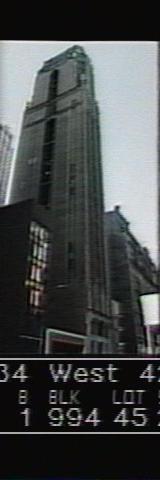
The city photographed every building for its tax records around 1940 and again in the 1980s. NYC Municipal Archives.
Written with AI from the source each entry cites, then fact-checked.
- 1917
Irving T. Bush opens a 30-story wholesale showroom on West 42nd Street
Developer Irving T. Bush, who built the Bush Terminal complex in Brooklyn, opens the Bush Terminal International Exhibit Building and Buyers' Club on a narrow 50-foot-wide midtown lot. Architects Helmle & Corbett give the neo-Gothic tower exhibition floors where out-of-town merchants can inspect manufacturers' goods without traveling to individual factories.
Source: Daytonian in Manhattan
- 1919
The International Buyers' Club hosts a children's fashion show at the Bush Terminal Building
The New-York Tribune reported on February 6, 1919, that the first children's fashion show had taken place the night before at the Bush Terminal Building, held under the auspices of the International Buyers' Club. According to Daytonian in Manhattan, the Buyers' Club occupied the first floor and mezzanine of the Bush Terminal Sales Building as a lounge and service center for visiting buyers.
Source: Daytonian in Manhattan
- 1919
Peace and civic reform groups sign leases in the Bush Terminal Sales Building
In 1919 four organizations signed leases at the Bush Terminal Sales Building: the Vacation War Relief Committee of the Vacation Association, the League of Free Nations Association, the City Government Committee of Citizens' Union, and the League to Enforce Peace. Daytonian in Manhattan points to them as a new kind of tenant that the First World War brought to a tower first built for showrooms.
Source: Daytonian in Manhattan
- 1919
A fire breaks out on the eighth floor during a Persian art exhibition
Flames damage the building's eighth floor, but fireproof construction keeps water from reaching a Persian art exhibition of 4,000 pieces, including a 16-foot tapestry valued at $100,000, on display five floors below on the third floor. The exhibit had drawn crowds earlier that year as one of the tower's cultural attractions.
Source: Daytonian in Manhattan
- 1921
The Old Town Tavern is announced for the building's lower floors
The New York Times reports that the lower three floors, originally built for the Buyers' Club, are being converted into the Old Town Tavern, furnished in the style of old New York inns and English manor houses. Developer Irving Bush loans antiques from his own collection, marking a shift away from his original vision of a manufacturers' showcase toward more conventional commercial tenants.
Source: Daytonian in Manhattan
- 1922
The New-York Tribune picks the Bush Terminal Sales Building as a sight for two famous visitors
In July 1922 the novelist Hugh Walpole and the Maharajah of Rajpipla were both touring the United States, and the New-York Tribune remarked on July 10 that no one could see America in two weeks. Assuming the Maharajah would have time for one landmark in each city, the paper chose the Bush Terminal Sales Building as New York's. Daytonian in Manhattan cites the item as a sign of the building's reputation.
Source: Daytonian in Manhattan
- 1926
The American Architect names the Bush Tower the commercial building of the decade
In 1926 the journal American Architect named the Bush Tower its commercial building of the decade, according to the city's landmark designation report. The same year the architectural historian Talbot Hamlin praised it for facing the problem of the modern skyscraper head-on, singling out the patterned brick on its bare side walls and its floodlit upper stories at night.
“In 1926 the building was named "commercial building of the decade" by the American Architect.”
- 1930
Architects Rodgers & Poor, based in the building, win the Wright Memorial design contest
On February 18, 1930, a design by the architects Robert P. Rodgers and Alfred E. Poor was selected from 35 entries for the Wright Memorial at Kitty Hawk, North Carolina. Their firm, Rodgers & Poor, had its offices in the Bush Terminal Sales Building that year, according to Daytonian in Manhattan.
Source: Daytonian in Manhattan
- 1938
Metropolitan Life takes the Bush Terminal Company's tower in foreclosure
In 1938 the Bush Terminal Company lost the building to the Metropolitan Life Insurance Company in foreclosure proceedings. The lower floors, built as the Buyers' Club, had housed the Hamilton Trust Company in the early 1920s and the Old London Restaurant from 1931. The city's landmark report notes that windows were inserted between the trompe l'oeil piers of the side walls in 1939.
“The Bush Terminal Company lost the property to the Metropolitan Life Insurance Company in 1938 during foreclosure proceedings.”
- 1943
The Red Cross War Fund of Greater New York opens its headquarters in the tower
In January 1943 the Red Cross War Fund of Greater New York set up its headquarters in the Bush Terminal Sales Building. Its sole purpose was raising money for Red Cross work in Europe and on the battlefronts. By 1946 the name had changed to the Red Cross Fund Headquarters, and its fund-raising included an annual benefit Broadway variety show.
Source: Daytonian in Manhattan
- 1983
Owners overhaul the old Bush Terminal Building instead of demolishing it, and it becomes Bush Tower
By the early 1980s the owners had considered demolishing the building and were letting tenants' leases expire. Nicholas B. Ghattas, president of American Properties, instead urged an overhaul in the hope that West 42nd Street would recover. The work ran from 1983 to 1985: new heating, electrical systems and elevators, a wider lobby and a cleaned facade. The porn films showing in its theater were cleared out, and the building took the name Bush Tower.
Source: Wikipedia
- 1988
The city designates Bush Tower a landmark
The Landmarks Preservation Commission designates the building an individual New York City landmark, citing Harvey Wiley Corbett's neo-Gothic design. The tower's narrow side walls are laid up in three tones of brick arranged to create trompe-l'oeil depth as sunlight crosses the facade.
Source: Wikipedia
Further reading
- Bush TowerWikipedia
- The Bush Terminal Sales Building - 130 West 42nd StreetDaytonian in Manhattan
Nearby
- The Knickerbocker Hotel1466 Broadway | 13 entries
- Salesforce Tower1095 Avenue of the Americas | 8 entries
- Lewisohn Building119 West 40th Street | 2 entries
- Bank of America Tower1111 Avenue of the Americas | 12 entries
- 5 Bryant Park2 entries
- Times Square Tower1459 Broadway | 12 entries