Bank of America Tower
1111 Avenue of the Americas | also 100 West 43rd Street, 108 West 43rd Street, 104 West 43rd Street | Times Square | built 2005
Open on the map12 entries

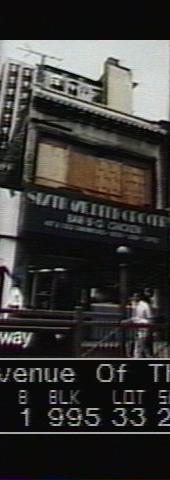
The city photographed every building for its tax records around 1940 and again in the 1980s. NYC Municipal Archives.
Written with AI from the source each entry cites, then fact-checked.
- 1918
Henry Miller's Theatre is the first built under the new zoning law and hides its side alleys
Earlier Broadway theaters had to leave open alleys along both sides, but Henry Miller's Theatre was the first erected under new zoning rules. That let its architects extend the red-brick neo-Georgian facade to either side and mask the alleys. The second- and third-story windows on the street were also considered unusual for a theater at the time, though they belonged to the Georgian style that the architects borrowed.
“Another unusual aspect of the theater's design resulted from the Henry Miller being the first theater erected under new zoning laws.”
- 1918
Actor Henry Miller opens his namesake theater
Actor Henry Miller, backed by philanthropist Elizabeth Milbank Anderson, opened Henry Miller's Theatre at 124 West 43rd Street on April 1, 1918. Paul R. Allen, with Henry Creighton Ingalls and F. Burrall Hoffman, designed the neo-Georgian house, which seated about 1,000 and had an interior in old ivory and antique gold. Miller fell ill at the theater before the opening of a new play in April 1926 and died of pneumonia days later. The theater's facade survives at the base of today's tower.
Source: Daytonian in Manhattan
- 1925
Noel Coward makes his American debut in The Vortex at Henry Miller's Theatre
In 1925 Henry Miller's Theatre, whose facade survives at the base of 1 Bryant Park, staged The Vortex, which the Landmarks Commission calls Noel Coward's triumphant American debut. The house had opened seven years earlier as actor Henry Miller's own theater. Later in the decade it housed a popular revival of Our Betters with Ina Claire and Constance Collier, and Journey's End, which ran for 485 performances.
“Other notable productions from this period include ... The Vortex (1925), Noel Coward's triumphant American debut.”
- 1926
Henry Miller dies days after falling ill at his own theater, and a blind pencil seller mourns him
Henry Miller, still nursing a cold, went to his theater on the evening of April 5, 1926 for the opening of A Stranger in the House, but fell ill and was taken to his apartment; the show went on without him. Pneumonia was diagnosed and he died on April 9. At his funeral, a policeman barred Joseph Hahn, the blind pencil vendor whom Miller had often helped outside the theater, until a friend escorted him in.
Source: Daytonian in Manhattan
- 1938
Thornton Wilder's Our Town opens at Henry Miller's Theatre, then moves to the Morosco
Thornton Wilder's Our Town opened in 1938 at the Henry Miller Theater, but the run did not last there. The production soon moved to the Morosco Theatre, freeing the Miller for Freddy Lonsdale's Once Is Enough, starring Ina Claire. The Landmarks Commission lists it among the notable productions in the house's history, alongside Eugene O'Neill's Days Without End, which came here in 1934.
- 1964
Josephine Baker opens a limited run at Henry Miller's Theatre
The Henry Miller was still booking famous names in the early 1960s. Josephine Baker opened a 24-run show there on May 13, 1964. The day after it ended, Helen Hayes, then 64, returned to the house to star opposite James Daly in The White House. Hayes had appeared at the theater earlier, in the play Quarantine, reviewed by the Times in December 1924.
Source: Daytonian in Manhattan
- 1978
The former theater reopens as the Xenon disco
Once legitimate theater gave way to movies, the house at 124 West 43rd Street became a pornographic movie venue by the 1970s. Howard Stein closed it in 1977 and reopened it in June 1978 as the disco Xenon, which later became Shout and then Club Expo. A stage revival of Cabaret followed in 1998, and the original auditorium was demolished in 2004.
Source: Daytonian in Manhattan
- 1989
Seymour Durst puts up the National Debt Clock on a building at the site
Developer Seymour Durst began buying property on this Sixth Avenue block in 1967, starting with a building that housed a seafood restaurant, and he repeatedly floated and dropped plans for towers. In 1989 he mounted the National Debt Clock on one of his buildings there. By 1990 he owned twenty lots, including the old Henry Miller Theater. By early 2004, with the last property acquired, Durst was planning to move the clock.
“Seymour Durst erected the National Debt Clock on one building at the site in 1989. By the next year, Seymour Durst had acquired 20 lots…”
Source: Wikipedia
- 1998
The old theater becomes the Kit Kat Klub for a revival of Cabaret
After the Club Expo nightclub shut, the former Henry Miller's Theatre came back as a stage in 1998 with a revival of Cabaret. Its interior was remodeled to evoke wartime Germany, and the house was renamed the Kit Kat Klub, echoing the show. Urinetown, which opened in 2001, was the final play produced in Miller's original 1918 auditorium; the theater closed and was torn down in 2004.
Source: Daytonian in Manhattan
- 2004
Durst and Bank of America break ground on the day terror threats hit city banks
The groundbreaking on August 2, 2004 fell on the same day that threats were made against several of the city's biggest banks and financial firms. Governor George Pataki remarked that it was probably the best day they could have picked to start building. Soon afterward, workers framed a steel support for the old theater's facade, and the interior was taken apart with hand tools while sensors watched for vibration.
Source: Wikipedia
- 2009
A preserved 1918 facade becomes the base of a new tower
When the 55-story Bank of America Tower was completed in 2009, the neo-Georgian facade of the old Henry Miller's Theatre was kept as part of its base. A new theater of 1,055 seats was built behind it and was named the Stephen Sondheim Theatre in 2010. At 1,200 feet, the tower was billed as the first commercial skyscraper in the United States designed to earn LEED Platinum certification.
Source: Wikipedia
- 2010
The Bank of America Tower opens as the first LEED Platinum office tower in the US
Durst and Bank of America held the grand opening in May 2010, with former vice president Al Gore praising Mayor Bloomberg at the ribbon-cutting. The building earned LEED Platinum certification that month, the first U.S. office tower to do so, though the theater at its base got Gold. Appraised at $2.2 billion, it was soon refinanced, and the theater was renamed for Stephen Sondheim that year.
Source: Wikipedia
Further reading
- Bank of America Tower (Manhattan)Wikipedia
- The Henry Miller's Theatre -- 124 West 43rd StreetDaytonian in Manhattan
Nearby
- The Town Hall113 West 43rd Street | 13 entries
- Bush Tower130 West 42nd Street | 12 entries
- Salesforce Tower1095 Avenue of the Americas | 8 entries
- The Knickerbocker Hotel1466 Broadway | 13 entries
- 4 Times Square1472 Broadway | 10 entries
- Lambs Club Building130 West 44th Street | 5 entries