Weill Cornell Medical College
1300 York Avenue | also 1176 York Avenue | Lenox Hill | built 1956
Open on the map13 entries

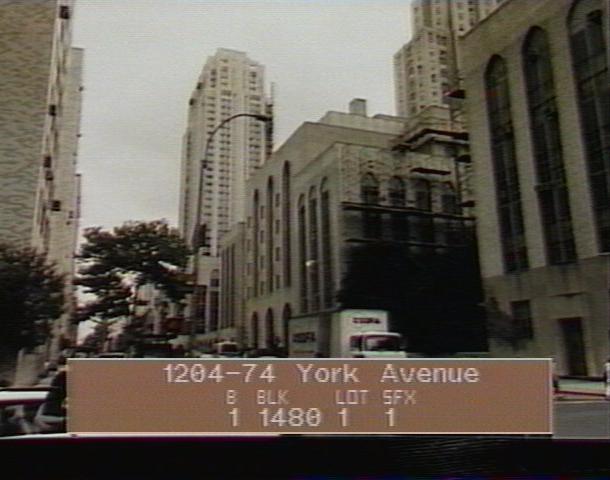
The city photographed every building for its tax records around 1940 and again in the 1980s. NYC Municipal Archives.
Written with AI from the source each entry cites, then fact-checked.
- 1898
Oliver H. Payne's endowment founds Cornell University Medical College in New York City
Cornell University Medical College was established on April 14, 1898, with an endowment from Col. Oliver H. Payne. The university put the school in New York rather than at its Ithaca campus, which was judged too small to offer students enough clinical training. James Ewing, the first professor of clinical pathology, was for a time the only full-time professor. In 1932 the college and New York Hospital opened a joint campus in Yorkville.
Source: Wikipedia
- 1927
New York Hospital and Cornell agree to build one shared medical center beside the East River
In 1927 the hospital and Cornell's medical college agreed to share one large medical center, with faculty and staff holding joint appointments at both. They chose a site running from East 68th to East 71st Streets, with York Avenue on one side and the river on the other. Payne Whitney, the hospital's chief benefactor, gave more than $40 million toward construction, and the General Education Board of the Rockefeller Foundation added $5 million for the medical college.
Source: library.weill.cornell.edu
- 1929
Ground is broken for the New York Hospital-Cornell Medical Center, with college buildings set along York Avenue
Demolition of the Central Brewing Company and several row houses on the site came in 1929, and the groundbreaking took place on June 17. The Boston firm Coolidge, Shepley, Bulfinch, and Abbott designed the complex under Henry Shepley, and Marc Eidlitz & Son, which had built Columbia-Presbyterian, was the contractor. The medical college's wings were placed on York Avenue so the river views would be kept for patients.
Source: library.weill.cornell.edu
- 1932
Loomis Laboratory and the Russell Sage Institute move into the new medical center
When the New York Hospital-Cornell Medical Center opened in 1932, two older research units moved with the medical college. Loomis Laboratory, which Oliver Payne had set up across from Bellevue Hospital in 1886, became part of the Department of Pathology. The Russell Sage Institute of Pathology, part of the college since 1912, relocated to the new center as well.
Source: library.weill.cornell.edu
- 1932
The medical center takes its first patients on September 1, and the college begins teaching on September 26
New York Hospital received its first patients at the new York Avenue complex at 10:00 a.m. on September 1, 1932. Cornell University Medical College began instructing students there on September 26. The archives describe the pale, award-winning building as towering over the Upper East Side like a temple of modern medicine, opening at the height of the Great Depression.
Source: library.weill.cornell.edu
- 1943
George Papanicolaou's Pap smear test for cervical cancer is first used
Dr. George Papanicolaou of the college's Department of Anatomy saw the Pap smear, his test for cervical cancer, come into first use in 1943. He developed it with Dr. Harold Traut of Obstetrics and Gynecology, and the two men's book Diagnosis of Uterine Cancer by the Vaginal Smear was published by the Commonwealth Fund. Papanicolaou had begun the underlying research in the 1920s.
Source: library.weill.cornell.edu
- 1955
Vincent du Vigneaud, chair of biochemistry, receives the Nobel Prize in Chemistry
Dr. Vincent du Vigneaud, who chaired the Department of Biochemistry and Biophysics at Cornell's medical college, received the Nobel Prize in Chemistry in 1955. The prize honored his research on oxytocin, a pituitary hormone needed for childbirth and for milk production. The college's archives also credit him with the first synthesis of penicillin, in 1946.
Source: library.weill.cornell.edu
- 1962
The Samuel J. Wood Library and Research Building at 1300 York Avenue is dedicated
Built from 1960 to 1962 for the Cornell University Medical College, the Samuel J. Wood Library and Research Building at 1300 York Avenue was dedicated on October 17, 1962. It was one of several additions to the medical center in those years, alongside the Connie Guion Building for outpatient care, dedicated in May 1963, and the Theodora Griffis Faculty Club on East 68th Street.
Source: library.weill.cornell.edu
- 1966
Anthony Fauci earns his medical degree at Cornell, first in his class
Anthony Fauci took his medical degree at Cornell's medical college in 1966 and placed first in his class. Two years after graduating he joined the staff as a clinical associate at the National Institute of Allergy and Infectious Diseases, and he became its director in 1984. The school later gave him its Weill Alumni Award of Distinction, in 1992.
Source: cornellsun.com
- 1989
The Lasdon Biomedical Research Center is dedicated, with the Starr information center inside
The William and Mildred Lasdon Biomedical Research Center was dedicated on March 14, 1989, with construction dated 1986 to 1990. The York Avenue building has space for the medical college's departmental laboratories, its Department of Pharmacology and its Institute for Human Neuroscience. The C.V. Starr Biomedical Information Center is housed there as well.
Source: library.weill.cornell.edu
- 1998
Sanford I. Weill's $100 million pledge gives the medical college its name
Sanford Weill, then chairman of Citigroup, pledged $100 million to Cornell for biomedical research in 1998, and the medical school took the name Joan and Sanford I. Weill Medical College. In 2015 it was renamed Weill Cornell Medicine. In 2019 the Starr Foundation gave $160 million so that students who qualify for financial aid can attend free.
Source: Wikipedia
- 2011
An exhibit on Dr. George Papanicolaou, "A Man of Science," is installed in the main lobby
In June 2011 an exhibit titled George Papanicolaou, A Man of Science went up in the main lobby of the medical college at 1300 York Avenue. The archives' companion biography traces him from his birth in Kymi, Greece, in 1883 to New York in 1913. For the following 47 years he worked at Cornell University Medical College, where he set up the cytology laboratory for his Pap smear work.
Source: library.weill.cornell.edu
- 2019
Weill Cornell announces that attendance will be free for students who qualify for financial aid
On September 16, 2019, dean Augustine M.K. Choi announced that Weill Cornell Medicine would waive the full cost of attendance for every student who qualified for financial aid. The money came from a $160 million gift from The Starr Foundation, which overseer Maurice R. Greenberg directed, together with gifts from Joan and Sanford I. Weill.
“…would make the cost of attendance free for all students who qualify for financial aid, made possible by a $160 million gift from The Starr Foundation…”
Source: Wikipedia
Further reading
- Weill Cornell MedicineWikipedia
Nearby
- Memorial Sloan Kettering Cancer Center1275 York Avenue | 14 entries
- Hospital for Special Surgery535 East 70th Street | 5 entries
- Sotheby's1334 York Avenue | 6 entries
- The Belaire524 East 72nd Street | 6 entries
- Founder's Hall, Rockefeller University1216 York Avenue | 4 entries
- Church of St. John Nepomucene411 East 66th Street | 2 entries