Memorial Sloan Kettering Cancer Center
1275 York Avenue | also 444 East 68th Street, 425 East 67th Street | Lenox Hill | built 1940
Open on the map14 entries

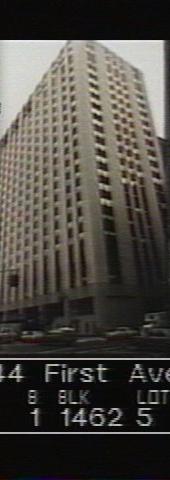
The city photographed every building for its tax records around 1940 and again in the 1980s. NYC Municipal Archives.
Written with AI from the source each entry cites, then fact-checked.
- 1884
A group including John Jacob Astor III and Charlotte Astor founds the New York Cancer Hospital on the Upper West Side
Memorial Sloan Kettering traces its start to 1884, when a group including John Jacob Astor III and Charlotte Astor founded the New York Cancer Hospital in a building on the Upper West Side. Surgeon William B. Coley, a pioneer of early immunotherapy against tumors, worked there. The hospital moved to York Avenue decades later.
Source: Wikipedia
- 1939
Memorial Hospital moves to York Avenue on land given by John D. Rockefeller Jr.
John D. Rockefeller Jr. gave land on York Avenue in 1934 and followed in 1936 with a 3 million dollar grant, and the hospital began its move across town. The new building formally opened in 1939. By then it had become a model for combining patient care with clinical and laboratory research under James Ewing.
Source: Wikipedia
- 1945
Alfred P. Sloan and Charles F. Kettering fund the Sloan-Kettering Institute next door
In 1945 General Motors chairman Alfred P. Sloan gave 4 million dollars through his foundation, and Charles F. Kettering gave GM stock worth 2 million dollars; together the gifts created a cancer research institute bearing both names. Kettering agreed to oversee a research program based on industrial methods. The institute was built adjacent to Memorial Hospital.
Source: Wikipedia
- 1948
The Sloan-Kettering Institute opens and launches a hunt for cancer-killing chemicals
Three years after Alfred Sloan and Charles Kettering announced it, the Sloan-Kettering Institute opened its doors beside Memorial Hospital in 1948. It was meant to be devoted entirely to research and to occupy the dominant place in the cancer center. Its first big program was a large-scale search for chemicals that kill cancer cells, an effort that produced some of the first approved chemotherapy drugs. Immune-system research followed later as a second focus.
Source: mskcc.org
- 1949
Time puts Cornelius Rhoads, director of the Sloan-Kettering Institute, on its cover as the 'Cancer Fighter'
The June 27, 1949 issue of Time carried a cover portrait of Cornelius P. Rhoads under the title 'Cancer Fighter'. Rhoads had been the first director of the Sloan-Kettering Institute next door since 1945. During the war he worked for the Army developing chemical weapons, and research on mustard gas led to chemotherapy advances at Sloan Kettering.
“Rhoads was featured on the cover of the June 27, 1949, issue of Time magazine under the title "Cancer Fighter".”
Source: Wikipedia
- 1950
The Sloan-Kettering Institute opens its laboratories to Cornell doctoral students
In 1950 the Sloan-Kettering Institute struck a deal with Cornell's graduate school of medical sciences. Students working toward PhDs could now do their research in the institute's laboratories under its faculty. This was the start of the institute's educational mission, which later grew into its own graduate school.
Source: mskcc.org
- 1963
Regents put researcher Chester Southam on probation over experiments run without informed consent
Between the mid-1950s and mid-1960s, researcher Chester M. Southam tested immunotherapy at the hospital on people who had not given informed consent, including prisoners. In 1963 doctors complained about him to the state Board of Regents, which ruled that he had committed fraud, deceit and unprofessional conduct. He was placed on probation for a year, and the case drew coverage in The New York Times.
Source: Wikipedia
- 1964
The Kettering Laboratory is dedicated on East 68th Street
The Sloan-Kettering Institute dedicated the Kettering Laboratory in 1964, naming it for the Kettering family. It stands on East 68th Street. The institute's first building was paid for largely by Alfred Sloan's donation, and its facilities have grown steadily since, including the Walker Laboratory in Rye, New York, which opened in 1959.
Source: mskcc.org
- 1971
Memorial Sloan Kettering is named one of only three Comprehensive Cancer Centers under the National Cancer Act
In the early 1970s, researcher Joseph Burchenal and investor and trustee Benno Schmidt were appointed to the presidential panel that started the federal war on cancer. When Congress passed the National Cancer Act of 1971, Memorial Sloan Kettering was one of only three centers in the country designated a Comprehensive Cancer Center.
Source: Wikipedia
- 1977
Jimmie Holland founds one of the first psychiatric services at a cancer center
In 1977 Jimmie Holland and two colleagues founded a psychiatric service staffed full time at Memorial Sloan Kettering, one of the first programs of its kind and part of the start of the field of psycho-oncology. She chaired the service until 1996, then became the first chair of the center's department of psychiatry and behavioral sciences. Holland went on to build the largest training and research program in the field in the country.
Source: Wikipedia
- 1980
Memorial Hospital and the Sloan-Kettering Institute merge into one institution
The two bodies had coordinated formally since 1960, and the National Cancer Act of 1971 designated it among just three Comprehensive Cancer Centers nationwide. In 1980 the two merged into a single organization named Memorial Sloan Kettering Cancer Center. Researchers there purified human G-CSF in 1985, and a 1990 agreement with Amgen brought the institute over 100 million dollars in royalties.
Source: Wikipedia
- 1985
Researchers at the center purify human G-CSF, a drug that later earned it over $100 million
In 1985 a team at Memorial Sloan Kettering, including Karl Welte, Erich Platzer, Janice Gabrilove, Roland Mertelsmann and Malcolm Moore, purified human G-CSF. The center patented the method in 1986. In 1990 it struck an agreement with Amgen for royalties on the recombinant version, the basis for Neupogen and Neulasta, which earned the institution more than $100 million.
Source: Wikipedia
- 2004
The Gerstner Sloan Kettering graduate school opens with its own PhD program
In 2004 the Sloan-Kettering Institute began offering its own doctoral degree in cancer biology, offered by the Louis V. Gerstner, Jr. Graduate School of Biomedical Sciences. The institute's educational mission dated to 1950, when it first trained Cornell doctoral students in its labs. The new program came during a period of expansion, after Harold Varmus became MSK president in 2000 and recruited Thomas Kelly as institute director in 2002.
Source: mskcc.org
- 2006
The 23-story Zuckerman Research Center opens with more than 100 laboratories
In 2006 the center opened a 23-story laboratory building, the Mortimer B. Zuckerman Research Center, housing more than 100 labs, under director Harold Varmus, who led from 2000 to 2010. The Evelyn H. Lauder Breast Center followed in 2009. Another milestone came in 2017, when the FDA approved CAR-T, an MSK-developed immunotherapy, for certain leukemias and lymphomas.
Source: Wikipedia
Further reading
Nearby
- Church of St. John Nepomucene411 East 66th Street | 2 entries
- Weill Cornell Medical College1300 York Avenue | 13 entries
- First Hungarian Reformed Church346 East 69th Street | 4 entries
- Founder's Hall, Rockefeller University1216 York Avenue | 4 entries
- Rockefeller University Hospital1198 York Avenue | 11 entries
- Julia Richman Education Complex300 East 68th Street | 7 entries