134 Grand Street
also 136 Grand Street, 29 Crosby Street, 27 Crosby Street | SoHo | built 1900
Open on the map5 entries

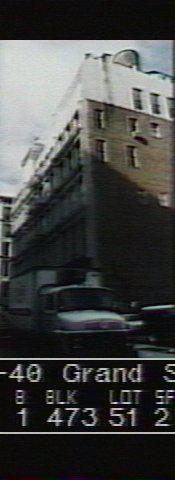
The city photographed every building for its tax records around 1940 and again in the 1980s. NYC Municipal Archives.
Written with AI from the source each entry cites, then fact-checked.
- 1869
A cast-iron Second Empire warehouse replaces the Grand Street Presbyterian Church
Clothing manufacturer Charles C. Hastings put up this six-story warehouse in 1869, to designs by William Field & Son, on the site of a church. Its rusticated ground-floor piers, Corinthian columns and mansard roof are typical of the Second Empire style as applied to cast-iron commercial buildings. The mansard was enlarged in 1874, and later tenants included boot makers, dry-goods firms and a tobacco company.
- 1877
Detectives catch a janitor who was smuggling steel pens out in his coat
Publisher Ivison, Blakeman, Taylor & Co. noticed its stock of Spencerian pens was vanishing in late 1876. A Chicago letter about a Rochester shopkeeper selling the pens below cost led detectives to the building's janitor of ten years, James J. Smith. They found 1,672 gross of pens at his Bronx home, about $4,000 worth. The New York Herald reported that his brother-in-law had been peddling them.
Source: Daytonian in Manhattan
- 1879
A wall of a burning Grand Street building falls onto the warehouse and kills a firefighter
A fire in the former Brooks Brothers building across Crosby Street brought its five-story Grand Street wall crashing down. The wall struck this building's third story, tearing off much of the front and filling floors with brick. Firefighter John Reilly had warned a comrade to move away; his body was found minutes later on the stoop of the Hinck Brothers store. Repairs left the facade looking whole.
Source: Daytonian in Manhattan
- 1918
Astor leases the building to an office-furniture maker, which buys it in 1920
By World War I John Jacob Astor owned the building. In 1918 he leased all of it to Globe-Wernicke of Cincinnati, among the country's leading office-furniture makers, and had it reconstructed for warehouse use. In July 1920 the New-York Tribune reported that he had sold the company the structure, which covered nearly 100,000 square feet.
Source: Daytonian in Manhattan
- 1977
The upper floors become artists' co-op housing, home to Dorothea Rockburne and others
The upper floors were converted to a residential cooperative in 1977. The Landmarks Preservation Commission lists residents including painter Dorothea Rockburne, Dina Recanati, musician Kristian Roebling, documentary filmmaker Catherine Gund, and photographers Arthur Elgort, David Lawrence and Greg Kadel. A 1937 plan by architect Ely Jacques Kahn to give the building new facades was never carried out.
Further reading
- William Field & Son's 1870 134-140 Grand StreetDaytonian in Manhattan
Nearby
- 138 Grand Street5 entries
- 31 Crosby Street1 entry
- 33 Crosby Street1 entry
- 35 Crosby Street2 entries
- 30 Crosby Street1 entry
- 37 Crosby Street2 entries