138 Grand Street
also 140 Grand Street, 134 Grand Street | SoHo | built 1900
Open on the map5 entries

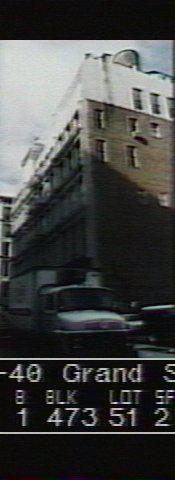
The city photographed every building for its tax records around 1940 and again in the 1980s. NYC Municipal Archives.
Written with AI from the source each entry cites, then fact-checked.
- 1870
Clothing manufacturer Charles C. Hastings builds a cast-iron Second Empire building at Grand and Crosby
Charles C. Hastings, head of the clothing firm C. C. Hastings & Co., put up this building on the northeast corner of Grand and Crosby Streets as an investment, since his own company stayed at 327 Broadway. The firm of William Field & Son designed it in the French Second Empire style, with free-standing Corinthian columns at the corners of the upper floors and a mansard roof topped by a corner cupola. The cupola still carries the date 1870.
Source: Daytonian in Manhattan
- 1877
Detectives trace missing Spencerian pens to the janitor of the school-book publisher upstairs
Ivison, Blakeman, Taylor & Co., the building's main tenant, printed schoolbooks and also wholesaled Spencerian steel pens. After noticing in late 1876 that its pen stock kept shrinking, the firm learned in 1877 that a Rochester storekeeper was selling the pens below cost. Detectives followed the firm's 28-year-old janitor, James J. Smith, who had worked there ten years. Searching his Bronx home, they turned up 1,672 gross of pens, part of a theft the company put at about $4,000.
Source: Daytonian in Manhattan
- 1879
A burning building across Crosby Street collapses onto this one and kills a firefighter
On January 14, 1879, the former Brooks Brothers building opposite, at Grand and Crosby, caught fire and its Grand Street wall fell. The falling wall hit this building at the third story, tearing away cast-iron sills and columns and sending debris into every floor. Firefighter John Reilly, who had warned a comrade the wall was giving way, was found dead on the stoop of the Hinck Brothers dry goods store on the ground floor. The damaged front was repaired.
Source: Daytonian in Manhattan
- 1920
Astor sells the building to the office-furniture maker Globe-Wernicke, which had leased it as a warehouse
By World War I the property belonged to John Jacob Astor, who in 1918 leased the whole building to the Cincinnati furniture maker Globe-Wernicke Co. for warehouse use and reconstructed it for the firm. The New-York Tribune of July 21, 1920 carried the news that Astor had sold the company the structure, which covered nearly 100,000 square feet. A sign on the corner called it the firm's Warehouse No. 2.
Source: Daytonian in Manhattan
- 1977
Lofts above the ground floor become legal apartments, and artists and photographers move in
By the 1970s artists were already living and working secretly in the building's lofts. In 1977 the upper floors were officially converted to residential use. Later residents included the artists Dina Recananti and Dorothea Rockburne, the filmmaker Catherine Gund, the musician Kristian Roebling and the photographer Arthur Elgort. By then the mansard roof had been heavily altered, though most of the facade survived.
Source: Daytonian in Manhattan
Further reading
- William Field & Son's 1870 134-140 Grand StreetDaytonian in Manhattan
Nearby
- 134 Grand Street5 entries
- 31 Crosby Street1 entry
- 33 Crosby Street1 entry
- 176 Lafayette Street2 entries
- 178 Lafayette Street1 entry
- 35 Crosby Street2 entries