1345 Avenue of the Americas
also 100 West 55th Street, 120 West 55th Street | Midtown | built 1968
Open on the map14 entries

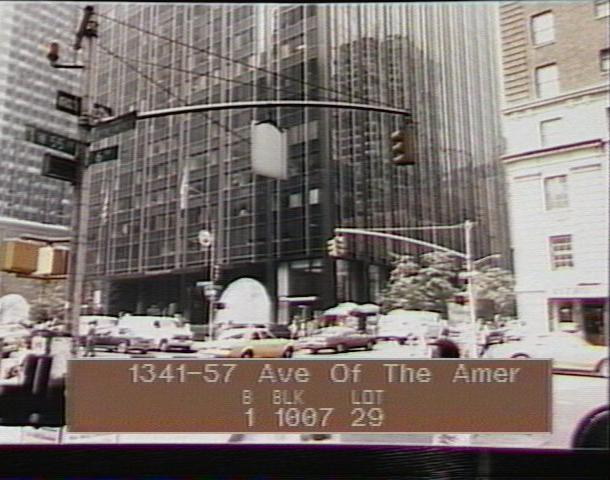
The city photographed every building for its tax records around 1940 and again in the 1980s. NYC Municipal Archives.
Written with AI from the source each entry cites, then fact-checked.
- 1925
William Randolph Hearst announces a $7 million Sixth Avenue group with a theater for Ziegfeld
On June 13, 1925 the New York Times reported that William Randolph Hearst and Arthur Brisbane had bought 14 aging buildings along Sixth Avenue that were already coming down. Hearst planned a $7 million complex of two office buildings, a residence hotel and a theater. The theater became the Ziegfeld Theatre, which stood on the site Burlington House now covers, and two days later Florenz Ziegfeld said Joseph Urban would design it with Thomas Lamb.
Source: Daytonian in Manhattan
- 1926
Will Rogers hosts the cornerstone ceremony for the Ziegfeld Theatre, the earlier building on this site
The earlier Ziegfeld Theatre's cornerstone was laid on December 9, 1926 with Will Rogers as master of ceremonies and Vincent Lopez's orchestra playing. Billie Burke and her daughter Patricia placed items in the box, among them photographs, a program from Sally and an ancient brick from a Greek theater. About 1,500 people attended, many afterward going into the Warwick Hotel for coffee.
Source: Daytonian in Manhattan
- 1927
The earlier Ziegfeld Theatre, on the block this tower now covers, opens with Rio Rita
The Ziegfeld Theatre stood at Sixth Avenue and 54th Street, on ground later covered by this tower. Florenz Ziegfeld Jr. built it, with money from William Randolph Hearst, and Joseph Urban and Thomas W. Lamb designed it with about 1,640 seats. It opened on February 2 with the musical Rio Rita.
Source: Wikipedia
- 1927
Show Boat premieres at the earlier Ziegfeld Theatre on this site and runs 572 performances
Jerome Kern's musical Show Boat opened on December 27, 1927, at the Ziegfeld Theatre, which stood where this tower is now, only months after the theater's debut. It ran for 572 performances and became the best known show staged in the house. The theater later served as a movie house, a Billy Rose property and a television studio for NBC.
Source: Wikipedia
- 1932
A dispossess warrant is posted on the Ziegfeld Theatre months after Ziegfeld's death
Florenz Ziegfeld died on July 22, 1932 as the Depression battered Broadway. In December 1932 a dispossess warrant was posted at the main entrance of his theater on this site. In February 1933 the New York Times reported that the Loew theater circuit had leased it, planning to reopen it under another name with continuous movies.
Source: Daytonian in Manhattan
- 1933
Ziegfeld stars give their old theater a send-off as it reopens as a movie house
On the afternoon of April 21, 1933 the earlier Ziegfeld Theatre on this site reopened as a second-run film house, and chorus girls, stars and stagehands staged a tribute to their late boss. Eddie Dowling served as master of ceremonies, and Abe Lyman's orchestra provided the music, with Marilyn Miller, Jimmy Durante, Fannie Brice and Will Rogers among those present. Fifty of Ziegfeld's chorus girls took part.
Source: Daytonian in Manhattan
- 1944
Billy Rose buys the Ziegfeld Theatre from Hearst and has it restored
Forced to sell real estate in 1944, William Randolph Hearst let go of the earlier Ziegfeld Theatre on this site, and the producer Billy Rose paid $630,000 for it, against the $2.5 million it had cost to build. Rose hired Joseph Urban's daughter Gretl to restore the house to its original look and returned it to live theater. Later hits included Brigadoon in 1947 and Gentlemen Prefer Blondes in 1949.
Source: Daytonian in Manhattan
- 1955
NBC turns the Ziegfeld Theatre into a television studio
In 1955 Billy Rose leased the earlier Ziegfeld Theatre on this site to NBC as a television studio, and the Perry Como Show was broadcast from it. The Emmy Awards ceremonies of 1959 and 1961 were also held here. The musical Anya, which opened on November 29, 1965 and ran only 16 performances, was the last stage production before the building was torn down.
Source: Daytonian in Manhattan
- 1966
The earlier Ziegfeld Theatre on this site is demolished to make way for Burlington House
The Ziegfeld had reopened as a legitimate theater in 1963 after years as a film house and a TV studio, where NBC aired The Perry Como Show. Its last production, Anya, opened in late November 1965 and ran only 16 performances. The theater came down in 1966 for a Fisher Brothers office skyscraper.
Source: Wikipedia
- 1968
Dandelion-seed fountains by Robert Woodward decorate the Burlington House plaza
The small plaza of Burlington House had fountains at its street corners, shaped like dandelion seedheads, which the Australian architect Robert Woodward designed in 1968. They echoed his 1961 El Alamein Fountain in Sydney. They were removed when the plaza was upgraded in 2019.
“Its small plaza had two fountains on each street corner shaped like dandelion seedheads, designed by Australian architect Robert Woodward in 1968.”
Source: Wikipedia
- 1969
Fisher Brothers' Burlington House, designed by Emery Roth & Sons, rises as a 50-story dark glass slab
The tower was built by Fisher Brothers to designs by Emery Roth & Sons, and was first named for Burlington Industries. It is a 625-foot slab in the International Style faced in dark glass. Its small plaza originally had two dandelion-seedhead fountains by the Australian architect Robert Woodward, which were removed during a 2019 plaza upgrade.
Source: Wikipedia
- 1973
The world's first public handheld cellular phone call is made using a base station on the roof
Martin Cooper of Motorola used a base station atop the building to place the first handheld cellular phone call in public. He rang Joel S. Engel of rival Bell Labs to announce that Motorola had built a portable cell phone. Engel was staying across the street at the Hilton.
Source: Wikipedia
- 1980
The Mill, a free moving-walkway attraction about textile making, closes at the building's southeast corner
The southeast corner of Burlington House held The Mill, a free attraction where visitors rode a moving walkway for eight minutes past knitting machines and looms. It stayed open until 1980. A business now occupies the space.
Source: Wikipedia
- 2007
The tower appears in the films Spider-Man 3 and Michael Clayton
In the 2007 film Spider-Man 3, this tower is the building Gwen Stacy falls from during the crane scene. The same year it served as the foyer of the fictional law firm in Michael Clayton. It is also the establishing shot for the corporate headquarters of Dunder Mifflin, the fictional company in the television show The Office.
“1345 Avenue of the Americas is the building Gwen Stacy falls from in the crane scene.”
Source: Wikipedia
Further reading
- 1345 Avenue of the AmericasWikipedia
Nearby
- Ziegfeld Theatre141 West 54th Street | 6 entries
- Avenue of the Americas Plaza125 West 55th Street | 7 entries
- New York Hilton Midtown1335 Avenue of the Americas | 11 entries
- Warwick Hotel1348 Avenue of the Americas | 10 entries
- New York City Center131 West 55th Street | 13 entries
- CitySpire150 West 56th Street | 13 entries