German Dispensary (Ottendorfer Clinic)
137 2nd Avenue | East Village | built 1900
Open on the map4 entries

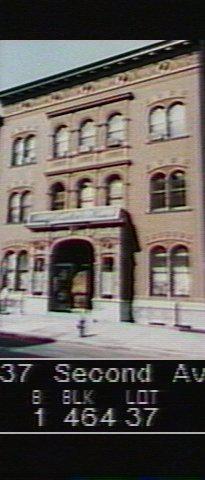
The city photographed every building for its tax records around 1940 and again in the 1980s. NYC Municipal Archives.
Written with AI from the source each entry cites, then fact-checked.
- 1866
German aid societies form a hospital and dispensary for Little Germany
German immigrant aid organizations in Little Germany first attempt to open a facility for indigent countrymen in 1854, formally incorporating the effort in 1861 with support from financier August Belmont. By 1866 the organization becomes the German Hospital and Dispensary of the City of New York, the institution that later builds a dedicated dispensary on Second Avenue and eventually grows into Lenox Hill Hospital.
Source: Daytonian in Manhattan
- 1884
Anna and Oswald Ottendorfer's German Dispensary opens on 2nd Avenue
Publisher Oswald Ottendorfer and his wife Anna fund a dispensary for the largely German Lower East Side, hiring architect William Schickel to design an Italian Renaissance-style building of red brick and terra cotta. The dispensary, built alongside the Ottendorfers' free public library next door, opens on May 24, 1884, though Anna Ottendorfer dies before the ceremony. Its facade carries busts of physicians and naturalists including Hippocrates, Galen, and Alexander von Humboldt.
Source: Daytonian in Manhattan
- 1905
The dispensary relocates and the building becomes the Deutsche Poliklinik
In 1905 the original dispensary moves nearer its affiliated hospital, and the building at 137 Second Avenue is sold to the Deutsche Poliklinik, which repairs the aging structure the following year. The clinic keeps serving Lower East Side patients into the 20th century, logging between 2,800 and 35,000 visits a year during the 1970s and 1980s before affiliating with Cabrini Medical Center.
Source: Daytonian in Manhattan
- 2008
The former dispensary is restored and converted into offices
After the Cabrini Stuyvesant Polyclinic moves out in 2006, the 1884 dispensary building is listed for sale at 13 million dollars and later bought for office use. As part of the 2008 conversion, architects David Mayerfield Associates restore the building's original skylights, stained glass panels, and encaustic tile floors.
Source: Daytonian in Manhattan
Further reading
- The 1884 German Dispensary (Ottendorfer Clinic) - No. 137 2nd AvenueDaytonian in Manhattan
- The terra cotta beauty of the German DispensaryEphemeral New York
Nearby
- Ottendorfer Library135 2nd Avenue | 10 entries
- Gem Spa131 2nd Avenue | 11 entries
- Winthrop Mansion138 2nd Avenue | 4 entries
- 129 2nd Avenue1 entry
- Isaac Carow House (the Dom)25 St Marks Place | 6 entries
- Ukrainian National Home140 2nd Avenue | 4 entries