Isaac Carow House (the Dom)
25 St Marks Place | East Village | built 1920
Open on the map6 entries

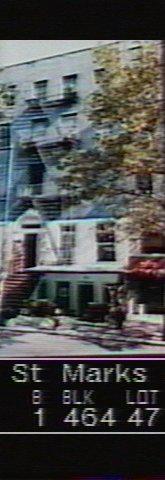
The city photographed every building for its tax records around 1940 and again in the 1980s. NYC Municipal Archives.
Written with AI from the source each entry cites, then fact-checked.
- 1832
Developer Thomas E. Davis builds No. 25 as a Federal-style rowhouse on the new St. Marks Place
Tax records show the house was built in 1832-33 by Thomas E. Davis, who bought land on both sides of Eighth Street in 1831 and named the block for nearby St. Mark's Church to draw wealthy buyers. It has a plain facade and an arched Gibbs doorway surround. The house was enlarged in 1882 and 1888 under owner Nicholas Schultz and used as a multiple dwelling.
- 1832
Shipping merchant Isaac Carow raises his family here; his daughter marries his partner
Isaac Quentin Carow, a shipping merchant of Huguenot descent, lived here with his family and was known for his library. In 1832 his eldest daughter Eliza married his business partner Robert Kermit, and in 1835 Kermit & Carow bought the Red Star Line of Liverpool packet ships. The family names are best remembered through Edith Kermit Carow, who married Theodore Roosevelt in 1886.
Source: Daytonian in Manhattan
- 1925
Six armed men rob a crowded restaurant in the basement, and return in January
Around 4:30 a.m. on October 4, 1925, six armed men lined up customers at Max Pfeffer's restaurant, a late-night spot for hotel and theater waiters, and took $9,000 in cash and jewelry. One patron saved his diamond ring by dropping it into hot coffee. Three months later, on January 14, 1926, six gunmen again held up some 200 patrons.
Source: Daytonian in Manhattan
- 1949
Twenty Polish sailors who jumped ship ask the Polish National Home for asylum
The Polish National Home was based here, and on March 17, 1949, twenty seamen from the liners Sobieski and Batory came seeking asylum, saying their anti-Communist views would get them persecuted at home. Federal immigration authorities said they would face expulsion hearings. Similar cases continued: in 1958 a sailor who sought help from a committee here was seized and sent back to his ship.
Source: Daytonian in Manhattan
- 1966
The Velvet Underground begins a residency at the Dom as part of Warhol's Exploding Plastic Inevitable
Beginning April 1, 1966, the Velvet Underground and Nico played a residency at the Dom, the former Polish National Home, in a space spanning 19-25 St. Marks Place that includes No. 25. The multimedia shows were billed as Andy Warhol's Exploding Plastic Inevitable. Warhol had discovered the band playing at the Cafe Bizarre on West 3rd Street.
Source: Village Preservation
- 1967
The Electric Circus nightclub opens in the former Dom
The space was briefly the Balloon Farm in 1966, then passed to new operators in 1967. The Electric Circus was created by Jerry Brandt and Stanton Freeman with their partners and designed by Chermayeff & Geismar. Acts included the Velvet Underground, the Grateful Dead, Ike and Tina Turner, Terry Riley and Morton Subotnick.
“The club was created by Jerry Brandt, Stanton J. Freeman and their partners and designed by Chermayeff & Geismar.”
Source: Wikipedia
Further reading
- The Isaac Carow House - No. 25 St. Marks PlaceDaytonian in Manhattan
Nearby
- Electric Circus19 St Marks Place | 10 entries
- Daniel LeRoy House20 St Marks Place | 3 entries
- Charles L. Carpenter House210 East 9th Street | 2 entries
- Ottendorfer Library135 2nd Avenue | 10 entries
- German Dispensary (Ottendorfer Clinic)137 2nd Avenue | 4 entries
- Barney Building26 Stuyvesant Street | 3 entries