James Earl Jones Theatre
138 West 48th Street | Times Square | built 1913
Open on the map11 entries

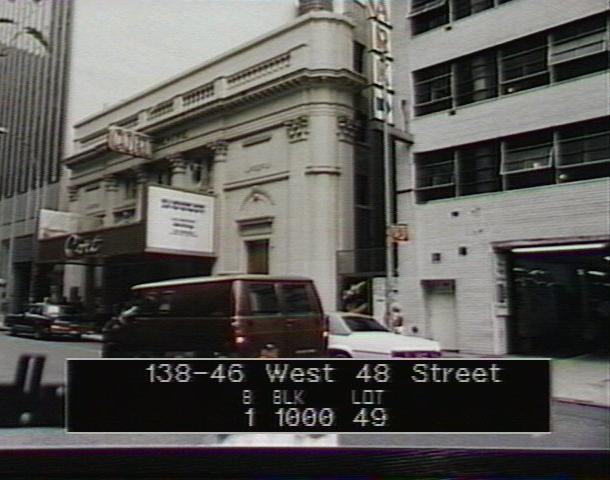
The city photographed every building for its tax records around 1940 and again in the 1980s. NYC Municipal Archives.
Written with AI from the source each entry cites, then fact-checked.
- 1910
John Cort leads theater owners against the Klaw and Erlanger syndicate before building his own house
In 1910 John Cort became president of the National Theater Owners' Association, a group of some 1,200 theaters that opposed the control of the Klaw and Erlanger syndicate. He did not open a New York house of his own until 1912, when the Cort Theatre on West 48th Street became the first of three he planned for the East. A Cort Theatre in Boston followed two years later.
- 1912
Thomas Lamb gives the Cort a three-story marble colonnade modeled on the Petit Trianon
The Cort's facade is modeled on the Petit Trianon at Versailles, with a marble-faced Corinthian colonnade rising three stories, a feature the Landmarks Preservation Commission called very unusual among Broadway theaters. The commission also noted that Thomas Lamb, the city's most prolific theater architect, has only two legitimate stage theaters of his design still standing in the Broadway area, and the Cort is one of them.
- 1912
The Cort Theatre opens with Peg o' My Heart
Theatrical producer John Cort commissioned architect Thomas W. Lamb to design a neoclassical playhouse on West 48th Street. It opened with Peg o' My Heart starring Laurette Taylor on December 20, 1912, and the house quickly earned a reputation as a lucky venue despite sitting on what was then considered the wrong side of Broadway.
Source: Wikipedia
- 1925
Three producers sue each other over the same booking, and a judge cancels one show after four performances
In October 1925 three producers sued one another, each saying John Cort had promised them the theater for the same stretch of time. Judge Thomas D. Thacher of the federal court issued two injunctions, one favoring Jane, Our Stranger and the other ending that production after four performances. The Jazz Singer, which transferred to the Cort in late 1925, was among the hits of the mid-1920s.
Source: Wikipedia
- 1927
The Shubert Organization buys the Cort Theatre
The Shubert Organization bought the Cort Theatre in May 1927, and John Cort, who had run it since it opened, stepped away from operating it. Under Shubert ownership the house hosted productions including Uncle Vanya in 1930 and Room Service in 1937.
Source: Wikipedia
- 1928
Katharine Hepburn's first Broadway appearance comes in These Days, which lasts eight performances
The 1928 drama These Days played the Cort for only eight performances. It was Katharine Hepburn's first Broadway appearance. The theater went on to host Alice Brady in A Most Immoral Lady later that year and Walter Connolly in Your Uncle Dudley in 1929, under the Shubert Organization, which had bought the house in May 1927.
“The 1928 drama These Days, which had eight performances at the Cort, was Katharine Hepburn's first Broadway appearance.”
Source: Wikipedia
- 1949
Grace Kelly makes her Broadway debut in The Father
The 1949 production of The Father at the Cort marked Grace Kelly's Broadway debut. It came after the 1948 hits The Respectful Prostitute and Two Blind Mice. Long-running productions continued through the 1950s, including The Rainmaker in 1954 and The Diary of Anne Frank, which began in 1955 and ran at the Cort for over a year before it moved to another theater.
“The 1949 production of The Father featured Grace Kelly's Broadway debut.”
Source: Wikipedia
- 1958
James Earl Jones makes his Broadway debut at the Cort
James Earl Jones made his Broadway debut at the Cort Theatre in the 1958 production Sunrise at Campobello, decades before the theater would be renamed in his honor.
Source: Wikipedia
- 1969
CBS leases the theater as a television studio
CBS leased the Cort starting in 1969 and spent about $1 million converting it into a studio for The Merv Griffin Show. Griffin moved the show to California by late 1970, and CBS held the lease until 1972. It was the only time the Cort served as a television studio instead of a theater.
Source: Wikipedia
- 1987
The city designates the Cort Theater a landmark after hearings that drew eighty supporters and one opponent
The Landmarks Preservation Commission designated the Cort Theater a landmark on November 17, 1987, after hearings held in June and October 1982. Eighty witnesses spoke or had statements read in favor and one spoke against, while the owner attended and said he had not formed an opinion. The commission described the Cort as one of the oldest surviving theaters in New York, built in 1912-13 to house the productions of John Cort.
“November 17, 1987; Designation List 196 ... Eighty witnesses spoke or had statements read into the record in favor of designation. One witness spoke in opposition to designation.”
- 2022
The theater is renamed for James Earl Jones
In March 2022 the Shubert Organization announced that the Cort would be renamed for actor James Earl Jones, making it the second Broadway theater named for a Black theatrical figure. The theater had closed in 2020 and was renovated and expanded with a western annex at a cost of $47 million. It reopened that fall with the play Ohio State Murders.
Source: Wikipedia
Further reading
- James Earl Jones TheatreWikipedia
Nearby
- News Corp. Building1211 Avenue of the Americas | 8 entries
- 1221 Avenue of the Americas8 entries
- Church of St. Mary the Virgin145 West 46th Street | 9 entries
- TSX Broadway and the Palace Theatre1568 Broadway | 9 entries
- 1251 Avenue of the Americas (Exxon Building)1251 Avenue of the Americas | 7 entries
- I. Miller Building1552 Broadway | 3 entries