Church of St. Mary the Virgin
145 West 46th Street | also 144 West 47th Street, 133 West 46th Street, 143 West 46th Street | Times Square | built 1895
Open on the map9 entries

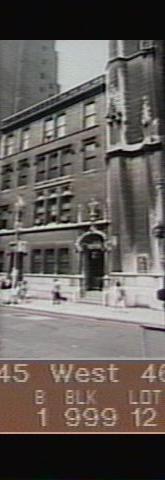
The city photographed every building for its tax records around 1940 and again in the 1980s. NYC Municipal Archives.
Written with AI from the source each entry cites, then fact-checked.
- 1892
Haley Fiske, a Metropolitan Life executive, becomes the parish treasurer in 1892
Haley Fiske was elected to the parish's board of trustees on March 23, 1892, and was then named its treasurer. He was a vice president of the Metropolitan Life Insurance Company and became its president in 1919. Several Met Life buildings were built from plans by Napoleon LeBrun & Sons, the firm that later designed St. Mary's, and the Landmarks Commission says there can be little doubt Fiske was involved. After Sara Cooke died in 1892 leaving the parish nearly $500,000, the report says he took the initiative immediately.
- 1894
The parish buys up lots lined with narrow rowhouses and stables on West 46th and 47th Streets
From January 1894 the parish accumulated lots for its new church on both West 46th and West 47th Streets, taking title to the last of five lots on West 47th that August. The Landmarks Preservation Commission notes that both streets were lined with the narrow rowhouses of working-class residents and with stables, which stood on the land before the church complex. The parish also sold its old property on West 45th Street.
“…title was taken to the last of the five lots ... narrow rowhouses of working class people and stables…”
- 1894
Trustees scrap an architectural competition and hand the church to Napoleon LeBrun & Sons
The trustees first announced a competition for the new church, with a program calling for a 13th-century French Gothic design seating 800, an apsidal chancel at least fifty feet deep, no towers or spires, and at least two chapels and a baptistry. After an unfavorable reception they withdrew the contest and gave the job to the LeBrun firm. Pierre LeBrun's plans were accepted on October 11, 1894.
- 1894
Haley Fiske offers to build the Lady Chapel and reuse windows from the old church
In a letter to his fellow trustees dated December 15, 1894, treasurer Haley Fiske offered to build the Lady Chapel and said he wanted to reuse the west windows of the old West 45th Street church in the new chapel. The chapel entrance carries a tympanum of the Annunciation by the sculptor John Massey Rhind, and the carved heads that support its drip molding are portraits of Fiske's son and daughter.
- 1895
Sculptor John Massey Rhind offers the trustees a Virgin and Child for the main doorway
John Massey Rhind, born in Edinburgh into a family of architectural sculptors, came to the United States in 1889. In a letter dated April 15, 1895, he offered the church's trustees a carved statue of the Virgin and Child for the central post of the main entrance, and two months later he was invited to sketch the tympanum above it. He also carved the statues of Saints George and Michael that flank the doorway.
- 1895
A parishioner's bequest builds a grander church for the congregation
The Episcopal parish of St. Mary the Virgin, founded in 1868 on West 45th Street, had outgrown its first church by 1890. A legacy from parishioner Sara L. Cooke, which eventually reached $700,000, funded a larger French Gothic church on West 46th Street, designed by Napoleon LeBrun & Sons with Pierre LeBrun as lead designer. The church was dedicated in 1895, after its cornerstone was laid on December 8, 1894.
Source: Wikipedia
- 1895
The church is built on a concealed steel skeleton, reportedly a first
The LeBrun firm had experience with steel framing, which it hid within the walls of St. Mary the Virgin, making it, reportedly, the world's first church built on a concealed steel skeleton. The finished church was 60 feet wide and 180 feet long, with a nave rising 80 feet from floor to ceiling.
Source: Wikipedia
- 1989
The church earns New York City landmark status
New York City designated St. Mary the Virgin a landmark in 1989, and the building was added to the National Register of Historic Places the following year. Known colloquially as Smoky Mary's for its heavy use of incense, the Anglo-Catholic parish continues to celebrate Solemn High Mass with a professional choir performing liturgical music ranging from medieval chant to contemporary works.
Source: Wikipedia
- 1996
The interior is restored in vivid color, with cobalt blue vaulting under gold stars
The church's interior was restored in 1996-97 by J. Lawrence Jones & Associates, bringing out bright color such as cobalt-blue vaulting dotted with gold stars. The parish is known for solemn liturgies and choral and organ music, and its heavy use of incense has earned it the nickname Smoky Mary's.
Source: Wikipedia
Further reading
Nearby
- James Earl Jones Theatre138 West 48th Street | 11 entries
- Public School 67 (High School of the Performing Arts)120 West 46th Street | 13 entries
- News Corp. Building1211 Avenue of the Americas | 8 entries
- TSX Broadway and the Palace Theatre1568 Broadway | 9 entries
- Lyceum Theatre149 West 45th Street | 13 entries
- I. Miller Building1552 Broadway | 3 entries