Anthony Arnoux House
139 Greene Street | SoHo | built 1825
Open on the map4 entries

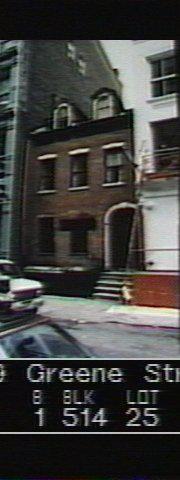
The city photographed every building for its tax records around 1940 and again in the 1980s. NYC Municipal Archives.
Written with AI from the source each entry cites, then fact-checked.
- 1825
Tailor Anthony Arnoux completes a Federal brick house on Greene Street, then moves in nearly a decade later
Anthony Arnoux, a tailor and apparel merchant, had the two-story house finished in 1825 after starting it a year earlier. He apparently leased it out for nearly a decade and moved in with his family in 1834. By 1850 the household was Arnoux, his five adult children and one servant. The family left in 1860 as the district filled with commerce and brothels.
Source: Daytonian in Manhattan
- 1867
Police raid the house as a brothel on the department's blacklist and arrest the owners
By 1867 the house, owned by Patrick and Amelia Whalen, was on the police 'black list' as a disorderly house. On the night of September 11, an officer of the 8th Precinct raided it, arresting the Whalens and seven women. The Whalens faced $500 bail each, while the women were fined $5. The Times observed that the women left court little the worse for it.
Source: Daytonian in Manhattan
- 1870
A guide to the red-light district lists 139 Greene as a third-class house with seven women
The 1870 Gentleman's Companion, a guidebook to the city's red-light district, described Greene Street as a 'complete sink of iniquity' with 41 brothels between Canal and Bleecker. It listed No. 139, run by Patrick and Amelia Whalen, as a third-class disorderly house with seven women. Ephemeral New York adds that millinery firms and light industry took the house over after the brothel years.
Source: Ephemeral New York
- 1973
Art dealer Richard Feigen sells the battered house to Peter Ballantine, who begins a decades-long restoration
The art dealer Richard L. Feigen bought No. 139 in the late 1960s, and in 1973 sold it to Peter W. Ballantine, who meant to restore it as his home. Decades of industrial use had bricked up the doorway and gutted the interior, and the Landmarks Conservancy put it on its endangered list that year. Ballantine started on the ground-floor windows in 1974, and progress remained slow for decades.
Source: Daytonian in Manhattan
Further reading
- The 1825 Anthony Arnoux House -- No. 139 Greene StreetDaytonian in Manhattan
- This might be the spookiest house in SohoEphemeral New York
Nearby
- 141 Greene Street2 entries
- Pomegranate Gallery137 Greene Street | 1 entry
- 143 Greene Street1 entry
- 133 Greene Street1 entry
- 160 Wooster Street1 entry
- 129 Greene Street1 entry