Samuel Winant House
14 Grove Street | West Village | built 1840
Open on the map5 entries

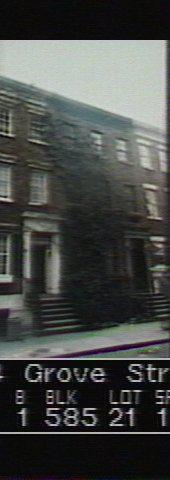
The city photographed every building for its tax records around 1940 and again in the 1980s. NYC Municipal Archives.
Written with AI from the source each entry cites, then fact-checked.
- 1840
Carpenters Samuel Winant and John Degraw build four houses and Winant takes No. 14
Winant and Degraw were carpenters from Long Island families who served together in Hook & Ladder Company No. 3 and merged their businesses in 1828. In 1839 they bought plots on the east end of the block and began four identical Greek Revival houses at 12-18 Grove Street. The partners kept the middle two, and Winant moved into No. 14.
Source: Daytonian in Manhattan
- 1857
Harper & Brothers cashier William Demarest lives at 14 Grove Street
By 1857 the family of William H. Demarest lived here. He had joined the publisher Harper & Brothers around 1832 and became chief cashier, keeping sales records and reporting figures to authors such as Herman Melville. In 1872, with his health failing, the Harpers gave him six months of paid leave abroad and a $5,000 check.
Source: Daytonian in Manhattan
- 1898
Four laundry workers strike in the basement of 14 Grove Street and lose their jobs
A small commercial laundry with four workers, probably leased by the landlady, occupied the basement of this boarding house. On December 15, 1898, the men walked out to protest the hiring of a nonunion worker. They had joined the union only days earlier, and their employer refused to make the new man join. The strike failed, and the strikers lost their positions.
Source: Daytonian in Manhattan
- 1931
Playwright Howard McLellan writes The Unknown Man at 14 Grove Street
In the 1930s, when the house took roomers, the playwright Howard McLellan lived at No. 14. He completed a three-act play, The Unknown Man, here in 1931.
Source: Daytonian in Manhattan
- 1966
Until 1966, 14 Grove Street was possibly the city's last untouched Greek Revival house
The Landmarks Preservation Commission's 1969 report said that until 1966 No. 14 had survived without any alterations, making it possibly the last such Greek Revival house in the city. The house still has its stoop, a paneled door with a rectangular transom flanked by pilasters, and original wrought-iron railings.
“Until 1966, No. 14 was perhaps the last completely unaltered Greek Revival building in the City.”
Further reading
- The 1840 Samuel Winant House - 14 Grove StreetDaytonian in Manhattan
- Then & Now photos: 14 Grove StreetVillage Preservation: Greenwich Village Then & Now
Nearby
- John Degraw House16 Grove Street | 5 entries
- 12 Grove Street2 entries
- 18 Grove Street5 entries
- 95 Bedford Street2 entries
- 93 Bedford Street1 entry
- 91 Bedford Street1 entry