Henry Heide Co. Building
14 Harrison Street | Tribeca | built 1882
Open on the map6 entries

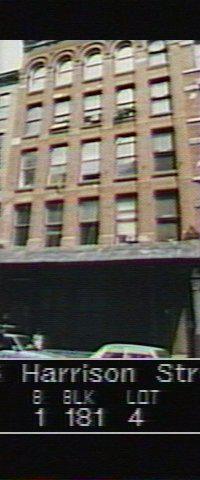
The city photographed every building for its tax records around 1940 and again in the 1980s. NYC Municipal Archives.
Written with AI from the source each entry cites, then fact-checked.
- 1882
George Da Cunha designs a candy factory for Henry Heide on the site of two small dwellings
Henry Heide, who started his candy business in 1868, had outgrown several earlier quarters, including one across the street at 15 Harrison Street. For this site he commissioned George W. Da Cunha, who designed a five-story factory in 1882 with a cast-iron base and a round-arched arcade above. The Landmarks Preservation Commission notes it replaced two smaller dwellings.
- 1886
Heide grows into neighboring buildings until the factory covers about 50,000 square feet
In spring 1886 Henry Heide leased No. 18 Harrison Street and hired Thomas R. Jackson to connect it to No. 14-16 inside. Two years later Illustrated New York described a six-story building going up behind to reach Franklin Street. In 1891 he added Nos. 181-183 Franklin Street, and the four joined buildings totaled about 50,000 square feet.
Source: Daytonian in Manhattan
- 1891
Detectives meet a ship at the dock as Heide's bookkeeper returns from Europe after taking $1,000
Otto Kuhn, a 27-year-old German bookkeeper, asked Henry Heide in February 1891 for a few months to make a quick trip to Europe. Heide then found about $1,000 missing from the books. Detectives learned Kuhn was aboard the steamship Britannic and met it in New York on April 10, where he admitted spending the money gambling and on high living.
Source: Daytonian in Manhattan
- 1894
A fired candy packer hides in the factory cellar and kills the night watchman
Charles Miller, a German-born candy packer fired after the night watchman complained about him, sneaked into the factory on April 18, 1894 and hid in the cellar. After the staff left, he attacked the watchman with a hammer and took $17 from the cash drawer. Police arrested Miller after he was seen near the factory. He cut his throat in the Tombs that August and died at Bellevue Hospital.
Source: Daytonian in Manhattan
- 1908
The building is leased for cold storage as the block becomes the butter and egg district
By 1908 Heide's firm had long since moved to a new factory, and the former factory was rented to others. On December 30, 1908 a trade paper reported that the Harrison Street Cold Storage Company had taken a twelve-year lease and would refit the building with cork insulation. Heide sold the property in 1916, and later tenants included the Merchants Refrigerating Co. and, from 1945, the cheese merchants J. S. Hoffman Company.
Source: Daytonian in Manhattan
- 1977
Playwright Edward Albee buys the top-floor duplex and fills it with modern art
In 1977 Edward Albee bought the duplex at the top of the former candy factory, which artists had converted into live-work space. He filled it with works by artists such as Chagall and Kandinsky and an African art collection. Scripts were read and rehearsed in the open space, and his annual Christmas party drew stage and screen stars.
Source: Daytonian in Manhattan
Further reading
- The Henry Heide Co. Bldg - 14-16 Harrison StreetDaytonian in Manhattan
Nearby
- 18 Harrison Street3 entries
- 12 Harrison Street1 entry
- 20 Harrison Street3 entries
- 10 Harrison Street2 entries
- 22 Harrison Street2 entries
- 179 Franklin Street3 entries