World Apparel Center (site of the Old Metropolitan Opera House)
1411 Broadway | also 555 7th Avenue, 136 West 40th Street | Garment District | built 1969
Open on the map17 entries

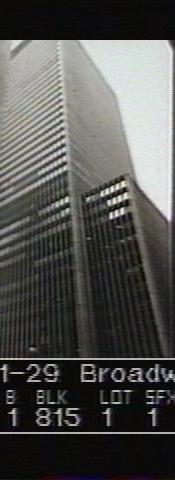
The city photographed every building for its tax records around 1940 and again in the 1980s. NYC Municipal Archives.
Written with AI from the source each entry cites, then fact-checked.
- 1882
Met backers vote 8 to 3 to keep building the Old Met as costs climb
When the founders of the Metropolitan Opera House Company first spoke publicly, they said the building would cost no more than $600,000 and make no outward display. By March 15, 1882 the estimate for the opera house on Broadway at 39th Street had grown to about $1,525,000, and the Tribune reported that the directors were unsure whether to continue. The stockholders voted eight to three to go ahead, and ground was broken within a few months. The old opera house was later demolished and its site is now 1411 Broadway.
Source: Daytonian in Manhattan
- 1883
The Metropolitan Opera House opens at Broadway and 39th Street with Faust
The new opera house, on the lot where 1411 Broadway stands today, opened on October 22, 1883, built by wealthy New Yorkers shut out of the Academy of Music's boxes. Christine Nilsson sang Marguerite in Faust, and after her encore of the Jewel Song she was handed a casket holding a gold wreath. The Academy opened its own season the same night, and the two houses competed for two years.
Source: Daytonian in Manhattan
- 1883
The Old Met's Golden Horseshoe boxes go to seventy stockholders at $15,000 each
The two tiers of boxes in the Old Metropolitan Opera House, called the Golden Horseshoe, were occupied by the seventy original stockholders, each of whom paid $15,000 for a box. Every box had a small salon behind it that its owner could furnish to his own taste and at his own expense. Covered carriage entrances on the 39th and 40th Street sides were kept for the box holders, so that they did not have to mix with the public using the Broadway doors. The building stood where 1411 Broadway is today.
Source: Daytonian in Manhattan
- 1892
Fire guts the 'fireproof' Metropolitan Opera House
In August 1892 a fire gutted the opera house that once stood on this site, which had been widely promoted as fireproof. Rebuilding the interior took more than a year, and the house reopened in November 1893. Before the opening in 1883, press coverage had noted that little in the auditorium except the floor could burn.
Source: Daytonian in Manhattan
- 1903
Carrere and Hastings redesign the interior, creating the golden auditorium
The architects Carrere and Hastings extensively redesigned the interior of the old opera house on this lot in 1903. They gave it the golden auditorium with a sunburst chandelier and a curved proscenium inscribed with six composers' names: Gluck, Mozart, Beethoven, Wagner, Gounod and Verdi. The first gold damask stage curtain went up in 1906, finishing the look it kept until it closed.
“In 1903, architects Carrère and Hastings extensively redesigned the interior of the opera house.”
Source: Wikipedia
- 1903
Enrico Caruso makes his Metropolitan Opera debut in Rigoletto at the Old Met
On November 23, 1903, the Neapolitan tenor Enrico Caruso first sang with the Metropolitan Opera, in a new production of Rigoletto at the old opera house on Broadway at 39th Street. Marcella Sembrich sang opposite him as Gilda. Caruso went on to be the company's leading tenor for 18 consecutive seasons. He appeared at the Met more often than at any other house.
“On 23 November 1903, Caruso made his debut with the Metropolitan Opera in New York City... a new production of Rigoletto with Marcella Sembrich singing opposite him as Gilda.”
Source: Wikipedia
- 1903
The Met stages Parsifal in defiance of Bayreuth's monopoly
Bayreuth had controlled stage performances of Wagner's Parsifal since the opera's premiere in 1882. After a US court ruled that Bayreuth could not prevent performances in the United States, the Metropolitan Opera staged the complete opera at its Broadway house on December 24, 1903, with many Bayreuth-trained singers in the cast. Wagner's widow Cosima answered by barring everyone who took part in the New York production from future work at Bayreuth. The old opera house was demolished in 1967.
“Cosima barred anyone involved in the New York production from working at Bayreuth in future performances.”
Source: Wikipedia
- 1908
Arturo Toscanini becomes the Met's conductor and raises its musical standards
Arturo Toscanini took over as conductor at the Metropolitan Opera in 1908 and stayed until 1915, when major disagreements with the management led him to leave. A history of the old house on Daytonian in Manhattan credits him with bringing the company's musical standards to their highest level. He led the orchestra in the opera house that stood on Broadway between 39th and 40th Streets, on the site of today's 1411 Broadway.
Source: Daytonian in Manhattan
- 1910
Lee de Forest tests broadcasting live opera from the Old Met, with Caruso the next day
In January 1910 the inventor Lee de Forest ran trials with the Metropolitan Opera House to find out whether live opera from the stage could be sent out by radio. Tosca was the test performance on January 12, and the following day's trial included the tenor Enrico Caruso. The experiments showed that the idea was not yet technically workable, and de Forest made no more entertainment broadcasts until late 1916, when better vacuum-tube equipment became available.
“Tosca was performed on January 12, 1910, and the next day's test included Italian tenor Enrico Caruso.”
Source: Wikipedia
- 1910
Puccini's La fanciulla del West has its world premiere at the Old Met
The Metropolitan Opera first staged Puccini's La fanciulla del West on December 10, 1910, in its world premiere. Enrico Caruso sang the role of Dick Johnson, which the composer had written with his voice in mind, alongside Emmy Destinn and Pasquale Amato, and Arturo Toscanini conducted. Puccini himself and David Belasco, author of the play the opera was based on, were both in New York to supervise the production at the old house on Broadway.
“The composer wrote the music for Johnson with Caruso's voice specifically in mind.”
Source: Wikipedia
- 1920
Enrico Caruso gives his last performance at the Metropolitan Opera House
Enrico Caruso suffered a throat hemorrhage on December 11, 1920, while singing in Brooklyn, but insisted on finishing the act. Only three more Met performances followed, the last on Christmas Eve 1920 at the opera house that stood here. He died on August 2, 1921, aged 48.
Source: Daytonian in Manhattan
- 1938
Supporters give $1 million to keep the Old Met from being lost
By the 1930s the opera house stood in a Garment District neighborhood far less refined than the one it was built for, and ideas for replacing it kept coming up. In 1938 sentimental supporters gave $1 million toward staving off a threat to the building. A New York guidebook of 1939 noted that efforts to give the company a new home were made perennially, and called Rockefeller Center a by-product of that effort.
Source: Daytonian in Manhattan
- 1955
Marian Anderson becomes the first Black American to sing at the Metropolitan Opera
On January 7, 1955, Marian Anderson sang the witch Ulrica in Verdi's Un ballo in maschera on the stage of the old house at Broadway and 39th Street, at the invitation of the Met's director, Rudolf Bing. She was the first Black American singer on the Met stage. She later recalled that the audience applauded before she had sung a note.
Source: Wikipedia
- 1965
The Landmarks Commission votes 6 to 5 against designating the Old Met
The newly formed Landmarks Preservation Commission put the old opera house, then standing on this site, on its first list of proposed landmarks in September 1965. The opera company opposed protection, planning to raze the house and lease the land once it moved to Lincoln Center. The commissioners voted 6 to 5 not to designate, a close result given the building's plain exterior.
Source: nypap.org
- 1966
Stokowski begs the audience to save the Old Met on its closing night
The Metropolitan Opera gave its last performance in the old house on April 16, 1966. Ten days earlier, Marian Anderson, Tony Randall, Gian Carlo Menotti and Leonard Bernstein had launched a drive to raise $8 million to purchase the hall. On closing night the conductor Leopold Stokowski pleaded from the podium for the audience to save it.
Source: nypap.org
- 1966
Anderson, Bernstein and Menotti try to raise $8 million to buy the Old Met
With the opera company leaving for Lincoln Center, its management had leased the site to the developer Keystone Associates for fifty years. A drive led by Marian Anderson, Leonard Bernstein, Gian Carlo Menotti and other musicians began in 1966 to raise $8 million to buy the property and as much as $14 million to renovate it. The opera management said no, noting that it stood to collect nearly twice $8 million in rent for the land.
Source: Daytonian in Manhattan
- 1967
The Old Met is demolished, the first potential landmark lost after the 1965 Landmarks Law
The opera house on this site was torn down in January 1967, the first potential landmark lost since the city's Landmarks Law took effect in 1965. The World Apparel Center was built there in 1970. The loss was cited when the law was amended in 1973 to allow designation of public interiors.
Source: nypap.org
Further reading
Nearby
- Lewisohn Building119 West 40th Street | 2 entries
- Nederlander Theatre208 West 41st Street | 15 entries
- Times Square Tower1459 Broadway | 12 entries
- Springs Mills Building109 West 39th Street | 4 entries
- The Knickerbocker Hotel1466 Broadway | 13 entries
- Bush Tower130 West 42nd Street | 12 entries