4 Times Square
1472 Broadway | also 138 West 43rd Street, 1488 Broadway, 150 West 43rd Street | Times Square | built 1998
Open on the map10 entries

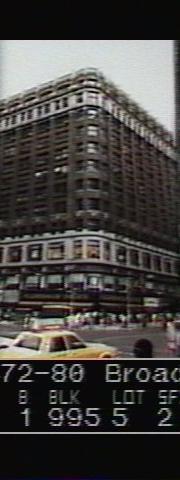
The city photographed every building for its tax records around 1940 and again in the 1980s. NYC Municipal Archives.
Written with AI from the source each entry cites, then fact-checked.
- 1940
Toffenetti opens a 24-hour restaurant on the Broadway and 43rd Street corner
Before the tower, the site held a 24-hour Toffenetti restaurant, which opened at Broadway and 43rd Street on August 6, 1940, in a modernist building with murals by Hugh Troy and seating said to be 850 to 1,000. By 1949 it reported serving 212,000 pounds of ham and some 462,000 Idaho potatoes a year. It closed on February 4, 1968, and Nathan's Famous leased the space.
“A 24-hour Toffenetti restaurant opened on Times Square, on the southeast Broadway and 43rd Street, on August 6, 1940.”
Source: Wikipedia
- 1996
The Durst Organization, long opposed to the 42nd Street project, buys the site and plans a tower
The Durst family had owned land on the block since 1967 and opposed the state's 42nd Street redevelopment for about 15 years. After Seymour Durst died in 1995, his son Douglas negotiated with Prudential, whose board voted in February 1996 to sell its corner site. Durst combined it with family lots and hired Fox & Fowle to design a tower of 1.6 million square feet.
Source: Wikipedia
- 1996
Condé Nast and Skadden Arps sign on before construction starts, and the tower takes the publisher's name
In May 1996 Condé Nast leased 500,000 square feet on floors 4 to 23, wanting to bring 17 magazines scattered across six buildings under one roof, and the project was named for it. That October the law firm Skadden, Arps agreed to move its headquarters into the top 21 stories. By March 1997, 87 percent of the office space was leased.
Source: Wikipedia
- 1998
A construction elevator falls onto the Woodstock Hotel next to 4 Times Square, killing one woman
On July 21, 1998, a construction elevator fell onto the Woodstock Hotel beside the site, killing one woman and injuring twelve other people. The area was closed and residents and businesses were displaced, and 43rd Street reopened about a month later after netting was put up around the collapsed scaffold. Officials later concluded that the scaffold had been missing key support beams.
Source: Wikipedia
- 1999
Condé Nast staff begin moving in, arriving by limousine and clogging nearby streets
Almost 200 employees from three magazines, among them Brides and House & Garden, moved in first, on June 21, 1999, and the rest followed over two months. So many staff arrived by limousine that the city created a drop-off area nearby. Many at The New Yorker were reluctant to move, partly because that magazine had been housed apart from the other titles.
Source: Wikipedia
- 1999
The Nasdaq MarketSite LED tower lights up after an arbitrator sides with Nasdaq over Condé Nast
The building's eight-story cylindrical corner at Broadway and 43rd Street holds Nasdaq's MarketSite studio, wrapped in an LED display that was the world's largest when finished. Condé Nast objected that it blocked its art department's windows and stuck out too far, but an arbitrator ruled for Nasdaq in August 1999 and the sign lit in December. It cost $37 million and has over 18 million LEDs.
Source: Wikipedia
- 1999
Fox & Fowle, chosen for its green-building record, builds solar panels into the facade of 4 Times Square
Fox & Fowle was chosen partly for its record with sustainable buildings, and Condé Nast committed to environmentally efficient standards in its own space, though Skadden Arps did not. On the south and east sides, 208 photovoltaic panels replace some spandrels on the 37th through 43rd floors. They cover about half a percent of the facade and supply only about half a percent of the building's power needs.
Source: Wikipedia
- 2003
A new antenna mast is finished to host radio stations that lost their World Trade Center transmitters
After the broadcast equipment on the World Trade Center was destroyed on September 11, 2001, several radio stations moved their main or backup transmitters to 4 Times Square. In November 2002 Durst announced a replacement mast, since the original had been built for four stations but was carrying eight. The $25 million mast, designed for 18 stations, was finished on October 2, 2003, and carried its first broadcast on October 30.
Source: Wikipedia
- 2013
H&M opens its store and puts its logo atop the tower after the retail floors sat empty
After the ESPN Zone restaurant shut in June 2010, the retail floors stayed empty for more than two years. After talks with Express fell through, H&M agreed in late 2012 to lease most of the space. In August 2013 it announced that logo panels would go up on top of the building, and its store opened that November.
Source: Wikipedia
- 2017
Durst plans to reopen Frank Gehry's empty Condé Nast cafeteria as a tenants' food hall
In December 2017 6sqft reported that the Durst Organization would reopen Frank Gehry's fourth-floor Condé Nast cafeteria, which it said had sat empty for five years, as part of a $35 million tenants-only space. Danish-born chef Claus Meyer was hired to run it, seating rose from 260 to 300, and the titanium walls and curved glass were kept.
Source: 6sqft
Further reading
- 4 Times SquareWikipedia
Nearby
- One Times Square1475 Broadway | 16 entries
- 1500 Broadway (Times Square Plaza)1500 Broadway | 10 entries
- Times Square Tower1459 Broadway | 12 entries
- 3 Times Square (Reuters Building)1481 Broadway | 12 entries
- The Knickerbocker Hotel1466 Broadway | 13 entries
- Bank of America Tower1111 Avenue of the Americas | 12 entries