Sohotel (Occidental Hotel)
148 Bowery | also 345 Broome Street, 351 Broome Street, 341 Broome Street | Little Italy | built 1915
Open on the map6 entries

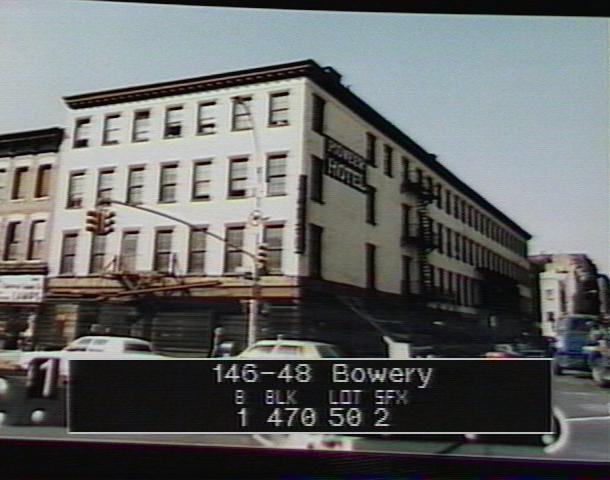
The city photographed every building for its tax records around 1940 and again in the 1980s. NYC Municipal Archives.
Written with AI from the source each entry cites, then fact-checked.
- 1805
A tavern called the New Bull's Head opens at Bowery and Broome Street
A tavern called the New Bull's Head went up in 1805 on the corner of the Bowery and Broome Street, the site of today's hotel at 146-148 Bowery. The city then had about 60,000 people, and this corner lay on its outskirts. The name set it apart from the original Bull's Head on Canal Street, where cattlemen gathered. Like most taverns of the day it probably also rented rooms, and by 1825 a hotel called Bowery House had replaced it.
Source: Ephemeral New York
- 1847
A temperance advocate calls the Westchester House a nuisance to churchgoers
The New-York Tribune quoted a temperance speaker in 1847 who complained that the Westchester House was a terrible nuisance. He said churchgoers in the neighborhood were rarely able to pass without being bothered by the profane or drunken revelry of the boys and others gathered outside. Ephemeral New York notes that the hotel was a raucous dive even as it styled itself a first-class house.
Source: Ephemeral New York
- 1851
Boss Tweed holds his birthday party at the Westchester House
In 1851 William "Boss" Tweed celebrated his birthday at the Westchester House, according to the Bowery Alliance of Neighbors as relayed by Ephemeral New York. A memoir from 1875 described the hotel then as an old, dingy, yellow-painted building. The name Westchester House had come back in 1840, and by 1897 The Sun was calling it a first-class hotel that had been a rendezvous for senators, congressmen and actors from the Old Bowery Theatre.
Source: Ephemeral New York
- 1900
Big Tim Sullivan, 'King of the Bowery,' makes the Occidental Hotel his headquarters and home
Tammany boss Big Tim Sullivan, who was born poor in the nearby Five Points and won the nickname King of the Bowery through his popularity and political skill, made the Occidental Hotel his headquarters and home from 1900 until his death in 1913. The hotel had been renamed to honor the Westerners who patronized it. According to the Bowery Alliance of Neighbors, its bar and restaurant drew politicians, entertainers and sports figures, among them the boxers John L. Sullivan and James J. Jeffries, Teddy Roosevelt and Al Smith.
Source: Ephemeral New York
- 1940
The Pioneer Hotel runs as a Bowery lodging house owned by the Gatto family
The old hotel was the Commercial Hotel around 1920, and by the 1940s it was the Pioneer Hotel, a lodging house owned by the Gatto family. It had been raised to four stories in the late nineteenth century. The nomination for the Bowery Historic District calls it apparently the oldest hotel in New York still in operation, with travelers lodged there since about 1805.
“Over the years it has been known as the Commercial Hotel (ca. 1920) and later the Pioneer Hotel (1940s), a lodging house owned by the Gatto family.”
Source: National Register nomination
- 1966
The New York Times reports homeless women housed in dormitory rooms at the Pioneer Hotel
By the 1950s the elevated train was gone from the Bowery, but the hotel stayed a cheap flophouse. A 1966 New York Times story, headlined "Misery at Close Quarters Marks Hotel on the Bowery," described homeless women being put up in dormitory-style rooms at the Pioneer. Today the building is the boutique Sohotel, which plays up its history with exposed brick and tin ceilings.
Source: Ephemeral New York
Further reading
- Westchester HouseWikipedia
- 200 years of revelry and tragedy on the Bowery at New York’s oldest continuously run hotelEphemeral New York
Nearby
- Delaplaine House134 Bowery | 7 entries
- Church of San Salvatore359 Broome Street | 3 entries
- Bowery Savings Bank Building130 Bowery | 16 entries
- Fire Engine Company 55363 Broome Street | 4 entries
- Fire Engine Company 55363 Broome Street | 4 entries
- Bowery Bank of New York Building124 Bowery | 5 entries