King Manor
150-03 Jamaica Avenue | also 150-05 Jamaica Avenue | Jamaica | built 1730
Open on the map9 entries

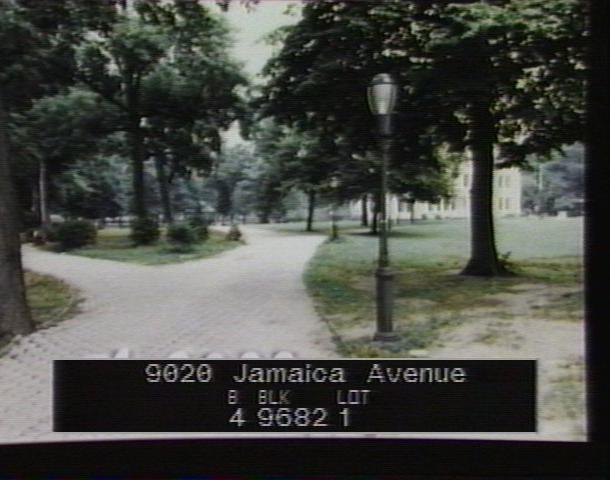
The city photographed every building for its tax records around 1940 and again in the 1980s. NYC Municipal Archives.
Written with AI from the source each entry cites, then fact-checked.
- 1726
Two Grace Church rectors farm the land where the oldest part of the house stands
Thomas Poyer, rector of Grace Episcopal Church, married Sarah Oldfield in 1724 and in 1726 took over a 53-acre farm from her father, Joseph Oldfield; he stayed until his death in 1732. Thomas Colgan, the second of the two rectors to live on the land, bought Poyer's farm, grew the holding to 66 acres and lived there until he died in 1755. Researcher Robert Venables credits Colgan with possibly building the western half of the present house.
Source: Wikipedia
- 1805
Rufus King buys the Smith farmhouse and turns it into a country mansion
Rufus King, a former Continental Congress delegate, senator and U.S. minister to Britain, paid $12,000 for Christopher Smith's house and 90 acres and cleared Smith's mortgage, which was owed to the estate of King's father-in-law John Alsop. He moved in early in 1806 and began enlarging it, adding the eastern half of the main house and a new kitchen built with pine, oak and shingles from nearby; the mansion eventually had 17 rooms.
Source: Wikipedia
- 1812
Rufus King frees Margaret, a woman he had held in slavery
King, an abolitionist who paid his workers, appears in the 1810 census as the owner of an enslaved woman named Margaret, and he freed her two years later. Accounts differ on why he had acquired her: the Amsterdam News said he bought her out of a dead friend's estate in order to free her, while Newsday said he wanted to reunite her with Moses, her husband, a free man in King's service.
“The 1810 United States census shows that he had a slave named Margaret, whom he freed two years later.”
Source: Wikipedia
- 1827
Rufus King dies in the mansion and his son John Alsop King inherits it
Rufus King, a Founding Father who had returned to the Senate from 1813 to 1825, died at the house and was buried next to his wife in Grace Churchyard in Jamaica. His eldest son, John Alsop King, took over the estate, which kept working as a farm into the mid-1800s. John later became a state legislator, a congressman and governor of New York, and he died in the house on July 8, 1867.
Source: Wikipedia
- 1897
Jamaica's voters agree to buy the King estate for a public park
Cornelia King, the last of the family to live in the house, died in 1896 at 73. Her brother John A. King turned down a $700,000 offer and instead offered it to Jamaica's village government at a discounted $50,000. Residents approved the bond purchase on June 29, 1897; despite a citizens' lawsuit, the trustees took the land on July 9, opened it to the public and installed a policeman as live-in caretaker.
Source: Wikipedia
- 1900
The King Manor Association opens the house as a clubhouse for local groups
Local women led by Mary E. Craigie pressed to turn the empty mansion into a meeting place, and the King Manor Association formed by February 1900, signing a three-year lease that June. The Daughters of the American Revolution and the Jamaica Women's Club were among the groups planning to refurbish the ground-floor rooms, and the first social gathering was held that October. By December the association counted over 200 members and its clubs 1,000 combined.
“The first social meeting in the house took place in October 1900.”
Source: Wikipedia
- 1964
A fire, probably from bad wiring, destroys two rooms of the mansion
The blaze started on the first floor and left smoke and water damage through the house. Officials first put repairs at $39,000 outside and $20,000 inside, but an expert who toured the rooms raised the interior estimate to $50,000. Donations paid for the work, which was finished in 1966.
Source: Wikipedia
- 1966
Landmark commission designates the King Mansion, tracing its three building phases
The designation report dates the low rear wing, with the original kitchen, to 1730, the rest of the main house to about 1750, and Rufus King's addition to 1806. It singles out the gambrel-roofed shingle house's entrance porch with Doric columns, the Palladian window above it, and a Dutch door opening into a center hall. Five speakers backed designation, and Parks Commissioner Thomas Hoving recommended it by letter.
“The small original cottage, the portion at the rear, dates from 1730 and contains the original kitchen.”
- 1989
Former radio host Roy Fox moves in as the mansion's live-in caretaker
Fox, who needed somewhere to live, heard about a rent-free apartment at the house from his wife's supervisor. The couple, Roy and Mary, settled into the third floor and gave informal tours, their apartment included, and though he held no museum post he often lectured and performed there. Three decades later, when the museum closed in 2020 for the COVID-19 pandemic, Fox was still looking after the property.
“Roy Fox, a former radio host who was looking for a place to live, became the house's caretaker in 1989…”
Source: Wikipedia
Further reading
- King ManorWikipedia
Nearby
- First Reformed Church of Jamaica153-10 Jamaica Avenue | 9 entries
- Grace Episcopal Church155-15 Jamaica Avenue | 3 entries
- Luna de Xelajú88-34 Parsons Boulevard | 1 entry
- Jamaica Savings Bank (Sutphin Boulevard branch)146-19 Jamaica Avenue | 9 entries
- La Casina90-33 160th Street | 8 entries
- Queens General Court House88-11 Sutphin Boulevard | 5 entries