Rubin Museum of Art
150 West 17th Street | Chelsea | built 1915
Open on the map11 entries

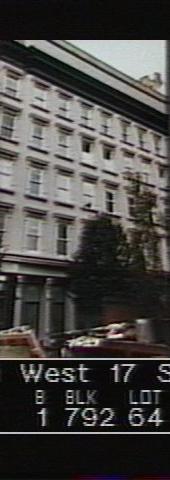
The city photographed every building for its tax records around 1940 and again in the 1980s. NYC Municipal Archives.
Written with AI from the source each entry cites, then fact-checked.
- 1986
Barneys opens a 70,000-square-foot women's store here with an Andrée Putman spiral staircase
Barneys, which began as a men's discount store at 115 Seventh Avenue in 1923, opened a women's store in 1986 in a row of six townhouses from about 1915 and neighboring buildings at 138-154 West 17th Street. Architect Andrée Putman designed a spiraling staircase of steel and marble running up the middle of the six-story store. Barneys left this flagship in 1993 for a Madison Avenue store.
Source: villageview.nyc
- 1998
Donald and Shelley Rubin buy the former Barneys buildings for $22 million to display their Himalayan art
The Rubins had collected Himalayan art since 1974 and wanted a place to show it. In 1998 they paid $22 million for the building occupied by Barneys, the fashion retailer that had filed for bankruptcy. Preservation architects Beyer Blinder Belle remodeled it as a museum, keeping the six-story spiral staircase at the center of about 25,000 square feet of galleries.
Source: Wikipedia
- 2004
Critics welcome the Rubin as a standout, and Holland Cotter admires its uncluttered galleries
After the Rubin opens in the former Barneys store, critics praise it for standing out in a cramped art scene. In his 2004 review, Holland Cotter singles out the museum for exhibiting art in an uncluttered, atmospherically lit, ideology-free space. ARTnews later recalled the praise while reporting that the museum would close its building in 2024.
Source: artnews.com
- 2004
The Rubin Museum of Art opens at 150 West 17th Street with exhibitions on Himalayan art
The museum opened on October 2, 2004, with a new 17th Street facade and five gallery floors designed by museum architects Celia Imrey and Tim Culbert. Milton Glaser created its graphic identity. The first exhibitions included Methods of Transcendence and The Demonic Divine in Himalayan Art, and in 2006 the three-part Holy Madness show focused on tantric siddhas.
Source: Wikipedia
- 2004
Barneys' one-story entrance becomes a three-story, mandala-shaped gateway beside the 108-step staircase
The most significant new design element was the entrance, rebuilt from Barneys' one-story opening into a three-story, mandala-shaped gateway to Himalayan art. The Putman staircase was kept, and the museum points out that it has 108 steps, a number sacred in Buddhism. According to the museum, Donald Rubin decided the building was right for his collection while walking down that staircase.
Source: rubinmuseum.org
- 2011
The Rubins give $25 million and Patrick Sears replaces Donald Rubin as chief executive
In 2011 Donald and Shelley Rubin give the museum $25 million to fund operations and programming in the years ahead, and Donald steps down as chief executive. Chief operating officer Patrick Sears replaces him and serves as executive director until he retires in 2017. When Jorrit Britschgi takes over later that year, he knows the gift will run out by the end of 2020.
Source: theartnewspaper.com
- 2013
A photography show documents the sacred sites of Uyghur China
In 2013 the museum displays Living Shrines of Uyghur China, a photography project by the American photographer Lisa Ross. The series documents Uyghur sacred sites across Xinjiang.
“Living Shrines of Uyghur China, a photography project by American photographer Lisa Ross. This series, which was on display in 2013…”
Source: Wikipedia
- 2019
The museum cuts a quarter of its staff, its hours and its exhibitions on its 15th anniversary
On October 2, 2019, the museum's 15th anniversary, executive director Jorrit Britschgi tells staff in a letter that the workforce will shrink by 25 percent, from 89 to 67 employees. From January 2020 the Rubin will close on Wednesdays as well as Tuesdays, and special exhibitions will drop from five or six a year to two. The restructuring is meant to secure the museum's finances before the Rubins' multi-year gift runs out.
Source: theartnewspaper.com
- 2021
The Mandala Lab opens on the third floor as an interactive space for emotional learning
The Rubin prepares to open the Mandala Lab on September 24, 2021, an interactive space for social, emotional and ethical learning on the remodeled third floor. Designed by Peterson Rich Office, it offers five experiences, including a commissioned sculpture that invites collective breathing and a gong orchestra with eight gongs hung over water. It is also the new home of the museum's School and Family Programs.
Source: bdcnetwork.com
- 2022
The museum voluntarily returns two objects to Nepal after researchers show they were stolen
In 2022 the Rubin voluntarily repatriates a 14th-century carving and a 17th-century gateway to Nepal, after researchers offer proof that smugglers had taken both objects from sites there. A year later it sends back a Bhairava mask as well. When it made the first return, the museum said it was undertaking a complete review of its holdings.
Source: artnews.com
- 2024
The Rubin announces it will sell its building and close it on October 6, 2024, to become a museum without walls
On January 31, 2024, the Rubin said it would sell its 17th Street building and become a global museum with loans, traveling exhibitions, partnerships and digital programs. The building stayed open until October 6 with the anniversary show Reimagine: Himalayan Art Now, featuring 32 contemporary artists from Nepal, Tibet and Bhutan. The new model includes grants, partnerships and digital programs, and the museum cited its support for Nepal's first national pavilion at the 2022 Venice Biennale.
Source: rubinmuseum.org
Further reading
- Rubin Museum of Himalayan ArtWikipedia
Nearby
- Hellmuth Building154 West 18th Street | 4 entries
- Colored School No. 4128 West 17th Street | 5 entries
- 203 West 14th Street3 entries
- Old Chelsea Post Office217 West 18th Street | 3 entries
- 144 West 14th Street Building144 West 14th Street | 8 entries
- 223 West 19th Street3 entries