Hellmuth Building
154 West 18th Street | also 158 West 18th Street | Chelsea | built 1906
Open on the map4 entries

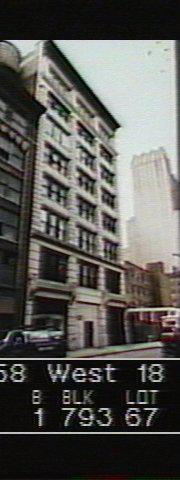
The city photographed every building for its tax records around 1940 and again in the 1980s. NYC Municipal Archives.
Written with AI from the source each entry cites, then fact-checked.
- 1907
Adolph Schoeller gives the Hellmuth ink factory an Art Nouveau ground floor
Ink and varnish maker Charles Hellmuth bought three old four-story houses here in 1905 and hired architect Adolph Schoeller to design a fireproof brick and terra-cotta factory for his company. The eight-story building was completed in 1907. Swirling vines and lilies flank the cornices over its two entrances, and terra-cotta panels spell out the Hellmuth name in Art Nouveau lettering, while the upper floors are plain tan brick.
Source: Daytonian in Manhattan
- 1916
A chemical fire breaks out in the basement mixing vault with 900 workers inside
On November 27, 1916, about 900 people were at work when flames shot out as an employee mixed chemicals in the basement vault. Sprinklers and the fire alarm went off, and the workers walked out in order. A vat exploded while firefighters fought the blaze and burned several of them, but the heavy brick vault kept the fire from spreading beyond it.
Source: Daytonian in Manhattan
- 1973
The Hellmuth firm leaves its headquarters after nearly 70 years
In 1973 the company, by then known as Sleight & Hellmuth, moved out of the building where it had been based since 1907. The building had also housed printing firms, including T. J. Hayes Printing Company, which arrived in 1912 and stayed on for decades.
Source: Daytonian in Manhattan
- 1988
The former ink factory is converted into 28 cooperative apartments
In 1988 the eight-story building was converted into 28 co-op apartments. Their scalloped ceilings are the brick barrel vaults that were built to carry heavy printing presses. The ground floor was altered only slightly, so the Art Nouveau brackets and name panels remain.
Source: Daytonian in Manhattan
Further reading
- The 1907 Hellmuth Bldg -- No. 154 West 18th StreetDaytonian in Manhattan
- Art Nouveau flower petals on a Chelsea factoryEphemeral New York
Nearby
- Rubin Museum of Art150 West 17th Street | 11 entries
- Colored School No. 4128 West 17th Street | 5 entries
- Old Chelsea Post Office217 West 18th Street | 3 entries
- 223 West 19th Street3 entries
- 203 West 14th Street3 entries
- Siegel-Cooper Building620 Avenue of the Americas | 3 entries