Russian Tea Room
150 West 57th Street | also 151 West 56th Street | Midtown | built 1890
Open on the map16 entries

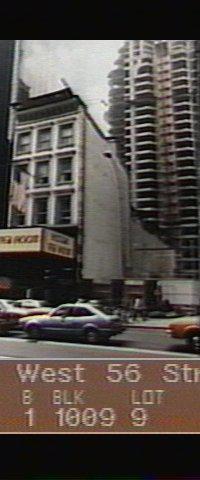
The city photographed every building for its tax records around 1940 and again in the 1980s. NYC Municipal Archives.
Written with AI from the source each entry cites, then fact-checked.
- 1875
Tea merchant John F. Pupke completes a 25-foot brownstone at 150 West 57th Street
John F. Pupke, a tea and coffee importer, bought two back-to-back lots between 56th and 57th Streets in February 1873 for $29,750. He built a narrow brownstone on the 57th Street side, designed by John G. Prague, with a brick carriage house behind it on 56th. The house was finished in 1875 and held the family and three servants. In 1886 William Schickel designed a two-story brick extension that took the place of a glass conservatory.
Source: Daytonian in Manhattan
- 1913
Architect Katharine C. Budd remodels the Pupke house with a storefront and studios
By 1911 the Pupke family has left its brownstone at 150 West 57th Street, though it still owns the house, and Nellie H. Wall leases it as a boarding house. In May 1913 the family hires architect Katharine C. Budd for extensive renovations, adding a storefront, new walls and studio space. The neighborhood is full of workspaces for painters, sculptors and musicians, and number 150 fills with similar tenants.
Source: Daytonian in Manhattan
- 1919
A car showroom replaces the stoop of the old Pupke house
Real estate operator Robert E. Simon bought the house from the Pupke family in February 1919 for $150,000. He took off the stoop and fitted out the ground floor as a car showroom, with offices on the second floor and bachelor apartments on the third and fourth. The first tenant sold Pic-Pic cars, and in November 1920 the showroom went to the Fiat company of Turin. Around 1929 a cafe called the Russian Tearoom leased the same space.
Source: Daytonian in Manhattan
- 1929
The Russian Tea Room leases the old car showroom at 150 West 57th Street
Around 1929 a cafe called The Russian Tearoom leases the former showroom. The business, incorporated that year, dates to 1927, when members of the Russian Imperial Ballet founded it, and it lists Russian Art Chocolate among its offerings. Vocalists and musicians keep renting studios on the upper floors, and by the 1940s the restaurant has spread through the whole property to 56th Street.
Source: Daytonian in Manhattan
- 1940
The Russian Tearoom pleads guilty to underpaying the state insurance fund by $3,973
Charged in December 1939 with defrauding the State Insurance Fund of workmen's compensation premiums, The Russian Tearoom, Inc. and its secretary, Solo Judenfreund, first plead not guilty. On June 18, 1940, guilty pleas are entered for both, admitting they cheated the fund of $3,973 between March 1934 and March 1939. The episode is a rare blemish; in 1941 the restaurant earns better press by serving Thanksgiving dinners to soldiers and sailors on leave.
Source: Daytonian in Manhattan
- 1955
Carnegie Hall's defenders plan their campaign over lunch at the Russian Tea Room
When demolition threatened Carnegie Hall in 1955, the Tea Room next door became the unofficial meeting place of the Committee to Save Carnegie Hall. Members gathered over lunch in the restaurant to work out how to keep the concert hall standing. The concert hall was also where many of the restaurant's well-to-do and famous customers came from.
Source: Daytonian in Manhattan
- 1965
Anatole Voinoff, the Tea Room's Moscow-born maitre d' and a founder, dies
Anatole E. Voinoff dies on February 9, 1965. Born in Moscow, educated at the Military Academy of Catherine the Great and once an officer in the czar's army, he was one of the restaurant's original founders and its maitre d'hotel. The Times calls him probably the best-known maitre d' in the city to opera, ballet and classical-music fans, and his death makes headlines in Manhattan newspapers.
Source: Daytonian in Manhattan
- 1967
Sidney Kaye, who left Christmas tinsel up all year, dies at 53
Sidney Kaye, the son of Russian immigrants, ran the Tea Room after Alexander Maeef and made its look more flamboyant. He treated the old-world atmosphere as untouchable, never taking the Christmas balls and tinsel off the dining-room chandeliers and leaving a Christmas tree in the front window all year, because he thought it looked Russian. He died in 1967 at 53, and the press covered his death as it had that of his maitre d' two years earlier.
Source: Daytonian in Manhattan
- 1981
The Times lists the Tea Room's regulars, from Diana Ross and Mel Brooks to Candice Bergen
A December 9, 1981, New York Times piece by Moira Hodgson names diners from the previous week, including Diana Ross, Anne Bancroft, Mel Brooks, Max von Sydow and Joseph Heller. Regular Candice Bergen tells her that without the Tea Room she would starve. When Raquel Welch comes in following her debut night in Woman of the Year, she asks whether stepping into Lauren Bacall's role means she gets Bacall's table, and she does.
Source: Daytonian in Manhattan
- 1983
Hollywood rebuilds the Russian Tea Room on a Fox soundstage for Unfaithfully Yours
Dustin Hoffman filmed Tootsie inside the real restaurant, but the makers of Unfaithfully Yours copied it instead. Director Howard Zieff, a lunchtime regular, had a replica built on Stage 16 at 20th Century-Fox because shooting in the real room would have forced overnight work and cost at least $1 million more. The paintings were photographs, the champagne was ginger ale, and extras stood in for regulars such as agent Sam Cohn.
Source: The New York Times
- 1988
The Tea Room refuses to sell as towers rise on both sides
By 1988 the five-story brownstone stood between Harry Macklowe's Metropolitan Tower and the rising Carnegie Hall Tower. Its owners had refused to sell either the building or its air rights to either developer. In 1981 Faith Stewart-Gordon had announced plans to add three floors and reface the front, but the project was never carried out. She said the site could be built up to 18 stories if she chose.
Source: The New York Times
- 1990
Rowan Atkinson marries a Blackadder make-up artist at the Russian Tea Room
In 1990 the British comedian Rowan Atkinson, star of Blackadder and Mr Bean, marries a make-up artist from the Blackadder crew at the Russian Tea Room. The couple go on to have two children, Lily and Benjamin. The Guardian's profile lists the wedding venue among the basic facts of Atkinson's life, alongside his birth in Gosforth, near Newcastle, in 1955.
Source: theguardian.com
- 1995
The Russian Tea Room closes its doors for a planned rebuild
On December 31, 1995, regulars and staff said goodbye to the restaurant. Faith Stewart-Gordon, who had owned it since her husband died in 1967, had sold the property to Warner LeRoy, who then planned to demolish the building and replace it with a $12 million restaurant featuring chef David Bouley. The Times reported that Dustin Hoffman sat through take after take of Tootsie in booth No. 2, and that Madonna had once been a coat-check clerk there.
Source: The New York Times
- 1999
The Russian Tea Room reopens after a four-year, $22 million renovation, with a revolving aquarium upstairs
On October 11, 1999, the Tea Room reopens, with ladies who lunch streaming through the revolving doors from 11:30 a.m. and waiters in red tunics pouring vodka. Upstairs, an 18-foot revolving aquarium for sturgeon stands under a 700,000-piece Tiffany glass ceiling, next to a gilded tree carrying 35 glass eggs in the Faberge style. Former owner Faith Stewart-Gordon, among the first-day diners, says she was stunned by the result.
Source: latimes.com
- 2002
The U.S. Golf Association bids $16 million to turn the closed Tea Room into a golf museum
In November 2002 the U.S. Golf Association bids $16 million for the Tea Room, which closed in July despite $20 million of renovations, intending to open a golf museum before the 2004 U.S. Open. A spokesman says the Manhattan site would be more modern than the association's museum in Far Hills, New Jersey, with interactive displays such as a putting green, and that visitors would have to pay.
Source: golfchannel.com
- 2006
Gerald Lieblich reopens the Tea Room with Warner LeRoy's decor intact
After the United States Golf Association gave up the deed, Gerald Lieblich reopened the Russian Tea Room in November 2006, its fourth version since 1926. He kept most of Warner LeRoy's $36 million decor from 1999, including the antique samovars and the revolving door with its liveried attendant, and kept chicken Kiev and veal Pojarski on the menu. The New Yorker's review found the food acceptable but the service apathetic.
Source: The New Yorker
Further reading
- Russian Tea RoomWikipedia
- The Russian Tea Room - 150 West 57th StreetDaytonian in Manhattan
Nearby
- Carnegie Hall Tower152 West 57th Street | 9 entries
- Metropolitan Tower146 West 57th Street | 9 entries
- Carnegie Hall881 7th Avenue | 22 entries
- 140 West 57th Street4 entries
- 130 West 57th Street4 entries
- CitySpire150 West 56th Street | 13 entries