Carnegie Hall
881 7th Avenue | also 154 West 57th Street, 161 West 56th Street | Midtown | built 1891
Open on the map22 entries

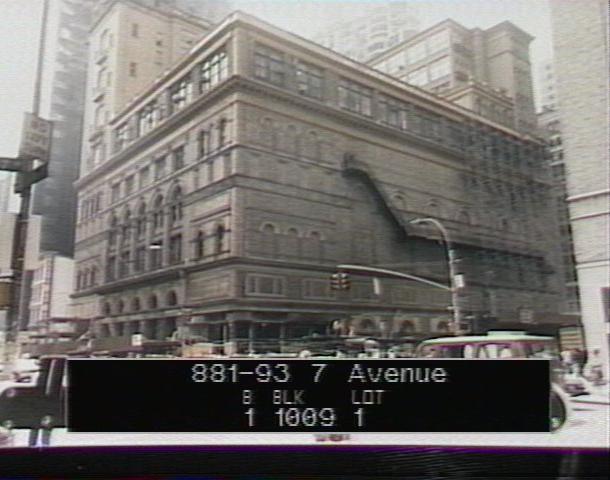
The city photographed every building for its tax records around 1940 and again in the 1980s. NYC Municipal Archives.
Written with AI from the source each entry cites, then fact-checked.
- 1889
Andrew Carnegie agrees to fund a music hall, but as a business deal rather than charity
After years of persuasion by conductor Walter Damrosch, Andrew Carnegie agreed in 1889 to back a new concert hall at Seventh Avenue and 57th Street, but he treated it as an investment. He set up a stock company, loaned it the cash in return for 90 percent of the stock, and gave the design job to William Tuthill, the Oratorio Society's board secretary, who at 34 was better known as a singer than as an architect.
Source: Daytonian in Manhattan
- 1891
A false floor and banked pines turn the auditorium into a ballroom for the Artists' Festival
In December 1891, seven months after the hall opened, the German-American Kunstlerfest, or Artists' Festival, ended in a grand ball. A false floor was built over the entire auditorium to make a dancing surface, and pines were banked to the height of the first tier of boxes. The New York Times called the scene a veritable indoor Eden, with musicians screened behind greenery on both sides of the stage.
Source: Daytonian in Manhattan
- 1891
Tchaikovsky helps open Andrew Carnegie's music hall
Paid for by industrialist Andrew Carnegie and designed by William Burnet Tuthill, the hall opened on May 5, 1891, with a concert led by Walter Damrosch that featured Pyotr Ilyich Tchaikovsky. The following year, on June 15, 1892, Sissieretta Jones became the first African American to sing there.
Source: Wikipedia
- 1892
The Philharmonic begins a seventy-year run at Carnegie Hall
The Philharmonic Orchestra gave its first concerts at the hall in 1892, the year after it opened, and remained there until 1962. The Landmarks Preservation Commission's designation report adds that the building has also served musicians who teach and live in its tower studios and many cultural groups needing an auditorium with 2,800 seats.
- 1892
Sissieretta Jones becomes the first Black artist to headline Carnegie Hall
Soprano Sissieretta Jones, nicknamed "the Black Patti" after opera star Adelina Patti, becomes the first African American performer to headline Carnegie Hall in 1892. She sings opera selections including "Ave Maria" and excerpts from Verdi's "La Traviata." Facing discrimination at many concert venues, she later founds her own touring company, the Black Patti Troubadours.
Source: Ephemeral New York
- 1905
Buffalo Bill's former star rider Bronco Charlie takes the stage
In March 1905 the hall hosted "Bronco Charlie," a former star rider of Buffalo Bill's Wild West show, showing that it housed more than classical music. The New-York Tribune said he had won a horse and bicycle race at London's Royal Agricultural Hall against the world's champion cyclist, with King Edward among the spectators, and that his feats of horsemanship drew wonder and applause wherever he went.
Source: Daytonian in Manhattan
- 1907
Andrew Carnegie argues his music hall is nearly worthless in a tax fight
In 1907 the city assessed Carnegie Hall at more than $1.54 million, and Andrew Carnegie, speaking through his attorney Robert L. Cutting, said the figure was too high by $1.5 million. In effect he argued that a building that paid him no return was nearly worthless. Cutting said Carnegie felt the hall was no business proposition and benefited the city more than the corporation that ran it.
Source: Daytonian in Manhattan
- 1912
James Reese Europe's Clef Club Orchestra brings proto-jazz to the hall
In 1912 James Reese Europe's Clef Club Orchestra, 125 musicians strong, played a benefit concert at Carnegie Hall for the Colored Music Settlement School. The program was written solely by Black composers, among them Harry T. Burleigh and Samuel Coleridge-Taylor, and the orchestra is described as the first to play proto-jazz in the hall, 26 years before Benny Goodman's famed concert. The group returned on several occasions through 1915.
“In 1912, the club made history when it played a concert at Carnegie Hall for the benefit of the Colored Music Settlement School.”
Source: Wikipedia
- 1917
Jascha Heifetz makes his American debut, and Mischa Elman and Leopold Godowsky trade a joke
On the unusually hot day of October 27, 1917, the violinist Jascha Heifetz made his American debut at Carnegie Hall. As he played, his fellow violinist Mischa Elman mopped his head and asked whether it was hot in the hall, and the pianist Leopold Godowsky, in the next seat, answered, "Not for pianists." Unlike some hall legends, this exchange has been confirmed as true.
“Heifetz made his American debut in Carnegie Hall. After Heifetz had been playing for a while, fellow violinist Mischa Elman mopped his head…”
Source: Wikipedia
- 1926
Arturo Toscanini arrives to guest-conduct the Philharmonic
Arturo Toscanini first came to Carnegie Hall in 1926 as a guest conductor with the Philharmonic for the 1926 and 1927 seasons, then stayed on as its permanent conductor, ending with a farewell concert on April 29, 1936. He was one of a long line of famous names on the stage, a list that includes Rachmaninoff, Horowitz, Rubinstein, Casals, Segovia, Caruso, Marian Anderson, Maria Callas, Paul Robeson and Leontyne Price.
Source: Daytonian in Manhattan
- 1938
Benny Goodman brings a swing band onto Carnegie Hall's stage
On January 16, 1938, the Benny Goodman Orchestra played a swing concert at Carnegie Hall that is remembered as a landmark in jazz history. Twenty-six years later, on February 12, 1964, the Beatles played two shows here.
Source: Wikipedia
- 1943
Leonard Bernstein, 25, steps in for an ailing Bruno Walter and conducts a broadcast concert
Leonard Bernstein, then 25, made his major conducting debut at Carnegie Hall on November 14, 1943, when he had to substitute for the suddenly ill Bruno Walter in a concert that CBS broadcast. Bernstein was also one of the hall's famous studio residents, along with Isadora Duncan, Martha Graham and Norman Mailer, who lived in the tower's high-ceilinged, skylit studios.
“…the 25-year-old Leonard Bernstein had his major conducting debut when he had to substitute for a suddenly ill Bruno Walter…”
Source: Wikipedia
- 1944
Florence Foster Jenkins sells out Carnegie Hall and turns away thousands
On October 25, 1944, the socialite Florence Foster Jenkins, then 76 and a cult figure for her technical incompetence as a singer, gave a general-admission recital at Carnegie Hall. Tickets sold out weeks ahead, and an estimated 2,000 people were turned away from the 2,800-seat hall. Celebrities in the audience included Cole Porter, Kitty Carlisle and Lily Pons, and her accompanist later recalled that a famous actress was carried from her box in hysterics.
“Tickets sold out weeks in advance; the demand was such that an estimated 2,000 people were turned away at the door of the 2,800-seat venue.”
Source: Wikipedia
- 1957
A blood-red, 44-story tower is proposed to replace Carnegie Hall
In the 1950s developers offered to buy and raze Carnegie Hall for a 44-story skyscraper, blood-red in color, set back from the corner with two sunken plazas around it. An architect's rendering appeared in Life magazine in 1957, and a demolition date was set for March 31, 1960. The hall, then the Philharmonic's home, was losing money, and only a last-minute campaign stopped the wrecking ball.
Source: Ephemeral New York
- 1960
Isaac Stern leads the campaign that saves Carnegie Hall
When the New York Philharmonic planned its move to Lincoln Center in the 1950s, Carnegie Hall faced demolition. Violinist Isaac Stern led a campaign to save it, the city bought the building in 1960, and it was named a National Historic Landmark in 1962.
Source: Wikipedia
- 1961
Judy Garland records the concert behind her Album of the Year
On Sunday, April 23, 1961, Judy Garland performed at Carnegie Hall with an orchestra conducted by Mort Lindsey, and the concert was recorded. Released on July 10 as Judy at Carnegie Hall, the double album won Album of the Year at the Grammys, a first for a woman, and spent thirteen weeks at number one on the Billboard album chart.
“…it won the Grammy Award for Album of the Year, making Garland the first woman to win the award…”
Source: Wikipedia
- 1961
Lenny Bruce records a live album at Carnegie Hall
Comedian Lenny Bruce performs at Carnegie Hall in February 1961, drawing a full house despite 20 inches of snow blanketing the city. The show is recorded and released as the three-record album "The Carnegie Hall Concert." Liner notes by Albert Goldman call it one of the finest performances of Bruce's career, capturing the profanity-charged style that had already gotten him arrested in several cities.
Source: Ephemeral New York
- 1964
Mayor Wagner calls the hall a place "where dreams live" as it is named a national landmark
At a gathering on November 6, 1964, the U.S. Interior Department designated Carnegie Hall a National Landmark. Mayor Robert F. Wagner said it was one of the places in the city where dreams live, adding that the rest of its story could best be told by the artists who perform there, the public figures who speak there and the millions whose lives it enriches. The city's own designation followed in 1967.
- 1964
The Beatles become the first rock band to play Carnegie Hall
The Beatles play two shows at Carnegie Hall on February 12, 1964, days after their Ed Sullivan Show debut, becoming the first rock band to perform on its stage. About 2,900 fans attend the 7:45 pm show, screaming so loudly the band can barely hear itself play. The first set lasts just 34 minutes.
Source: Ephemeral New York
- 1972
The Newport Jazz Festival moves to New York and Carnegie becomes a principal venue
A Place Matters nomination notes that jazz and its roots have been performed at Carnegie Hall since about 1900, and that it has been at the forefront of presenting jazz as concert music. When the Newport Jazz Festival relocated to New York in 1972, Carnegie Hall became one of its main stages. The listing describes a hall of about 3,000 seats that has presented music of all styles from around the world.
Source: Internet Archive
- 1986
The hall reopens after its restoration, and a Times critic tells Andrew Carnegie to rest easy
The hall reopened on December 15, 1986, after a restoration costing $50 million, with a gala performance that included Vladimir Horowitz. In The New York Times, critic Donal Henahan told Andrew Carnegie to rest easy, because his great music hall had survived another crisis. Daytonian in Manhattan notes the hall had been saved from demolition when the Board of Estimate approved in principle, in 1960, having the city acquire it.
Source: Daytonian in Manhattan
- 2010
Photographer Editta Sherman, the "Duchess of Carnegie Hall," leaves her studio after six decades
Editta Sherman lived and worked in a Carnegie Hall artist studio from the 1940s until July 2010, and kept working there until September 2010. Known as the "Duchess of Carnegie Hall," she photographed celebrities, writers, poets and athletes with a large-format 8x10 camera, and became a symbol of renters' rights and affordable housing for the elderly while fighting eviction by the hall's owner. The studios were slated to become educational and rehearsal space.
“…she lived and worked in Carnegie Hall Artist Studios for over 60 years.”
Source: Wikipedia
Further reading
- Carnegie HallWikipedia
- Carnegie HallPlace Matters
- When Lenny Bruce hit the stage at Carnegie HallEphemeral New York
- When the Beatles hit the stage at Carnegie HallEphemeral New York
- A couple of vintage ads on Eighth AvenueEphemeral New York
- Breaking barriers at Carnegie HallEphemeral New York
Nearby
- Carnegie Hall Tower152 West 57th Street | 9 entries
- Russian Tea Room150 West 57th Street | 16 entries
- Metropolitan Tower146 West 57th Street | 9 entries
- Rodin Studios900 7th Avenue | 3 entries
- CitySpire150 West 56th Street | 13 entries
- 140 West 57th Street4 entries