Macy's Herald Square
151 West 34th Street | also 160 West 35th Street, 140 West 35th Street, 441 7th Avenue | Garment District | built 1930
Open on the map10 entries

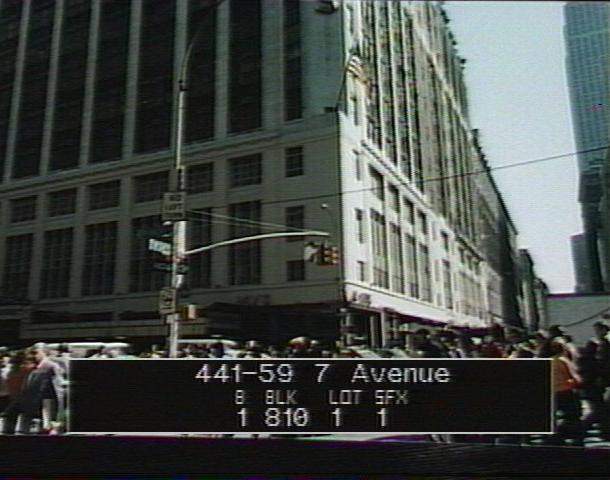
The city photographed every building for its tax records around 1940 and again in the 1980s. NYC Municipal Archives.
Written with AI from the source each entry cites, then fact-checked.
- 1900
A neighbor buys the Broadway corner for $375,000, and Macy's builds around it
In 1900 Robert H. Smith bought a five-story building on the southeast corner of the block, at Broadway and 34th Street, for $375,000. Many assumed he was acting for rival Siegel-Cooper, which had built its own huge store on Sixth Avenue in 1896, and hoped to keep Macy's from becoming the world's largest store. Macy's ignored the maneuver and built around the lot. By a lease arrangement, the small building still carries Macy's shopping-bag sign.
Source: Wikipedia
- 1902
Macy's opens its Herald Square store three days after moving uptown from 14th Street
The old Macy's on 14th Street closed at 6 p.m. on November 3, 1902. Its own delivery department then spent three days hauling stock and fixtures about twenty blocks north. On the evening of November 6 Isidor Straus was told the new store could open the next day, but he stuck with the advertised Saturday. Doors opened at 8 a.m. on November 8, and other downtown department stores soon followed Macy's north.
Source: gutenberg.org
- 1902
De Lemos & Cordes finish a $4.8 million store full of elevators, pneumatic tubes and arc lamps
The nine-story Broadway section, designed by De Lemos & Cordes and built by the George A. Fuller Company, was completed in 1902 for about $4.8 million, land included. The National Park Service's landmark nomination counts 13,000 tons of structural steel, 33 hydraulic elevators, 1,400 enclosed arc lamps and 18 miles of brass tubing carrying a pneumatic-tube system. Six steam engines drove the generators, and a built-in vacuum system, then called a suction duster, cleaned the floors.
Source: National Park Service
- 1902
Four escalators with level steps carry shoppers from the main floor to the fifth
When the store opened, four escalators ran from the main floor up to the fifth. Edward Hungerford's 1922 history of Macy's says they were the first built so that the tread a passenger stands on stays flat. Earlier moving stairways tilted the tread as it climbed, and riders kept their footing only because steel cleats were fitted at right angles to it.
Source: gutenberg.org
- 1924
A 20-story Seventh Avenue addition gives the store truck elevators for its delivery vehicles
By the early 1920s Macy's had outgrown its building. It bought the rest of the west side of the block except a tiny lot at the northwest corner, and a 20-story addition was finished in 1924. The new section had truck elevators that lifted delivery vehicles from basement loading docks up to the street. When the National Park Service prepared the store's landmark nomination in 1977, it noted that these elevators still worked.
Source: National Park Service
- 1924
Macy's first Christmas parade ends at Herald Square, where Santa is crowned King of the Kiddies
On November 27, 1924, store employees marched to Herald Square in costume, with floats, professional bands and animals borrowed from the Central Park Zoo. Santa Claus arrived at the end of the route and was seated on a throne on the Macy's balcony above the 34th Street entrance, where he was crowned King of the Kiddies. About 250,000 people watched, and Macy's declared that the parade would become an annual event.
Source: Wikipedia
- 1927
Macy's sets up a Bureau of Standards that tests the products it sells
In 1927 Macy's established a Bureau of Standards, which authors Tom Mahoney and Leonard Sloane called unique in all retailing. The bureau tested thousands of products every year, and goods that failed its tests never reached the store's shelves. The National Park Service's landmark nomination singles it out as especially significant to present-day consumer advocates.
“…in 1927 Macy's established a Bureau of Standards that ... was "unique in all retailing.”
Source: National Park Service
- 1942
A Latin-American Exposition fills the store with South American food, fashion and music
During World War II the store hosted the Latin-American Exposition of 1942, which presented South American culture, architecture, food, fashion and music. It was organized with the U.S. government's Coordinator of Inter-American Affairs and the CBS Network of the Americas, with Eleanor Roosevelt and South American ambassadors as patrons. Argentine composer Terig Tucci led daily performances, broadcast by short-wave radio to Latin America as part of the Good Neighbor Policy.
Source: Wikipedia
- 1946
Film crews shoot Miracle on 34th Street during the real 1946 Thanksgiving parade
The 1947 film Miracle on 34th Street was shot on location, and its parade scenes were filmed live as the 1946 Macy's Thanksgiving Day Parade went by. Assistant director Arthur Jacobson used nine cameras that morning, and each scene could be done only once. Maureen O'Hara recalled a bitterly cold day. Jacobson also put Edmund Gwenn and Natalie Wood in a department-store cafeteria line during a weekday lunch rush.
“…the Macy's Thanksgiving Day Parade sequences filmed live while the 1946 parade was happening…”
Source: Wikipedia
- 2019
Macy's confirms it is exploring an office tower above the Herald Square flagship
In May 2019 Macy's confirmed reports that it wanted to build an office tower on top of the Herald Square store. Bloomberg, quoted by Gothamist, described a 1.2 million-square-foot building of about 800 feet that would need zoning changes and bring roughly 6,000 more people to the area. CEO Jeff Gennette said he hoped to have a plan ready to put out to bid by the end of the year, after about eighteen months of work.
Source: gothamist.com
Further reading
- Macy's Herald SquareWikipedia
Nearby
- Million Dollar Corner1313 Broadway | 5 entries
- Fashion Tower135 West 36th Street | 3 entries
- Church of the Holy Innocents128 West 37th Street | 4 entries
- Nelson Tower450 7th Avenue | 4 entries
- Greenwich Savings Bank Building (Gotham Hall)1356 Broadway | 12 entries
- Gimbels Building (Manhattan Mall)100 West 33rd Street | 9 entries