Greenwich Savings Bank Building (Gotham Hall)
1356 Broadway | also 985 Avenue of the Americas, 1352 Broadway | Garment District | built 1924
Open on the map12 entries

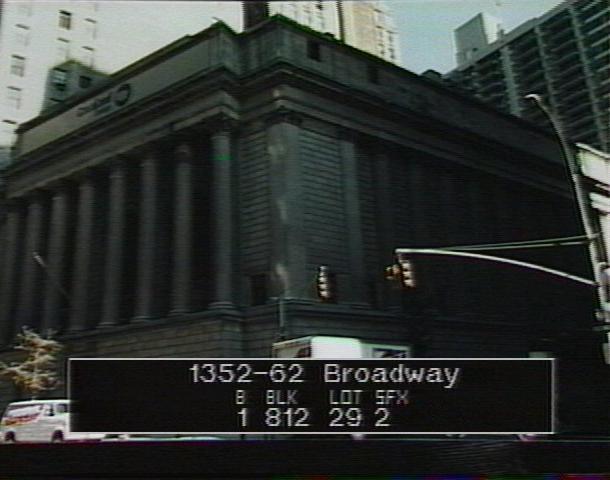
The city photographed every building for its tax records around 1940 and again in the 1980s. NYC Municipal Archives.
Written with AI from the source each entry cites, then fact-checked.
- 1921
Greenwich Savings Bank buys a block-wide lot on West 36th Street and hires York & Sawyer
In 1921 the trustees of the Greenwich Savings Bank decided to follow the shopping district north and bought a lot that filled the blockfront on West 36th Street, running from Sixth Avenue to Broadway. York & Sawyer won the commission in 1922. The Landmarks Commission notes a church link: trustee William Rhinelander Stewart, a Grace Church warden, sat on the building committee, and the firm had designed work for that church.
- 1922
Tenants' leases expire and demolition of the old buildings on the bank's lot begins
The two-story Sheridan Building had stood on the Broadway and Sixth Avenue lot before the bank. Work could not start until existing tenants' leases ran out on May 1, 1922, and demolition of the structures on the site followed. This entry concerns the earlier building on the lot.
Source: Wikipedia
- 1922
A Grace Church warden sits on the building committee as York & Sawyer win the job
William Rhinelander Stewart, a trustee of the Greenwich Savings Bank and a warden of Grace Church, sat on the bank's new building committee, which served in 1922-24. York & Sawyer had designed a Grace Church choir house finished in 1911 and a later addition to its parish house. The Landmarks report suggests the church connection may have helped the firm win the commission, and that Grace's rector, Walter Russell Bowie, may have supplied the thrift inscriptions.
“William Rhinelander Stewart, a Grace Church warden in 1909, was a trustee of the Greenwich Savings Bank and a member of the bank's new building committee in 1922-24.”
- 1924
A 40-ton vault door, the second largest in the country, guards the bank's money
The vault door, designed by Frederick S. Holmes, weighed 40 short tons and was 3 feet thick. When the building was completed, only the vault at the Federal Reserve Bank of Cleveland was larger. A stair hall off the Broadway vestibule led to the vault, which also had a coin lift.
Source: Wikipedia
- 1924
Armored cars carry $100 million from the old Greenwich Savings Bank to its new Broadway headquarters
On May 17, 1924, armored cars guarded by heavily armed police carried about $100 million of the Greenwich Savings Bank's holdings from its old Sixth Avenue headquarters to the new building. Only the move of the Bowery Savings Bank's assets had been more valuable in the city's history. The bank opened its new home to the public two days later, on May 19, and the old headquarters became a branch.
Source: Wikipedia
- 1924
Philip Sawyer designs the bank as a Roman temple with no entrance on 36th Street
Philip Sawyer of York & Sawyer gave the bank a rusticated base, a monumental Corinthian colonnade and a high attic, drawing on his knowledge of ancient Roman architecture. Delivery trucks serving the neighboring Herald Building clogged West 36th Street, so the bank has no entrance there. It has one on Broadway and, at the building committee's insistence, another on Sixth Avenue. The height of the base was kept close to that of the Herald's ground-floor colonnades.
- 1940
York & Sawyer file plans to add office space between the trusses above the banking hall
In 1940 York & Sawyer filed plans to add office space to the building at a cost of $100,000. The new space, about a third of a full story in size, was to fit among the trusses supporting the banking area's ceiling, and general contractor Eglehart, Caldwell & Scott was to carry out the work.
Source: Wikipedia
- 1971
A sixth-floor computer room is installed, and new windows are cut into the attic
In 1971 the bank installed a computer room on the sixth floor. To light it, three new aluminum-sash windows were cut into the limestone attic on the West 36th Street side. The Landmarks report counted them among the few changes to the exterior in the building's first seventy years.
“The three new aluminum sash windows were inserted into the limestone of the attic on the West 36th Street elevation in 1971 when the computer room was installed on the sixth floor.”
- 1981
The bank becomes Metropolitan Savings Bank, and its signage and inscriptions change
In 1981 the bank that built the headquarters became Metropolitan Savings Bank. The frieze inscription came off and the attic inscriptions were covered over. Two years later, according to the Landmarks report, Metropolitan became Crossland Savings Bank and the signs were altered again.
- 1992
The Landmarks Commission designates the bank's exterior and elliptical banking room
In March 1992 the Landmarks Preservation Commission designated the monumental exterior, whose 40-foot Corinthian columns line three facades, and the interior, including an elliptical banking room beneath a skylight about 72 feet high. The building had been a Metropolitan Savings Bank branch from 1981 and a Crossland branch from 1985. Its owner, Gerald Rosenberg, had spoken against designation at the public hearing.
Source: The New York Times
- 2001
Haier America buys the bank for $14 million to open an appliance showroom and restaurant
In June 2001 Haier America, the U.S. arm of China's largest appliance maker, bought the former Greenwich Savings Bank at 1356 Broadway for $14 million, a month after HSBC left the banking hall. Haier planned a restaurant in the tellers' area, with refrigerators, wine coolers and air conditioners displayed around the room.
Source: The New York Times
- 2002
Haier turns the old banking hall into Gotham Hall, an event venue
After a short period of showing refrigerators and air conditioners in the old banking hall, a use the company came to see as wasteful, Haier began marketing the room in August 2002 as Gotham Hall, an event space. An events company took a lease running through 2033. Guests at the hall have since included President Barack Obama, actress Eva Mendes and designer Tommy Hilfiger.
“…in August 2002, the company marketed the banking area as an event venue called Gotham Hall…”
Source: Wikipedia
Further reading
- Greenwich Savings Bank BuildingWikipedia
Nearby
- Casoni100 West 37th Street | 6 entries
- Keens Steakhouse72 West 36th Street | 7 entries
- Fashion Tower135 West 36th Street | 3 entries
- Church of the Holy Innocents128 West 37th Street | 4 entries
- Millinery Center Synagogue1025 Avenue of the Americas | 3 entries
- Macy's Herald Square151 West 34th Street | 10 entries