Robert Rutter House
152 West 13th Street | West Village | built 1846
Open on the map6 entries

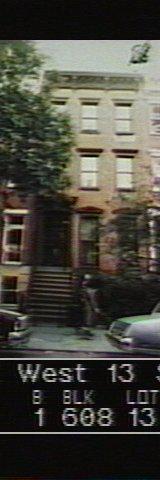
The city photographed every building for its tax records around 1940 and again in the 1980s. NYC Municipal Archives.
Written with AI from the source each entry cites, then fact-checked.
- 1846
The Peter Remsen estate builds five houses with Greek Revival details
In 1846 the estate of Peter Remsen put up No. 152 together with four neighbors, a row of five Greek Revival houses. Later owners updated the front: the Landmarks Commission notes an Italianate doorway typical of the 1850s, with double paneled doors and rope molding, and a paneled roof cornice added later. The stoop and areaway railings keep much of their original ironwork with a classic fret design.
“No . 152 displays an Italianate style doorway, typical of the Eighteen-fifties, with double paneled doors surrounded by the characteristic rope molding.”
- 1852
Samuel Roosevelt, son of a steamboat pioneer, lives here with his growing family
By 1852 the house was home to the businessman Samuel Roosevelt and his wife Mary Jane Horton. His father Nicholas Roosevelt had worked with Robert Fulton on the steamboat, and his mother was a daughter of the architect Benjamin Henry Latrobe. The couple lost their youngest son, Frank, in February 1853 and held his funeral in the parlor. They had left by about 1858.
Source: Daytonian in Manhattan
- 1879
Police arrest a sneak thief with two overcoats after a burglary at Rutter's house
Bookbinder Robert Rutter, who bought the house in 1867, discovered late in 1879 that a burglar had entered and stolen some of his clothing. Two policemen spotted a man on Waverly Place carrying two overcoats on the night of December 29 and took him in after he refused to explain where they came from. He was Dominick Kilogan, who had earlier snatched actress Ada Dyas's pocketbook and then inherited $50,000 in prison, money he spent soon after his release. Rutter's property was among the evidence at his trial in January 1880.
Source: Daytonian in Manhattan
- 1882
Rutter's runaway team triggers a chain of carriage crashes in Central Park
Robert Rutter took his wife Frances for a drive in Central Park, and his team ran out of control and hit a cart driven by the Wall Street broker William Fahnestock. Fahnestock's horse then bolted into General Gano Dunn's carriage, and Dunn's horse crashed into a carriage driven by Judge Hilton's son. The New York Herald reported that Rutter was the only one seriously hurt, and he was taken to Presbyterian Hospital.
Source: Daytonian in Manhattan
- 1918
The Dial, a radical political magazine, sets up its New York offices here
In 1918 Annie K. Smith, who owned the house and had run it as a rooming house, leased it to the bi-weekly The Dial as its headquarters. The Journal of Philosophy reported that the magazine had settled in at 152 West Thirteenth Street. The poet Marianne Moore later described the new home as a brick house of three stories with carpeted stairs, fireplaces and white mantelpieces.
Source: Daytonian in Manhattan
- 1919
Scofield Thayer and James Sibley Watson turn The Dial into a literary magazine here
After the two Harvard graduates bought The Dial in 1919 and became its editors, they changed it from a political journal to a literary one. They used it to introduce young, mostly unknown American writers, and contributors included E. E. Cummings, Ezra Pound, Marianne Moore and John Dos Passos. The magazine stayed at 152 West 13th Street until 1938.
Source: Daytonian in Manhattan
Further reading
- The Robert Rutter House - 152 West 13th StreetDaytonian in Manhattan
- Then & Now photos: 152 West 13th StreetVillage Preservation: Greenwich Village Then & Now
Nearby
- City and Country School146 West 13th Street | 3 entries
- 37 7th Avenue1 entry
- Christian and Minna Rost House161 West 13th Street | 5 entries
- The Cambridge43 7th Avenue | 2 entries
- Henry Jarvis Raymond House134 West 13th Street | 5 entries
- James W. Hale House132 West 13th Street | 5 entries