Christian and Minna Rost House
161 West 13th Street | West Village | built 1848
Open on the map5 entries

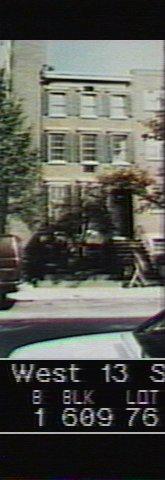
The city photographed every building for its tax records around 1940 and again in the 1980s. NYC Municipal Archives.
Written with AI from the source each entry cites, then fact-checked.
- 1848
John Hanrahan completes eight Greek Revival houses, and No. 161 stays the best preserved
John Hanrahan built a row of eight brick Greek Revival houses on this block in 1847 and 1848. The Landmarks Commission found No. 161 the best preserved of them, apart from its replaced upper windows, with its rusticated stone basement, stoop, original iron handrailings and dentiled roof cornice. The double doors of its doorway have center panels with rounded ends, which belong to a later date.
- 1851
A working-class boarding house from its first years
Although designed with an upper-middle-class family in mind, the house appears to have been a boarding house from the outset. In 1851 its residents included a paver, a laborer and a woman who took in washing, and another laborer lived in a small building in the rear yard. A boarding house ad in 1864 offered a second-floor front parlor and bedroom to a gentleman and wife.
Source: Daytonian in Manhattan
- 1865
A 17-year-old and his friend are arrested in a boarding room after a theft from his brother
Louis Rufane, 17, and Thomas Hennessy, 22, took a room on December 22, 1865. The day before, Rufane's brother and sister-in-law had returned home on James Street to find a trunk missing, with $850 in Treasury notes and two diamond rings. Police tracked Rufane to West 13th Street and arrested both men, and the New York Times reported that Rufane confessed.
Source: Daytonian in Manhattan
- 1891
Bank-note engraver Christian Rost, who engraved two 1869 stamps, buys the house
Christian Rost, born in Germany in 1826, was an engraver for the American Bank Note Company. He also made at least two federal postage stamps, showing a Pony Express rider on the 1869 two-cent stamp and a locomotive on the three-cent. He and his wife Anna, known as Minna, bought the house in 1891. Rost died in 1896.
Source: Daytonian in Manhattan
- 1895
Minna Rost runs a gold-embroidery workshop in the basement
Minna Rost was a trained artist who perfected a way of making deep-layered gold embroidery for military patches and uniforms. Her studio and workroom were in the basement, and the business thrived. An 1895 advertisement sought girls skilled at fine embroidery. She kept the business going after her husband's death in 1896, and she died in 1903.
Source: Daytonian in Manhattan
Further reading
- The Christian and Minna Rost House - 161 West 13th StreetDaytonian in Manhattan
- Then & Now photos: 161 West 13th StreetVillage Preservation: Greenwich Village Then & Now
Nearby
- The Cambridge43 7th Avenue | 2 entries
- 154 West 14th Street Building154 West 14th Street | 8 entries
- Robert Rutter House152 West 13th Street | 6 entries
- 37 7th Avenue1 entry
- 144 West 14th Street Building144 West 14th Street | 8 entries
- City and Country School146 West 13th Street | 3 entries