Concert Grove Pavilion (Oriental Pavilion)
153 East Drive | also 95 Prospect Park West | Prospect Park | built 1931
Open on the map6 entries

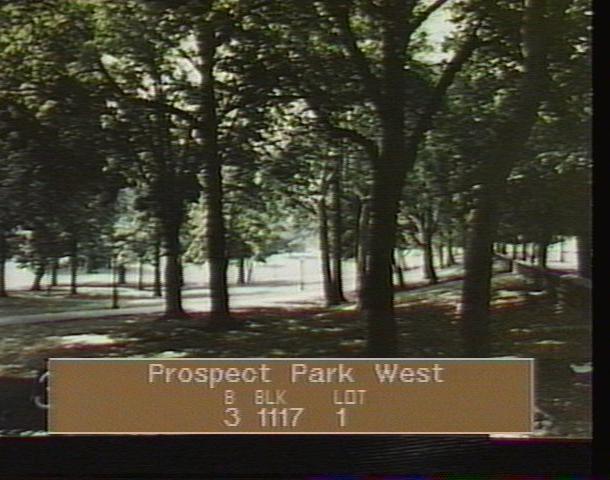
The city photographed every building for its tax records around 1940 and again in the 1980s. NYC Municipal Archives.
Written with AI from the source each entry cites, then fact-checked.
- 1874
Vaux and Wisedell build the Concert Grove Pavilion as a tea house in Prospect Park
Calvert Vaux and the London-trained architect Thomas Wisedell designed two buildings for the park's Concert Grove: a restaurant and comfort station, and this pavilion. The pavilion began as a tea house where visitors could rest in the shade and have a snack. A walk through the Grove, past busts of composers, led from it to the lake, where Sunday concerts were held.
Source: brownstoner.com
- 1874
The pavilion mixes Indian, Chinese and Moorish motifs under a stained-glass roof panel
Built in an Orientalist Victorian manner, the pavilion draws on Indian, Chinese and Moorish architecture and includes a roof panel of medieval-inspired stained glass. Brownstoner's account says the park's buildings there were depicted on countless postcards into the first decade of the twentieth century.
Source: brownstoner.com
- 1887
Poor acoustics move the park's concerts away and the Concert Grove becomes a flower garden
In 1887 the music at the Concert Grove was moved because the acoustics there were difficult. A new Music Pavilion went up near the northern part of the Nethermead, and the Grove was renamed the Flower Garden. The pavilion and the neighboring restaurant kept their original uses, and the Esplanade remained a place to rest.
Source: brownstoner.com
- 1949
Robert Moses clears the Concert Grove's surroundings and the pavilion becomes a snack bar
In 1949 Robert Moses, who disliked Victorian architecture, tore down numerous Victorian structures in the park, the Concert Grove House among them. He also filled in Music Island and left the Grove isolated. The pavilion was converted into a snack bar, which later served the Wollman Center skating rink built beside the lake in 1960.
Source: brownstoner.com
- 1974
A fire in the snack bar nearly destroys the pavilion a century after it was built
In 1974, exactly one hundred years after construction, a fire that began in the snack bar almost completely destroyed the pavilion. The structure remained a ruin for the next thirteen years.
Source: brownstoner.com
- 1987
The pavilion is fully restored, stained-glass skylight included, and becomes an events space
In 1987 the ruined pavilion received a total restoration that returned it to its original appearance and materials, including the stained-glass skylight in the roof. Brownstoner's 2013 profile describes it as in use for concerts, martial arts and physical education, other gatherings, and weddings.
Source: brownstoner.com
Nearby
- Prospect Park Boathouse101 East Drive | 6 entries
- LeFrak Center at Lakeside171 East Drive | 3 entries
- Willink Entrance Comfort Station8 Ocean Avenue | 1 entry
- Prospect Park Carousel454 Flatbush Avenue | 3 entries
- Brooklyn Central Office, Bureau of Fire Communications35 Empire Boulevard | 4 entries
- Lefferts Historic House452 Flatbush Avenue | 8 entries