C-Squat
155 Avenue C | East Village | built 1900
Open on the map10 entries

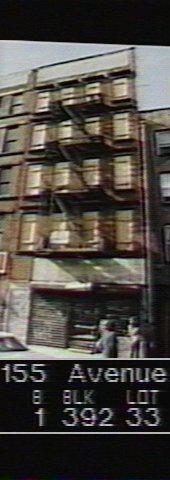
The city photographed every building for its tax records around 1940 and again in the 1980s. NYC Municipal Archives.
Written with AI from the source each entry cites, then fact-checked.
- 1872
J.G. Davenport builds a five-story Italianate tenement
In 1872, architect and owner J.G. Davenport, working with builder L.K. Osborne, erects a five-story pre-Old Law tenement at 155 Avenue C. Ground-floor shops open beneath apartments for sixteen families, and the Italianate facade carries carved stone lintels, sills, and a pressed-metal cornice.
- 1896
The building becomes a union hall whose saloon hosts gambling and political meetings
Between 1896 and 1914 the five-story building at 155 Avenue C serves as a union hall with a saloon that hosts illegal gambling. Republicans, Socialists, religious groups and striking union workers all hold meetings there. The account comes from a building history that Bill Cashman, who lives there, compiled for a zine.
Source: maximumrocknroll.com
- 1959
A real estate group renovates the building into a tenement
After years as a bottle warehouse, the building is completely renovated in 1959 by a real estate group, according to resident Bill Cashman's research. The work turns it into a residential tenement just as the Lower East Side begins to slide. The landlord later cuts essential services and abandons the property.
Source: maximumrocknroll.com
- 1978
A fire and an in rem foreclosure put the abandoned building in city hands
After the landlord cuts services and walks away, a fire damages the building, and the city takes it over through in rem foreclosure in 1978. Some tenants, mainly Latino and Black residents, stay on as squatters. The city's ownership lasts until the former squatters buy it for a dollar in 2002.
Source: maximumrocknroll.com
- 1984
Remaining tenants run an after-hours club until the building is emptied and locked
In the years after the city takes over, remaining tenants run an illegal after-hours social club at 155 Avenue C with a bar, pool tables and occasional live bands. Around 1984 or 1985 the place is cleared out and locked up, and it sits abandoned for several years until the squatters arrive in 1989.
Source: maximumrocknroll.com
- 1989
The first squatters jack up a building that has sunk almost a foot and replace its rotted beams one by one
When the building is first squatted, its beams are so rotted that it has sunk almost a foot in the middle, so the squatters jack it up and replace the joists one at a time. Workers at a nearby gut renovation save usable old joists for them in exchange for six-packs of beer. For a year or more, resident Popeye recalls, they live like a Hopi village, with ladders between floors, and the central hole lets them haul amplifiers by rope and pulley.
Source: citylimits.org
- 1989
Squatters occupy the vacant tenement and found C-Squat
After a 1978 fire left the city owning the building and an earlier group of squatters was evicted, a new group occupies 155 Avenue C in 1989. Renamed C-Squat, the building becomes home to punk musicians, artists, and activists, and its basement is fitted with a half-pipe for skateboarders.
Source: Wikipedia
- 1999
The Giuliani administration agrees to keep talking with UHAB about legalizing the Lower East Side squats
For 15 years squatters had approached the Urban Homesteading Assistance Board about becoming legal, and the answer from Koch to Dinkins was a blunt no. In the summer of 1999 the Giuliani administration agrees to keep talking, starting three years of negotiations. At C Squat many of the younger occupants distrust authority and consider nonprofit housing executives hypocrites, until UHAB's communitarian principles quiet their fears.
Source: citylimits.org
- 2002
The city sells C-Squat to its squatters for one dollar
In 2002, after negotiations with the Giuliani administration brokered by the Urban Homesteading Assistance Board, New York City sells the building to its longtime squatters for one dollar. The occupants convert it into a limited-equity housing cooperative and do much of the restoration work themselves to hold down costs.
Source: Wikipedia
- 2012
The Museum of Reclaimed Urban Space opens in the storefront
The ground-floor storefront becomes the Museum of Reclaimed Urban Space in October 2012, after planning began the previous year. The museum documents the Lower East Side's squats and community gardens through photographs, posters, and zines, and leads walking tours of nearby activist sites.
Source: Wikipedia
Further reading
- C-SquatWikipedia
- 155 Avenue CVillage Preservation: East Village Building Blocks
Nearby
- 630 East 9th Street2 entries
- 337 East 8th Street1 entry
- 331 East 8th Street1 entry
- 355 East 10th Street1 entry
- P.S. 64 (CHARAS/El Bohio)350 East 10th Street | 8 entries
- 315 East 8th Street1 entry