156 Waverly Place
West Village | built 1839
Open on the map5 entries

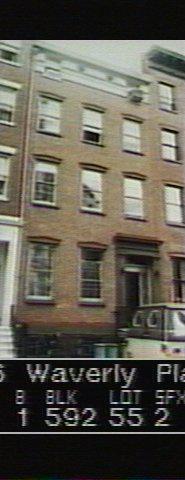
The city photographed every building for its tax records around 1940 and again in the 1980s. NYC Municipal Archives.
Written with AI from the source each entry cites, then fact-checked.
- 1839
No. 156 keeps the most original look of Lambert Suydam's 1839 row
Read more
Lambert Suydam built eight Greek Revival houses on this stretch of Waverly Place in 1839, and the Landmarks Preservation Commission singles out No. 156 as the best preserved of them, with Nos. 150 and 148 following to a lesser degree. Its three-and-a-half-story front has a distinctive attic inside a tall entablature, with a frieze of bull's-eye windows (two of the four survive), plus the original outer and inner doorways with palmetto capitals. The report names merchant William H. Powell as a resident around 1851.
- 1885
Anatomy professor William Darling's brief stay here leads to a contested will
In January 1880 the 75-year-old Scottish-born anatomy professor William Darling took the front parlor in Mary S. Jordan's boarding house here, staying only three months. After he died in December 1884, a will leaving everything to a Yonkers friend, Amelia Delacroiex, was challenged by a woman claiming to be his daughter. Jordan testified in 1885 about a heated argument she overheard between Darling and Delacroiex, who prevailed in court.
Source: Daytonian in Manhattan
- 1918
Federal agents raid a tenant's rooms in the 'Hindu plot' case, arresting Sailendra Nath Ghose and Agnes Smedley
In March 1918, federal officials raided the rooms of Sailendra Nath Ghose, suspected of backing the Indian independence movement, and arrested him and his American companion, the future writer Agnes Smedley. Papers found there reportedly outlined plans for an uprising. Held in the Tombs under $10,000 bail, they were indicted on April 1 for conspiracy to violate the Espionage Act. Ghose later became president of the Indian National Congress of America.
Source: Daytonian in Manhattan
- 1921
A basement tearoom with a gilded ceiling opens in the Prohibition-era Village
By about 1921 the basement was one of Greenwich Village's subterranean tearooms, known only by its address. The Greenwich Village Quill listed it as serving tea and refreshments, noting its gilded ceiling. It was run by Katie Seabrook and Alexander Popini, and a relative later said Popini applied the gold leaf himself. Upstairs, tenant Helen Todd drew press attention that January for heckling a speaker about Soviet Russia at the Hotel Astor.
Source: Daytonian in Manhattan
- 1923
Edna St. Vincent Millay lives briefly at No. 156
The poet Edna St. Vincent Millay lived in the house briefly in 1923, according to her biographer Daniel Mark Epstein in What Lips My Lips Have Kissed. At least two of her letters from that year survive with the Waverly Place address. The Daytonian in Manhattan blog calls her the most celebrated resident of No. 156.
Source: Daytonian in Manhattan
Further reading
- Educators, Plotters and a Poet - 156 Waverly PlaceDaytonian in Manhattan
- Then & Now photos: 156 Waverly PlaceVillage Preservation: Greenwich Village Then & Now
Nearby
- 148 Waverly Place5 entries
- Frances Perkins Residence121 Washington Place | 6 entries
- 92 Grove Street7 entries
- James Polhemus House96 Grove Street | 7 entries
- Fellows Company Building30 Christopher Street | 4 entries
- 10 Gay Street2 entries