James Polhemus House
96 Grove Street | also 170 Waverly Place | West Village | built 1826
Open on the map7 entries

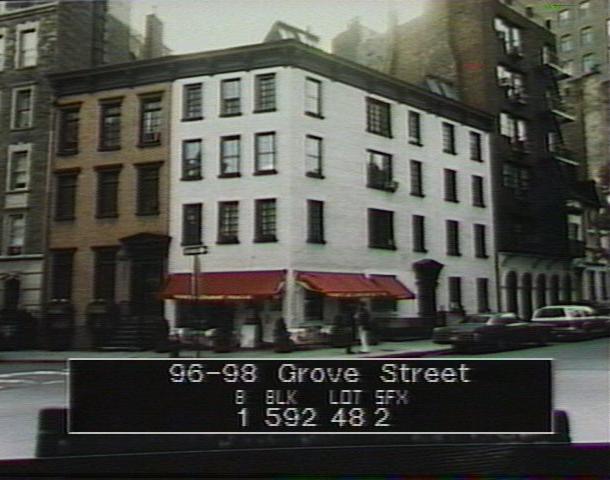
The city photographed every building for its tax records around 1940 and again in the 1980s. NYC Municipal Archives.
Written with AI from the source each entry cites, then fact-checked.
- 1826
Grocer James Polhemus builds a two-and-a-half-story brick house at Burrows and Sixth Streets
James Polhemus, a grocer, began a new home at the corner of Burrows Street and Sixth Street (now Grove Street and Waverly Place) in 1825 and finished it the next year. It was faced in Flemish bond brick. A wooden building next door on Burrows Street may have been a stable or small shop. The family Bible records a son born in 1827 at the corner of Burrows and Sixth Street.
Source: Daytonian in Manhattan
- 1829
Polhemus contests a Barrow Street pump assessment as Burrows Street is renamed Grove Street
Residents like Polhemus complained that Burrows Street sounded too much like Barrow Street, and by December 1829 it had been renamed Grove Street. That summer Polhemus was billed $4.75 for the Barrow Street public well and pump. He told the Committee of Assessments he had no frontage on Barrow Street, and on August 9 the committee reversed the charge.
Source: Daytonian in Manhattan
- 1870
James Green adds a two-bay extension and raises the house to four stories
James Green bought the property in March 1869 for $32,500. Within the year he replaced the wooden building at No. 96 with a two-bay extension and raised the whole corner house to four floors, topping it with a bracketed Italianate cornice. The Federal doorway with sidelights and transom survived the remodel.
Source: Daytonian in Manhattan
- 1883
A resident survives the 1883 Brooklyn Bridge stampede
Catharine Jones, 65, lived at No. 96 when she joined a huge crowd waiting to cross the Brooklyn Bridge footway on May 30, 1883. When officials tried to ease the crush by removing railing sections, the crowd stampeded and people were trampled on the roadway below. Newspapers printed long lists of the dead and injured; Jones survived with head and chest injuries.
Source: Daytonian in Manhattan
- 1885
A drunken boarder shoots his estranged wife through a window, then kills himself in the street
On April 14, 1885, John Henry McKenzie, a 55-year-old Scot who had been drunk for eleven weeks, came to the rooming house looking for his wife, a seamstress who had thrown him out two weeks earlier. When she opened a window he fired a revolver from the sidewalk and wounded her in the armpit, then shot himself behind the ear. She walked to the ambulance within half an hour; he died on the pavement.
Source: Daytonian in Manhattan
- 1921
Former Grace Church assistant rector and fire chaplain James Le Baron Johnson dies in a fall from his window
James Le Baron Johnson had been assistant rector at Grace Church and the city's fire chaplain, but left the ministry after he eloped with Bellevue nurse Mary Hoffman. The couple moved into this building, where he worked in insurance. The 51-year-old fell from his window into the courtyard and died at once on March 3, 1921; an associate told reporters he had been in poor health and lost his balance.
Source: Daytonian in Manhattan
- 1940
Modernist painter Saul Schary lives here in the 1940s
During the World War II years, the painter Saul Schary lived at No. 96. Born in Newark in 1904, he painted portraits, still lifes and landscapes in a modernist style. A 1934 still life by Schary is in the collection of the Smithsonian American Art Museum.
Source: Daytonian in Manhattan
Further reading
- The James Polhemus House - 96-98 Grove St (170 Waverly Place)Daytonian in Manhattan
- Then & Now photos: 96-98 Grove StreetVillage Preservation: Greenwich Village Then & Now
Nearby
- 92 Grove Street7 entries
- 88 Grove Street4 entries
- 39 Christopher Street1 entry
- 156 Waverly Place5 entries
- 45 Christopher Street3 entries
- 35 Christopher Street2 entries