159 Charles Street House
159 Charles Street | West Village | built 1901
Open on the map9 entries

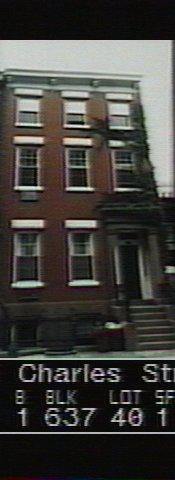
The city photographed every building for its tax records around 1940 and again in the 1980s. NYC Municipal Archives.
Written with AI from the source each entry cites, then fact-checked.
- 1797
Newgate State Prison, the state's first penitentiary, opens on land later cut by Charles Street
In 1796-97 New York built its first state penitentiary, Newgate, on a four-acre riverfront site in Greenwich Village, designed by Joseph-Francois Mangin. Frequent riots and arson attempts led to its closing, and the prisoners went to Sing Sing in 1828-29. In March 1829 the Common Council extended Charles Street across the former prison grounds and ordered them divided into 100 lots for auction.
- 1829
Merchant Henry Wyckoff buys nine lots at the auction of the prison grounds, including this one
In April 1829 Henry Wyckoff, a tea and wine merchant, former alderman and onetime president of the Eagle Fire Insurance Company, bought nine lots at the city's auction of the former Newgate grounds. They included the site of 159 Charles Street. Six of the lots lay on the south side of Perry Street, where he built rental houses during the 1830s.
- 1838
Wyckoff builds the house as an investment and leases it to lumber dealer James Hammond
Around 1838 Wyckoff built 159 Charles Street as rental property and leased it to James Hammond, who ran a lumber business at West and Leroy Streets. Hammond lived here with his wife and three children until 1844, and by 1849 the house was leased to two families.
- 1860
A dock master and a Scottish-born sea captain share the house
The 1860 census found two families sharing the house: dock master Archer Martine and his relatives, and Capt. Alexander Cunningham, a Scottish immigrant who owned several ships and commanded them on voyages from New York to Eastern and Southern ports. Their livelihoods reflect the growing role of the Hudson River piers in this part of the Village.
“By 1860, when the federal census was taken, Archer Martine had become a dock master and he and his family shared this house with the family of sea captain Alexander Cunningham…”
- 1889
Brewer William Henry Beadleston buys the house, later held by Beadleston & Woerz for its workers
William Henry Beadleston bought 159 Charles Street in 1889, and it later passed to the firm of Beadleston & Woerz, whose Empire Brewery stood across the street. By 1900 all three families living here were headed by German-immigrant brewery workers. One of them, Franz Baldes, rose from laborer to foreman while living in the house between at least 1900 and 1910.
- 1937
The brewing company becomes a real estate firm with offices in the house
Between 1937 and 1939 Beadleston & Woerz replaced the rest of its brewery building with a three-story factory leased to commercial tenants. By then the company was mainly a real estate firm, headed by Alfred Beadleston and Frederick Woerz, and 159 Charles Street served as its offices. After Woerz died in 1947, Beadleston began selling off its property.
“…the company was primarily a real estate firm headed by Ebenezer Beadleston’s grandson Alfred Beadleston and Ernest Woerz’s son Frederick Woerz with its offices at 159 Charles Street…”
- 1964
Realtor Chester Krone converts the house into two duplex apartments and lives in it
After the Terminal Leasing Company sold the house in 1964, realtor Chester W. Krone, Jr. turned it into two duplex apartments and moved in himself. In 1966 he sold it to Charles D. Rogers and Frederick Lock.
- 2004
Robert Cromwell Coulson, publisher of Pink Pages, buys a share of the house
In 2004 Robert Cromwell Coulson, the publisher of Pink Pages, bought an interest in the house from John McClenahan and Deborah Robin True, who had acquired a share in 1995. Earlier co-owners included stock analyst Barbara Chacour, who had lived here since 1980 and bought in during 1985.
“They sold their interest to Robert Cromwell Coulson, publisher of Pink Pages, in 2004…”
- 2007
The Landmarks Preservation Commission designates 159 Charles Street, a rare Greek Revival house
On March 6, 2007, the Landmarks Preservation Commission designated the house, citing it as one of the few surviving Greek Revival rowhouses on the Hudson River waterfront. Fourteen people spoke for designation at the November 2006 hearing, among them representatives of the Greenwich Village Society for Historic Preservation. Its standout feature is a brownstone entry with pilasters and a heavy entablature.
Nearby
- 398 West Street4 entries
- 689 Washington Street1 entry
- 139 Charles Street1 entry
- Holland Hotel396 West Street | 4 entries
- Fleischmann Company building695 Washington Street | 5 entries
- Everard Storage Warehouse275 West 10th Street | 5 entries