Waverly Inn
16 Bank Street | also 248 Waverly Place | West Village | built 1845
Open on the map6 entries

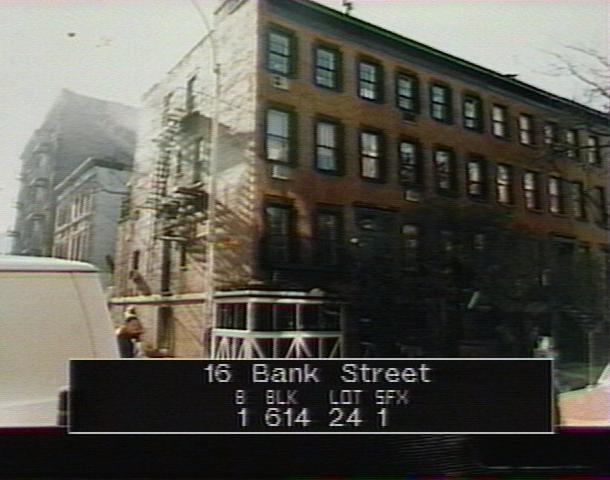
The city photographed every building for its tax records around 1940 and again in the 1980s. NYC Municipal Archives.
Written with AI from the source each entry cites, then fact-checked.
- 1844
Stephen B. Peet builds a row of ten Greek Revival houses that includes 16 Bank Street
Peet, a real estate developer, purchased the land in 1843 from the Bank of New York and put up the ten houses at Nos. 16 to 34 in 1844-45, financing the work with purchase-money mortgages. The row blends Greek Revival forms with shallow Gothic ogival arches over doors and windows, under one unbroken dentiled cornice. The Landmarks Preservation Commission calls it one of Greenwich Village's outstanding residential rows.
“This row of ten houses, built in 1844-45, is one of the outstanding residential rows in Greenwich Village.”
- 1920
The painter Henry Martyn Hoyt buys 16 and 18 Bank Street, and his estate soon leases them for conversion
The portrait artist Henry Martyn Hoyt bought Nos. 16 and 18 Bank Street in April 1920 from a real estate dealer, while keeping a studio on West 10th Street. He died that August, and two months later his estate leased both houses to be remodeled as apartments. The little shop in No. 16's basement was let to a restaurant.
Source: Daytonian in Manhattan
- 1921
Ye Waverly Inn opens in the basement of 16 Bank Street as a Colonial-style tavern
A small ad in the New-York Tribune announced Ye Waverly Inn, offering home cooking with lunch at 65 cents and dinner at 90 cents. Clarence H. Dettmers fitted it out like a Colonial tavern, with fireplaces, high-backed settles and beamed ceilings, and drew uptown diners to the Village. He ran it for three decades and died in 1951.
Source: Daytonian in Manhattan
- 1929
A patrolman fires three shots through a wall into the Waverly Inn's dining room
Diners were terrorized on February 1, 1929, when Patrolman Edward T. Coleman inexplicably forced his way into No. 18's basement apartment next door and put three bullets through the wall into the dining room. Coleman was taken into custody on charges of malicious mischief and of firing a gun in a public place, with patrons put in danger.
Source: Daytonian in Manhattan
- 1958
A pet ocelot bolts from a Waverly Place apartment and hides in the Waverly Inn's cellar grating
On August 16, 1958, three-month-old Lancelot, the 15-pound ocelot of record producer Stanley Sherman, leaped out of his third-floor apartment at 246 Waverly Place in terror when a recording of a Marine band began playing. Mrs. Sherman saw the cat dart into the cellar grating of the Waverly Inn, where it took refuge. After nearly two hours of coaxing, the police emergency squad gave up, and Sherman eventually retrieved the animal himself. The ASPCA took it away to be treated for shock and X-rayed, and Sherman was cited with a summons over the unlicensed wild animal he kept in the city.
Source: Daytonian in Manhattan
- 2006
The Waverly Inn reopens with a Sorel mural of Robert Frost and Edna St. Vincent Millay
The restaurant at 16 Bank Street opened in its current form in 2006, in a red brick townhouse dating to 1844. Among its earlier regulars were the poet Robert Frost and the playwright Edna St. Vincent Millay, and both are caricatured in Edward Sorel's mural on its walls. Willa Cather was said to have lunched there daily after the building became Ye Waverly Inn in 1919.
Source: Village Preservation
Further reading
- The 1845 No. 16 Bank StreetDaytonian in Manhattan
- Then & Now photos: 16 Bank StreetVillage Preservation: Greenwich Village Then & Now
Nearby
- 18 Bank Street2 entries
- 20 Bank Street1 entry
- 22 Bank Street2 entries
- 14 Bank Street1 entry
- 244 Waverly Place5 entries
- 24 Bank Street1 entry